8/19/23

The English Garden Mystery (2022) by Dan Andriacco

Last time, I babbled incessantly about "The Locked Room Mystery & Impossible Crime Story in the 21st Century," rattling on how the reprint renaissance and translation wave is already leaving its traces, but those visible traces do not stop at a locked room resurgence – even if you don't always get that idea from this blog. So today's review has no murders in hermetically sealed rooms or someone disappearing at the end of a trail of footprints in the snow. Instead, it's a pure, undiluted fair play whodunit.

Back in November, I learned of Dan Andriacco's The English Garden Mystery (2022) when Ellery Queen: A Website on Deduction highlighted it as "an homage to Golden Age great Ellery Queen." A modern-day mystery complete with a dying message, false-solution, challenge to the reader and even a subtitle ("A Problem in Deduction"). Andriacco is a former journalist, reviewer and an active member of the Baker Street Irregulars who writes detective novels and wrote on his blog, "all of my books owe a lot to Golden of mystery fiction," but none more than The English Garden Mystery. In another blog-post, "The Logical Successor to Sherlock Holmes," Andriacco calls his series-detective a devotee of EQ whose "exploits often include the Queenian tropes of the dying message and the false-solution" with his latest adventure being "an out-and-out homage to Queen."

The English Garden Mystery is the thirteenth novel starring the celebrated mystery writer, Sebastian McCabe, whose side career as a local amateur detective is chronicled by his brother-in-law, Jeff Cody. The entire series takes place in the small town of Erin on the banks of the Ohio River and the town with its inhabitants appears to be as much of a "character" as McCabe and Cody. An apparently living, breathing and buzzing community as the story is littered with footnotes referring back to previous events or appearances of characters and locations. Such as meeting with a local lawyer or museum director whom McCabe and Cody had met before other times, "on the edges of cases," which have footnotes referring back to two short stories, "Art in the Blood" and "Foul Ball" – respectively collected in Rogues Galley (2014) and Murderer's Row (2020). While another footnote informs the reader that the setting from No Ghosts Need Apply (2021) had "gone out of business after COVID and a murder." Yes, even the fictitious town of Erin, Ohio, was unable to escape the pandemic and The English Garden Mystery finds the town "much changed by the COVID-19 pandemic" with "some of our old friends gone forever and others transformed."

I mention all of this because, as of this writing, The English Garden Mystery is the latest addition to the series and, chronologically challenged as ever, I dropped in at the end simply for the dying message, false-solution and EQ fanboying. That left me feeling disconnected from most of the characters and parts of the stories, but that's wholly on me. Not Andriacco. So this review will be limited to discussing the plot and its treatment of those Queenian tropes of the dying message and false-solution.

The English Garden Mystery begins as Erin emerges from the COVID lockdowns and their social bubbles, "still stir-crazy from a year of social distancing and Zoom meetings," to attend a fundraiser for the Erin Arts Council in the English garden at the Bainbridge family compound of houses known as Stratford Court. Ezra Bainbridge is "the pater familias of one of the oldest of Erin's old-money families" and Shakespearean scholar who named his triplet daughters, Desdemona, Portia and Ophelia, after characters from the Bard's plays ("...Des is the bad girl, Portia is the socialite and Ophelia is the scholar"). The story's opening finds the elderly Ezra Bainbridge in poor health, "battling brain fog in the wake of COVID-19," confining the patriarch mostly to a wheelchair and getting pushed around by his much younger wife, Fleur. She gets accused by Desdemona and Portia of elder abuse and adultery, but their sister Ophelia does not believe it. So asks McCabe and Cody to drop by Stratford Court to observe for themselves nothing is going on ("nobody observes more than Sebastian McCabe, except maybe Sherlock Holmes on a good day").

Before the long, the personal favor becomes a full-blown murder case when Ophelia's body is found, "hit in the head with a marble bookend in an art deco design," holding a bright yellow bell-shaped flower – a columbine from the garden at Stratford Court. Erin Police Chief Oscar Hummel believes the murder is a bungled burglary, but McCabe believes the presence of the flower argues otherwise. Ophelia was a puzzle fiend who loved word games, anagrams and "the dying message stories of detective story great Ellery Queen" who reviewed detective stories for the Oxford Gazette and taught a course on "Locked Rooms and Dying Messages." So reasons a dying Ophelia must have taken "the columbine out of that vase after the killer left as she sought to tell us who killed her." A classic dying message straight out of the Golden Age detective stories! Why not? Leaving a dying message is something that would occur to someone who reads and collects Ellery Queen. Just one problem: the murderer is not even close to being done and every murder comes with its own floral tribute. So the flowery clue goes from a potential dying message to the killer's cryptic calling card. Or is it?

I noted earlier that airdropping into the thirteenth title in the series with its living setting and cast of recurring characters made me feel disconnected from the characters and parts of the story, but nothing to muddy the clarity or cleverness of the EQ-style plot.

Andriacco carefully constructed the correct-and false-solution alongside each other with enough clues and red herrings to delight, or frustrate, the amateur armchair detective who wants a shot at beating McCabe to the solution. Something that's absolutely doable with the given clues, even if you miss a small detail or two. Although the hook of the plot is the dying message/calling card and false-solution, The English Garden Mystery played the Queenian trope of the fallible detective card slightly better. There was already a hint and characters suggesting McCabe's luck ("let us say good fortune rather than luck") as the local Sherlock Holmes is eventually going run out, which all nicely builds up towards gathering all the suspects in the library to present and destroy the false-solution – punctuated by a short challenge to the reader ("...he didn't see it. Neither did anybody else. Do you?"). I just wonder how far Andriacco played out the fallible detective card as the ending left me with the feeling the second solution is also incorrect and will come back to haunt him in a future mystery novel. Something that does not appear unlikely in a series like this, but I could be wrong.

Either way, The English Garden Mystery succeeded with flying colors in capturing the feeling of the characters wandering into an EQ-style novel that fully does justice to the favorite tropes of those two mystery writing cousins, Frederic Dannay and Manfred B. Lee. If there's anything to nitpick at, it's that perhaps more could have been done with the English garden with its riot of lowers, bronze fountain and statue of a flute-playing Pan to evoke that "Ellery-in-Wonderland" atmosphere of There Was An Old Woman (1943) and The Player on the Other Side (1963), which would have been perfect for a story taking place right after the characters emerged from the pandemic lockdowns. Other than that, The English Garden Mystery is a compelling detective novel that comes highly recommended to every Ellery Queen fan and West 87th Street Irregular. But if you're completely new to series, like me, the characters can make you feel like a stranger among friends.

8/15/23

The Locked Room Mystery & Impossible Crime Story in the 21st Century: A Brief Historic Overview of the First Twenty (Some) Years

I perhaps should have waited with compiling and writing this brief history of the locked room mystery in 21st century, probably until 2025, but recent publications made me reflect on the state of the locked room subgenre in 2000 and how radically the landscape has altered in two short decades – a transitional period, of sorts, that ended in 2020. Fittingly, the world went into lockdown at the same time the locked room mystery started on, what appears to be, a new phase in its long and storied history stretching all the way back to Edgar Allan Poe's "The Murders in the Rue Morgue" (1841). But first, we have to go back in time a little further than the year 2000.

The locked room mystery, in all its guises, has always been somewhat of a large, specialized niche that attracted its own devoted admirers and practitioners, but the immediate post-war period came with a sharp decline in locked room novels. John Dickson Carr and John Russell Fearn were the only writers who stubbornly persisted alongside some occasionally flareups over the decades. Some valiant, frustratingly short-lived attempts were made in the sixties like Paul Gallico's Too Many Ghosts (1961), Kip Chase's Murder Most Ingenious (1962), Charles Forsyte's Diving Death (1962) and John Vance's The Fox Valley Murders (1966). None of those writers or series got pass two or three novels. John Sladek left an indelible mark on the genre a decade later with Black Aura (1974) and Invisible Green (1977). The 1980s represent a small revival as Bill Pronzini introduced his nameless detective to a series of impossible crimes in Hoodwink (1981), Scattershot (1982) and Bones (1985). Herbert Resnicow added a new dimension to the impossible crime with his large-scale locked room puzzles as exemplified by The Gold Deadline (1984) and The Dead Room (1987), which I consider to be the best of the lot. The next ten years were a lull as Peter Lovesey's Bloodhounds (1996) is the only well-known locked room mystery from the '90s, but Mary Monica Pulver's Original Sin (1991), Roger Ormerod's A Shot at Nothing (1993) and Paul Doherty's A Murder in Thebes (1998) should not be overlooked.

While the locked room and impossible crime novel experienced a decline in the second-half of the previous century, it positively thrived in short story form as various publications continued to publish them – most notably Alfred Hitchcock's Mystery Magazine, Ellery Queen's Mystery Magazine and Mike Shayne Mystery Magazine. These magazines produced three legitimate claimants to Carr's mantle, Edward D. Hoch, Joseph Commings and Arthur Porges, who wrote over 200 short impossible crime stories between them. More than half of the stories came from Hoch ("...among the most gifted contemporary creators of impossible crime stories").

So the locked room mystery novel took a backseat to the short story as publications like EQMM produced "a host of excellent authors, many of whom have contributed generously to the impossible crime saga." Occasionally, the locked room puzzle would turn in a novel and sometimes in the oddest of places. Like Nicholas Wilde's juvenile mystery Death Knell (1990) or Michael Slade's gory thriller Ripper (1994). That's more or less where things stood in 2000 and remained that way until roughly 2006. But those first years were not bereft of some excellent miracle crimes.

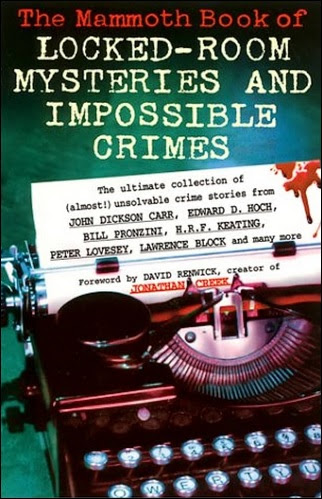
The first notable publication of the new century is undoubtedly Mike Ashley's 500-pager The Mammoth Book of Locked Room Mysteries and Impossible Crimes (2000), which is a diverse collection of older, rarely stories material and newly commissioned material original to the anthology. So the anthology added some new, good and interesting stories to the genre right off the bat. Kate Ellis' "The Odour of Sanctity" concerns a murdered man who's thrown from an open window of a locked tower room. Lois H. Gresh and Robert Weinberg's "Death Rides the Elevator" deals with the decapitation of the sole occupant of a sealed and moving elevator solved by a modern-day Nero Wolfe and Archie Goodwin. H.R.F. Keating's "The Legs That Walked" has a pair of freshly severed legs disappear from a guarded tent, but honesty compels me to point out Keating likely swiped the solution from Edmund Crispin, but Keating used it so much better than Crispin. Susanna Gregory's "Ice Elation" is not, strictly speaking, an impossible crime story and perhaps should not have been part of the anthology, but really liked the setting and premise of scientists disappearing from an Antarctic research station. It really should have been a novel-length mystery-thriller.

Edward D. Hoch continued to write short stories until his death in 2008 and two stories from this late period standout. "The Problem of the Potting Shed" (2000) offers an ingenious and original solution to the problem of how someone could be shot in a locked shed with a small window too small to have been used as an exit. "Circus in the Sky" (2000) answers a twenty year old challenge from Jon L. Breen's parody "The Problem of the Vanishing Town" (1979) to find a rational explanation how someone could be shredded to death on the top floor of a high-rise building as if a lion had appeared from nowhere and then vanished. Hoch represented the old guard during this period, but new writers appeared on the scene.

J.A. Konrath's debuted in the mid-2000s with Whiskey Sour (2004) that introduced his series-detective, Lt. Jacqueline "Jack" Daniels, who has starred as of this writing in 17 novels and numerous short stories – two of which are locked room stories. "On the Rocks" (2004) is a conventional of the two as Lt. Daniel is confronted with a dodgy suicide in a locked and barricaded apartment. "With a Twist" (2005) is a minor classic by turning the suicide-disguised-as-murder on its head. A terminally-ill puzzle fiend commits suicide under circumstances defying reality and planted clues all over the locked suicide room. Arguably, the first real gem the decade produced and pairs beautifully with "On the Rocks." If only Konrath had written some more!

The five-year period from 2000 to 2005 saw few noteworthy impossible crime novels with exception of Lee Sheldon's self-published Impossible Bliss (2001). Sheldon is a game designer and former scriptwriter who penned episodes for Blacke's Magic, Clue Club, Father Murphy, The Edge of Night and The Eddie Capra Mysteries. Many of which feature locked room murders and impossible disappearances. Impossible Bliss introduces his capricious painter and detective, Herman Bliss, who's confronted with the perplexing disappearance of a golfer right after making a nigh miraculous shot. Perhaps the most remarkable aspect of Impossible Bliss is that Sheldon was a good twenty years ahead of the curb. When self-published novels, regardless of merit, had the stench of the vanity press around them. So the second, still unpublished Herman Bliss novel, The Beast of Big Sur, never materialized. A peripheral author, of sorts, who deserves a mention is the late Christopher Fowler as he created the first Great Detectives of the new century, Arthur Bryant and John May of the Peculiar Crimes Unit, which began with Full Dark House (2004) and The Water Room (2004) – trumpeted at the time as modern-day locked room mysteries. However, the series only began to venture into the impossible crime territory with (IIRC) Ten Second Staircase (2006), White Corridor (2007) and The Victoria Vanishes (2008). I lost track of the series after The Memory of Blood (2011) and need to return to it one of these days.

Halfway through the first decade, subtle changes began to happen that would set the tone for the 2010s and completely alter the landscape of the locked room mystery in the West. There were three publications that can now be identified as bellwethers of those coming changes.

Firstly, Wildside Press published John Pugmire's eagerly anticipated translation of Paul Halter's short story collection La nuit du loup (The Night of the Wolf, 2000) in 2006. There are some excellent stories to be found in this collection. "La hache" ("The Cleaver," 2000) is simply one of Halter's best short stories and the best take on that rarity of the impossible crime story, the predictive dream, while "La marchande de fleurs" ("The Flower Girl," 2000) is an imaginative tangle of Christmas miracles concerning the possible existence of Santa Claus. More importantly, the lack of further interest from publishers drove Pugmire to create Locked Room International and changed the whole game. More on that in minute. Secondly, Hal White's collection of longish short stories, The Mysteries of Reverend Dean (2008), came like a bolt out of the blue as White had not enjoyed the same, decades-long myth building as Halter and a collection of exclusive, brand new impossible crime stories were not all that common at the time – especially from a single writer. So coming out guns blazing in your alliance to the impossible crime story left an impression in 2008, but not a lasting one as the collection seems to be largely forgotten today. You can likely blame that on White never returning to Reverend Dean and the fluctuating quality of the plots, but I personally liked "Murder at an Island Mansion" and "Murder on a Caribbean Cruise." The former presents Reverend Dean with three impossible crimes of the no-footprints variety and the latter is a pleasantly conventional shipboard mystery with a murder behind the tightly locked door of a cabin. But other readers praised "Murder in a Sealed Loft" as the collection's standout story. I should also note here The Mysteries of Reverend Dean received a Japanese translation. Foreshadowing!

The third publication is not a collection of short stories or even a novel, but an old school webpage, "A Locked Room Library," added to the MysteryFile in 2007. The page brings together the 1981 top 14 locked room novels voted on by a panel headed by Edward D. Hoch and the then brand new ranking conducted by the celebrated anthologist, Roland Lacourbe, who wanted to create "a list of novels which should be included in any respectable French locked room lovers collection." Lacourbe gathered the results under the title "99 Novels for a Locked Room Library" and appended the list with 14 additional novels that due to a lack availability in French failed to garner enough votes. I think the 1981 and 2007 ranking proved to be a window into both the past and the future. The 1981 ranking looks now more than ever as very basic and standard list with most of the usual, well-known suspects represented. Ellery Queen somehow got two novels listed purely on name recognition and not because The Chinese Orange Mystery (1934) or The King is Dead (1952) are classics of the impossible crime story, but a perfect illustration of the rut in which the English-language locked room novel found itself in during the second-half of the 20th century. Lacourbe's ranking is loaded with obscure, long out-of-print rarities, untranslated titles and generally some surprising picks. Lacourbe's "99 Novels for a Locked Room Library" appeared like a hazy mirage of a desert oasis as unreachable as an affordable copy of A. & P. Shaffer's Withered Murder (1955). You only have to take a glance at "The Updated Mammoth List of My Favorite Tales of Locked Room Murders & Impossible Crimes" and JJ's "A Locked Room Library – One Hundred Recommended Books" to get an idea how much that situation has changed since 2007.

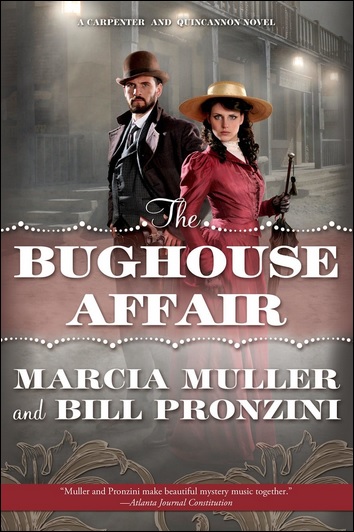
While the genre awaited the coming translation wave, the second-half of the 2000s saw several old names return to the locked room mystery. Bill Pronzini confronted his nameless detective with a double impossibility in Schemers (2009) when a collector of mystery novels asks him to investigate the mysterious disappearance of half a dozen collectibles from his private library, but then that same private library becomes the scene of a seemingly impossible murder. The theft of the books has an excellent explanation and the murder has "a sick new way of killing somebody" behind a locked door. In 2005, Pronzini resurrected his two historical gumshoes, John Quincannon and Sabina Carpenter, in a new series of short stories that appeared in Ellery Queen's Mystery Magazine. Years later, Pronzini began to rework the short stories, new and old, into a series novel-length mysteries which he co-wrote with his wife, Marcia Muller. The series began with The Bughouse Affair (2013) and each novel has one or more impossibility to dispel with The Stolen Gold Affair (2020) having a particular neat one staged in an underground, dead-end crosscut of a gold mine. This series would make for a great TV-series, but its biggest contribution is that it gave the locked room mystery attention outside of our niche at a time when it needed the most.

A strange, unlikely return was that of the sadistic thriller novelist, Michael Slade, who tried to merge a story of cruel, tortuous serial killings with several locked room puzzles in Ripper (1994), which received praise at the time for being Grand Guignol fair play mystery – not everyone agreed. Stylistically, anyway. Slade tried his hands at it again with Crucified (2008) and Red Snow (2010). Crucified proved to be surprisingly good, original even, as the skeleton discovered inside an excavated WWII-era bomber turns the wreck into an archaeological "locked room." Arguably an even stranger, more unlikely return was that of a long-dead pulp writer. John Russell Fearn died in 1960 and would have been forgotten even today had it not been for Philip Harbottle. Not only ensuring practically all of Fearn's work returned to print and remained in print, but expanded his body of work with several previously unpublished novels. The Man Who Was Not (2005) is a pulp-style mystery-thriller in which a seemingly omniscient killer terrorizes a family with terrifyingly accurate predictions of their death and the death become progressively more impossible as they try to take precautions. Pattern of Murder (2006) is Fearn's masterpiece and a highlight of the decade. A brilliantly presented and executed inverted mystery that takes place among the employees of a cinema, which was familiar territory for Fearn and makes the story standout. The murder method is inspired and something of an impossible crime from the perspective of the police.

I would be amiss not to mention the dark historian, Paul Doherty, who has been a lone, often overlooked, but prolific, champion of the locked room mystery ever since debuting in the 1980s. Doherty probably gets overlooked on account of exclusively writing historical mysteries making his impossible crime fiction feel disconnected from the rest of the genre. Like they existed in a separate pocket universe. Doherty produced two noteworthy locked room novels during the late 2000s. The Spies of Sobeck (2008) is the seventh and regrettably last novel to feature an Egyptian judge from antiquity, Amerotke, which has the impudent cheek to exploit its historical setting to explain how man could have been strangled inside a fortified retreat. The Mysterium (2010) is not the most ingenious impossible crime novel penned during this period, but Doherty clad the story in a thick, dark and brooding atmosphere somewhat reminiscent of Theodore Roscoe. The two impossibilities are merely an extra on top of Doherty's most engrossing Hugh Corbett chronicle to date.

So the genre entered the second decade of the 21st century, the 2010s, which would change everything and began with the founding of Pugmire's Locked Room International. A game changer, if there ever was one!

Locked Room International dedicated itself at first to publishing translations of Paul Halter that included a lot of his novels from the 1980s and '90s, but, over time, more of his novels from the past twenty years were translated – some of which can be counted among Halter's best. La toile de Pénélope (Penelope's Web, 2001) deserves a mention as it found a unique way to seal the scene of the crime by covering the open window with an intricately-woven, thick and undamaged spiderweb. La ruelle fantôme (The Phantom Passage, 2005) is a minor tour-de-force as Halter outdid himself with a stunningly brilliant answer to the problem of a dark, obscure passageway that keeps appearing and disappearing like a ghost. La masque du vampire (The Mask of the Vampire, 2014) is a dark flight of fancy and one of Halter's most successful attempt to intertwine multiple impossibilities like a murderer who's seen disappearing up a chimney as a wisp of smoke. Halter closed out the decade with an international exclusive. La montre en or (The Gold Watch, 2019) appeared in English, Chinese and Japanese ahead of the French publication and this time-shattering detective tale proved to be a highlight of the 2010s and rightfully praised for its take on the no-footprints scenario.

During the first five years, LRI mostly published Paul Halter with some odds and ends like Jean-Paul Török's tribute to John Dickson Carr, L'enigme du Monte Verita (The Riddle of Monte Verita, 2007), that can be read as a flattering fan letter to the master. The Derek Smith Omnibus (2014) finally gave Come to Paddington Fair (1997) a proper print-run as it had previously appeared in a limited run of less than 100 copies and fans have disagreed ever since whether or not it's actually better than Whistle Up the Devil (1954). Around 2014, LRI began to expand their catalog with translations of Noël Vindry, Ulf Durling and Yukito Ayatsuji. That last name appears to have opened to the floodgates to a translation wave.

In 2015, LRI published the first English edition of Ayatsuji's landmark novel, Jakkakukan no satsujin (The Decagon House Murders, 1987), which was received in Japan "as en epoch-making event" forever changing "the world of Japanese mystery fiction with revolutionary new ideas" – kick starting the shin honkaku movement. While it was The Decagon House Murders that got it moving, it was Soji Shimada who designed the shin honkaku blueprint earlier in the decade with novels like Senseijutsu satsujinjiken (The Tokyo Zodiac Murders, 1981) and Naname yashiki no hanzai (Murder in the Crooked House, 1982). This movement rejuvenated the Golden Age-style detective story and proved you can teach an old dog new tricks. Shimada wrote in his introduction to the English translation, "it is my belief that if we can introduce this concept to the field of American and British detective fiction, the Golden Age pendulum will swing back, just as The Tokyo Zodiac Murders and The Decagon House Murders managed to accomplish in Japan." The current developments in the Western detective story appear to be proving him correct, but more on that in a moment.

Just like Shimada's The Tokyo Zodiac Murders paved the way for Ayatsuji's The Decagon

House Murders, Keigo Higashino's 2011 translation of Yogisha X no kenshin (The Devotion of Suspect X, 2005) turning into an international hit can be credited with opening the door for publishers to take a chance on Japanese crime fiction. Ironically enough, neither The Decagon House Murders or The Devotion of Suspect X contain a locked room murder or impossible crime of any kind, but the so-called translation wave that followed were overwhelmingly locked room mysteries. And overwhelmingly older writers from the original classic period or from the 1980s. These names range from Akimitsu Takagi, Keikichi Osaka and Seishi Yokomizo to the new generation of Alice Arisugawa, Takemaru Abiko and Yamaguchi Masaya, but practically nothing from the '90s and only a handful of gems from the past two decades.

Zaregoto series: kubikiri saikuru (Zaregoto: The Kubikiri Cycle, 2002) by "NisiOisiN" is the least-known, unfairly overlooked of these translated gems as the series is perhaps too close to the fringes for your average western mystery reader. The series blends the storytelling and plotting of the traditional detective story with manga aesthetics and characters, but The Kubikiri Cycle has multiple impossible murders taking place among a group of geniuses who gathered at a place called Wet Crow's Feather Island. Unsurprisingly, the trick employed to present the detective and reader with a headless body in a locked room is quite ingenious and inspired. Misshitsu no kagi kashimasu (Lending a Key to the Locked Room, 2002) introduces Tokuya Higashigawa's "series-character," Ikagawa City, acting as an assemble cast and concerns the problem of a film student waking up in a locked apartment with a dead body in the bathroom. Another very well constructed locked room novel and an even better example of the high quality of debut novels of Japanese authors. I sincerely hope this is not the last western readers have seen of the port city and its citizens. Higashino second novel to be translated, Seijo no Kyusai (Salvation of a Saint, 2008), is an inverted mystery which tells the reader who poisoned the victim, but now how as it appeared to have been impossible for this person to have administrated the poison. A necessarily character-driven mystery with a very original solution to the problem that you can only swallow due to the character building. The best was yet to come!

Since the 1980s, the Japanese detective story has been enjoying its Second Golden Age, but, after three decades of dominance, readers yearned for the kind of impetus that Ayatsuji's The Decagon House Murders had created – a challenge that did not go unanswered. Masahiro Imamura's Shijinso no satsujin (Death Among the Undead, 2017) is a landmark mystery novel that, on its surface, begins like your regular shin honkaku mystery novel with an isolated setting, impossible crimes aplenty and university students who plays detective, but Imamura turned to concept on its head by situating the story right in the middle of a small, localized zombie apocalypse. The introduction of fantastic elements, like zombies, in a strictly fairplay detective story works better than you might assume, because readers are exactly told what the zombies can and cannot do. So the internal logic, while weird, remains sound and opened (not closed) new doors to tell and plot a detective story. Death Among the Undead was received in Japan as a potential sign a revolutionary change and possible Third Golden Age is on the horizon. I agree.

LRI also recently published the sequel, Magan no hako no satsujin (Death Within the Evil Eye, 2019), which combines a traditional murder mystery with inescapable visions of the future. Death Among the Undead and Death Within the Evil Eye are both modern-day classics and perhaps even signs of a coming age in which the hybrid mystery rises to dominance. John Pugmire confirmed that a translation of the third title, Kyoujinteo no satsujin (The Murder in the House of Maleficence, 2021), is forthcoming.

 I need to pause here to emphasize how important these developments have been up to this point and the locked room resurgence coinciding with the current reprint renaissance and translation wave. Never before had detective fans, like us, access to such a wide and varied selection of detective-and crime fiction as today. Whether reprints, translations, public domain work or newly published, the past twenty years has left us spoiled for choice. The effects have already become slowly visible over the past three years, or so, but more on that in a moment.

The locked room genre unexpectedly stirred back to life in my country, the Netherlands, which can be harsh, unforgiving place for detective fiction with a traditional bend, but that has changed a bit with M.P.O. Books – who reintroduced the concept in De blikvanger (The Eye-Catcher, 2010). Although this initial attempt provided a fairly minor and modest locked room-puzzle, a poisoning behind several locked doors, it lighted the way for a second, much more ambitious stab at the impossible crime story. En hoe! Een afgesloten huis (A Sealed House, 2013) is the first Dutch-language locked room mystery of note to be published since Cor Docter's Koude vrouw in Kralingen (Cold Woman in Kralingen, 1970) in which a notorious criminal is gutted inside his fortress-like home. A completely sealed fortress secured with steel shutters, burglar alarms and motion sensors that trigger security cameras and overhead lights. Books has since added many more novels and short stories under a now open penname, "Anne van Doorn," beginning with "De dichter die zichzelf opsloot" ("The Poet Who Locked Himself In," 2017). A short story that was translated and published in the September/October, 2019, issue of Ellery Queen's Mystery Magazine. The best of the short stories is perhaps "Het huis dat ongeluk bracht" ("The House That Brought Bad Luck," 2018) using the haunted house setting to stage a series of ghostly visitations, but the standout of the series is undoubtedly De man die zijn geweten ontlastte (The Man Who Relieved His Conscience, 2019) with two impossible murders, a dying message, false-solutions and a revelation about the main character that caught me off guard. Books is not the only Dutch author who tried his hands at everyone favorite trope.

P. Dieudonné's third politieroman (police novel), Rechercheur De Klerck en de ongrijpbare dood (Inspector De Klerck and the Elusive Death, 2020), strings together three impossible disappearances. Firstly, there's the disappearance of a body alongside with the murderer from a burning building with all exits either locked or under observation. Secondly, the police has to contend with a motor rider who tears up the city with dangerous stunts and has to peculiar ability to miraculous disappear or reappear. This breaks with traditions of the old-school Dutch politieroman as they tend to be more about the journey than the destination and rarely feature unbreakable alibis, dying messages or impossible crimes, but Dieudonné does not shy away from any of them – integrated them seamlessly into the style of the politieroman. The solution to the double vanishing from the burning building stands out as a huge improvement on an old idea that always felt a little contrived. Rechercheur De Klerck en een dodelijk pact (Inspector De Klerck and a Deadly Pact, 2022) returned to the impossible disappearance with a sub-plot involving a Swiss-style chalet that somehow got lost.

So while the 2010s were slowly drawing to a close, two self-published authors deserve singling out for their contributions before moving on to the first-half of the 2020s. Matt Ingwalson published three novellas, "The Single Staircase" (2012), "WDYG" (2013) and "Not With a Bang" (2016), which explored the reasons for creating a locked room scenario and the stories take a minimalist approach – chapter lengths run anywhere from a few lines to a couple of pages. Ingwalson cut everything out except the essentials and therefore one of those rare occurrences of deconstructionism creating something instead of tearing it down. You can say these three novellas take a pair of hedge clippers rather than a sledgehammer to the locked room mystery. Robert Innes has set himself the enviable task of trying to please two entirely different and demanding audiences by juggling two entirely different genres, locked room mysteries and romance, within the same series. I've only read two of the currently eleven novellas, but the presentation and resolution to the impossibilities showed the genre still has large, untapped reservoirs of creative juices. Ripples (2017) has a murderer fleeing the scene of the crime by sprinting across the surface of a lake and Flatline (2018) concerns a drowning inside a sealed, dry-as-dust, hospital elevator. The future of the genre as a whole was looking bright as the next decade loomed on the horizon.

I alluded to the visible effects of the reprint renaissance and translation wave that has slowly been taking shape over the past three, four years beginning with the arrival of James Scott Byrnside.

Byrnside is the child of the renaissance who did not began to read Golden Age detective fiction until 2017 and immediately penned two novel-length fan letters to Christianna Brand, Goodnight Irene (2018) and The Opening Night Murders (2019), but began to find his own voice with The Strange Case of the Barrington Hills Vampires (2020) and The 5 False Suicides (2021) – all of them containing one or more well-crafted locked room mysteries ("I wouldn't be interested in writing anything except impossible crime"). These four prodigious detective novels have raised the bar for self-published mysteries. Byrnside is not the only self-published author to demonstrate a firm grasp and keen-eyed understanding of what makes a good detective story tick. A. Carver's The Author is Dead (2022) and Jim Noy's The Red Death Murders (2022) impressively strung together multiple impossibilities, dazzling the reader with multiple false and original solutions, which have a distinctly Japanese flavoring to their storytelling, plots or characters. Carver wrote The Author is Dead specifically as a Western-style take on shin honkaku mysteries like The Decagon House Murders and The Kindaichi Case Files. So the translation wave is already leaving its traces on the genre's landscape. Robert Trainor's The Murder of Nora Winters (2016) warrants a mention as the story suggests Trainor is not a devout reader of impossible crime fiction, but, for an outsider, he produced a clever and spirited piece of amateur detective fiction.

I should note here that the uptick in self-published locked room mysteries have gone up considerably in recent years and the quality is rising along with it, but the lack of entry barriers means there's still a lot of tribe to wade through. So there's still a galaxy-wide gap between a Byrnside or Carver and a Steve Levi or Raymond Knight Read. Jim Noy, of The Invisible Event, has more closely examined this corner of the genre, "Adventures in Self-Publishing," but if you really want to know what's underneath the bottom of the barrel, you need to read David Marsh's Dead Box (2004). Only self-published novel Jim is too cowardly to review. I dare you, Jim! It's still print.

Away from the world of self-published mysteries and closer to the mainstream, Tom Mead, "a student of the locked room," debuted with the ambitiously-plotted Death and the Conjuror (2022) challenging his series-detective, Joseph Spector, to disentangle no less than three impossible crimes. The second entry in this locked room series, The Murder Wheel (2023), is expected to be released later this year. Gigi Pandian is another modern-day champion of the locked room genre, but, to date, have only read her short story collection The Cambodian Curse (2018) with "The Haunted Room" (2014) being the standout story. A tale of haunted room, suffering from kleptomania, where all kind of items have inexplicably vanished over the decades (it really should have been called "The Magpie's Nest"). Another notable and personal favorite among these moderns is D.L. Marshall's John Tyler series that merges the action-and spy thriller with the traditional detective story and locked room mystery. The first novel in the series, Anthrax Island (2021), is simply fantastic with its post-apocalyptic aesthetics on a contaminated island where someone receives a 7.65mm lobotomy inside a locked and watched room. Unfortunately, the impossible crime took a backseat in the second novel, Black Run (2021), but seems to be front and center in the third book. 77 North (2023) brings John Tyler to "an old Soviet-era hotel on an ice-locked island in the frozen wastes of Siberia," where the KGB experimented with psychic phenomena, but "a killer stalks the hotel's dilapidated corridors, able, apparently, to kill through concrete walls and sealed doors." That one will be published next month.

So this brief historic overview of the locked room mystery in the 21th century has gone on longer than originally intended, but still have glossed over a ton of stuff that brought us to this point. Such as the addition of several hefty anthologies with rarely reprinted and new material, an increased presence in TV-series (e.g. Monk and Death in Paradise) and the slightly more easier access to anime-and manga detectives with the Detective Conan one-hour TV-special The Cursed Mask Laughs Coldly (2000) being the first great locked room mystery of the century. So while brushing pass some of the finer details, I think my rambling served its purpose in showing where the genre was in 2000 and what happened between then and now. But where does it all go from here?

For the foreseeable future, say from now until 2028-29, I can see the trend from the past few years steadily continue as nearly every recent writer and publisher mentioned have new books or translations forthcoming to keep the fire kindled. The locked room story always had its own dedicated cult of followers, loyal as dogs and as dogmatic as an inquisitor, which grew as a niche due to the reprints and translations – which made it easier than ever before to indulge in impossible crime fiction. I'll refer you to the previously discussed best-of lists from past and present to get an idea how easy it has become. When the locked room mystery has you hooked, you can never pry yourself free from it.

Where the self-publishing side is concerned, I can see the online hub taking the place of the Japanese university club rooms in the West. A place where aspiring mystery writers and simply fans can test their ideas, hone their writing skills and freely experiment. Some of the best locked room mysteries from the past ten years either came from smaller publishers or were self-published. Depending how things turn out, the cream of the crop might get picked up by publishers who want a piece of the retro-GAD pie. After all, the locked room mystery is somewhat of specialist's game. My only reservation is that the fandom seems to be insulated today locked away in private groups and servers. These vintage mystery blogs began to appear during the 2010s as a response to the mailing groups and message boards dying out when an attempt was made to migrate to social media, which killed those large, interactive archives of reviews and discussions. And eventually were deleted. But they were open to everyone to browse, read or lurk before deciding whether or not to create an account to participate in the discussions. Those lists and boards did their part in changing the landscape as open information sources and gathering places. Something these cluster of blogs never managed to fully replicate, but let's not end this rambling on a sour note.

Wherever the locked room genre will find itself twenty years from now, the immediate future is looking bright and for now there's a lot to look forward to. So thank you all for coming to my TED talk and onward to the locked room's 200th birthday in 2041!

8/11/23

The Paradise Affair (2021) by Bill Pronzini

In 2005, Bill Pronzini revived his two historical gumshoes, John Quincannon and Sabina Carpenter, who sold their professional detective services in San Francisco at the turn-of-the-century – when the Old West was coming to an end. This new run of short stories appeared in Ellery Queen's Mystery Magazine starting with "Quincannon in Paradise" (collected in Quincannon's Game: A Western Quartet, 2005) and seems to have ended with "Pick Up Sticks" (2021). During the 2010s, Pronzini started to rework the Quincannon and Carpenter short stories into novel-length mysteries with his wife, Marcia Muller. The series began with the delightful The Bughouse Affair (2013) and some have called it the novel that rebooted the series, but it's more of a continuation of Quincannon (1985) and Beyond the Grave (1986) merging and streamlining the short stories with the original 1980s novels.

The Paradise Affair (2021) is the ninth and, as of this writing, seemingly last entry in the series based on the short stories "Quincannon in Paradise" and "Pick Up Sticks." A whole lot has changed since the days of The Bughouse Affair.

John Quincannon and Sabina Carpenter finally tied the marital knot, "their future together was bright," but Quincannon, "the most accomplished detective in the western United States," suffered an affront to his pride and skills – allowing two slippery criminals to escape his clutches. Jackson "Lonesome Jack" Vereen ("an ironical moniker, for he was a libertine of gargantuan appetites") and E.B. "Nevada Ned" Nagle ("whose primary vice was the opium derivative morphine") are con artists who graduated over their lengthy career from bait-and-switch trickery to swindling people with phony stocks. Their latest mark and Quincannon's current client, R.W. Anderson, not only bought two-thousand dollars of bogus stock in a nonexistent silver mine, but the two swindlers seized upon an opportune to make off with his portfolio of stock certificates and bearer bonds. Anderson hired Quincannon to bring the two to justice and hopefully recover the stolen portfolio. However, two weeks of exhaustive detective work gets thrown out of the window when Quincannon learns his quarries booked a passage for for Honolulu, Hawaii.

Sabina spots an opportunity for a second, busman's honeymoon ("we deserve a vacation, even if it is a working one") and convinces both her husband and their client to follow Lonesome Jack and Nevada Ned to Honolulu.

The Paradise Affair takes place during the first-half of 1898, "the Sandwich Islands Kingdom was overthrown and Queen Lili'uokalani's reign ended in January of '93, five years ago," but before the United States annexed the then independent Republic of Hawaii – which happened later that year on August 12, 1898. So the story is drenched in local and historical color. The impending annexation is a popular conversational topic ("...if Japan doesn't invade and annex it first, as they have threatened to do"), while the Spanish-American war and increased U.S. military presence hover in the background (Admiral Dewey's Asiatic Squadron swarm Honolulu Harbor). However, the best and most evocative part is Quincannon riding a donkey pass the rugged coastline, fishing villages, lava tubes and spouting blowholes as he tracks down his elusive quarries. It takes Quincannon's resigned Scottish pessimism ("no boats, no horses, naught but wagons and asses! What other handicaps did these island gardens of delight hold in store?") a while to acclimate, before his feelings towards the islands begin to mellow. And while her husband is hunting down a pair of swindlers, Sabina gets a case of her own practically thrown in her lap.

During their voyage, the Quincannon's befriended the Prichards, Lyman and Margaret, who are traveling homeward and invited them to stay at their Waikiki home. So stays with their new friends when her husband is roaming the islands for Lonesome Jack and Nevada Ned, but one particular hot, stuffy night, Sabina ventures out into garden when "an explosive report broke the quiet" – a gunshot coming from the house next door. Gordon Pettibone, owner of the neighboring property, had apparently had locked himself in the study with a loaded gun and opinions differ on how he got shot. The local police believes it was suicide, but Philip Oakes insists his uncle had been fiddling with the gun and accidentally shot himself. A twenty thousand dollar insurance policy with a nonpayment clause in case of suicide depends on it. Oakes heard Sabina is a detective and asks her to prove his uncle's death was due to an accidental misfire, but she has the sneaking suspicion Pettibone might have been cleverly murdered. Sabina thought she a shadowy shape close to the back wall shortly after hearing the gunshot and than there's those three, strange words Pettibone spoke before he died, "pick up sticks." Like the old nursery rhyme ("One, two, buckle my shoe. Three, four, knock on the door. Five, six, pick up sticks").

Ah, yes, an Ellery Queen-style dying message inside a John Dickson Carr-like locked room mystery. The detective story's take on the riddle wrapped inside an enigma and Sabina's knows dying messages and impossible murders is Quincannon's bread and butter ("conundrums of this sort intrigued him"), but "she had, after all, been instrumental in solving a few conundrums herself." Sabina makes short work of the locked room and dying message puzzles with the latter having a clever answer to the criticism often leveled at the dying message. Why would a mortally injured and dying person come up with a cryptic clue on the spot instead of outright naming the murderer? This dying message is even more damning than simply naming the murderer. The locked room-trick is a nicely-done variation on an impossible crime technique that always fascinated me (ROT13: haybpxrq qbbef naq jvaqbjf gung nccrne gb or ybpxrq naq obygrq sebz gur vafvqr). So both quickly, and neatly, wrap up their respective investigations with days left to spare to enjoy that second, well deserved honeymoon.

The Paradise Affair is a relatively short, but tightly written and plotted locked room mystery full of local and historical color, which certainly makes it a standout of the series. More importantly, it provided a satisfying closure to the character-arcs of John and Sabina Quincannon. John Quincannon was introduced as a broken ex-Secret Service operative haunted by the gun battle in which his ricocheting bullet killed a pregnant woman ("the burden of responsibility for the loss of two innocent lives had been unbearable"). Everything changed when he met Sabina, then a "Pink Rose" of the Pinkerton Agency, who had lost her husband in the line of duty. Their first collaboration allowed both of them to move on and create Carpenter and Quincannon, Professional Detective Services. So, if The Paradise Affair really is their last outing, they got a happy sendoff that retrospectively brightened Beyond the Grave. A crossover across time between this series and Muller's short-lived series-character Elena Oliverez, which takes place in 1894 and 1986. The 1986 portion of the story makes it very clear Carpenter and Quincannon are long gone. Either way, this is not the last you have seen of them on this blog. I still have The Bags of Tricks Affair (2018), which I overlooked and forgot about. The stories collected in Quincannon's Game warrant a second look as three of the four stories are locked room mysteries. Why not end where the series began, Quincannon, because that would be on theme for this blog.

8/7/23

Gallows Court (2018) by Martin Edwards

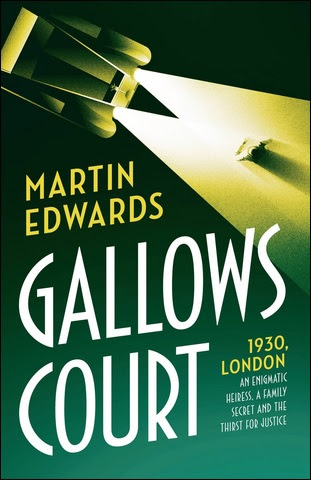
Martin Edwards is a British solicitor turned award-winning crime writer and anthologist who debuted with All the Lonely People (1991), introducing his first series-character Harry Devlin, but, over the past ten years, Edwards has been tirelessly championing the classics – assuming the role of Nestor of the Golden Age Renaissance. Edwards published well-timed genre studies, The Golden Age of Murder (2015) and The Story of Classic Crime in 100 Books (2017), right when the reprint renaissance gained some serious momentum. Serving as companion pieces and introductory guides to the swelling flood of reprints. Edwards has also been working overtime as he compiled over twenty anthologies, beginning with Capital Crimes (2015), published under the British Library Crime Classics banner. A noteworthy entry in the British Library anthology series is the locked room-themed Miraculous Mysteries (2017).

That's merely a small sampling of Edwards' contributions to the genre, classic and contemporary, but I've only read two of his short stories, "Waiting for Godstow" (2000) and "The House of the Red Candle" (2004), to date. So about time I tried one of his novels. Where better to begin than with the 1930s historical retro-GAD series Edwards created five years ago?

Gallows Court (2018) is the first of currently four novels in the Rachel Savernake series and had been warned that the novel is incredibly difficult to discuss and properly review. Holy shit, the reviews were not kidding! Gallows Court is an intricately-plotted, pulp-style thriller that can be best summed up as cloak-and-daggers in a dark labyrinth, surrounded by a dense hedge maze, rigged with traps, explosives and secret passageways – bodies around every corner the story takes. All the chaos and mayhem served one purpose: introducing and establishing the character of Rachel Savernake.

Rachel Savernake is the daughter of a wealthy and notorious hanging judge, "Savernake of the Scaffold, people called him," who was forced to retire after attempting to slash his wrists at the Old Bailey. So the old judge returned and Rachel returned to Savernake Hall, situated on an island called Gaunt, which is "as isolated as anywhere in the kingdom." Rachel spend her childhood in that lonely, isolated place with a demented father and some retainers reading every volume of criminal history in the judge's private library ("...no place for a child to grow up"). But when the old judge finally passed away, the now twenty-some Rachel returned to London as a fabulously rich woman while retaining her reclusive habits. She bought a mansion, rechristened Gaunt Hall, turned it into "a luxurious fortress" and generally shunned publicity. However, Rachel apparently has been playing amateur detective as she solved the Chorus Girl Murder and is currently on the trail of the Headless Torso Killer, but the murderers conveniently committed suicide. One took enough strychnine to put down a horse and the other swallowed a bullet inside a locked room.

Gallows Court makes it abundantly clear Rachel and her own faithful retainers had a hand in their suicides, but to what extend? You always have to take certain narrative tricks into consideration. The story is interspersed with old diary entries from Rachel's distant cousin, Juliet Brentano, who lived at Savernake Hall at the time of the Spanish flu pandemic and the diary entries do not paint a very flattering picture of the then 14-year-old Rachel – a child as "mad as the old brute who fathered her." Now she appears to be all tied in a spate of violent murders and dodgy suicides.

That unavoidably begins to attract unwanted attention. Firstly, there's the Clarion reporter, Jacob Flint, whose chief crime correspondent, Thomas Betts, was run over and is now on his death bed. Betts heard rumors of Rachel ferreting out the culprit behind the Chorus Girl Murder, but everyone refused to talk on the record. And then he got run over. So, recognizing a good story and wanting to tell Rachel's story, Flint dives head first into a very deep and dangerous rabbit hole, but realizes too late that everyone even remotely connected to the case has to fear for their lives. To say that there are a lot of murder would be an understatement. It would be more accurate to say that Gallows Court has the Paul Doherty amount of bodies. Flint does not emerge from his horrific ordeal entirely unscathed.

Now all of this still sounds relatively straightforward and comprehensible for a historical, pulp-style thriller, but the further the story progresses, the deeper it descends into pulp and thriller territory – really out there kind of pulp. Gallows Court reads like a modern descendant of the pulp-style mystery thrillers by John Russell Fearn (The Rattenbury Mystery, 1955) and Gerald Verner (They Walk in Darkness, 1947), but dialed all the way up. So with new plot developments, twists and turns every other chapter, the plot of Gallows Court is next to impossible to boil down. It's quite the journey. What can be said is mystery readers looking for a more traditionally treatment of the 1930s detective story will be disappointed as the story is essentially a thriller clad like a Golden Age detective, but it has a very good reason to take this route.

I noted earlier the plot serves to introduce and establish the character of Rachel Savernake, while peeling away the layers of her backstory. I think most people who read this blog can anticipate one of the main plot-twists concerning Rachel's character, but what counts is how it sets-up the series and the implications of Rachel appearing on the scene of an ordinary-looking murder. Rachel Savernake reminds me in that regard of younger version of Gladys Mitchell's Mrs. Bradley. You can draw a comparison between Rachel's debut and Mrs. Bradley's first appearance in Speedy Death (1929), but, like everything else in Gallows Court, the character of Rachel is dialed up to eleven. So its fortunate I listened to my inner voice of reason this time around and not immediately skipped to the third novel in the series (Blackstone Fell, 2022), because it has two impossible disappearances from a locked gatehouse and a clue-finder! So it was very tempting to start with the locked room title, but Gallows Court is clearly an essential piece needed to understand and fully appreciate what comes next. Look at me being chronological all of a sudden.

So while the thriller is not always the game I enjoy, I can enjoy a good, pulp-style thriller every now and then. Edwards wrote engrossing and absorbing historical thriller that keeps you turn the pages to see what's going to explode in your face next. Mortmain Hall (2020) and Blackstone Fell have been moved up the big pile. To be continued...

8/4/23

The Other Way Around: "The Mystery of the Green Room" (1936) by Pierre Véry

Pierre Véry was a French mystery writer, "novelist of adventure, novelist of the fantastic," who believed in preserving "what has been able to remain in us as the child that we were" so "full of flaws, of changes of heart, of shadow and mystery" – describing his own work as fairytales for grown-ups. While steeped in gentle surrealism, Véry was one of the Big Four of the French Golden Age mystery novel. Xavier Lechard, of At the Villa Rose, warns that "anyone expecting to find Christie-like deceptions will be sorely disappointed," but "Véry was quite able to manage brilliant tricks when he wanted" and pointed out Les quatre vipères (The Four Vipers, 1934) as "arguably one of the best locked room mysteries ever written." So, regrettably, only a tiny sampling of Véry's detective fiction has made it into translation.

Back in 2008, Alan Grimes translated and self-published a handful of Véry's whimsical mysteries that included two Prosper Lepicq novels, L'assassinat du Pére Noël (The Murder of Father Christmas, 1934) and Le thé des vieilles dames (The Old Ladies' Tea Party, 1937). The translations have since gone out-of-print, out-of-stock and secondhand copies are now difficult to find. Three years later, John Pugmire translated Véry's pastiche of Gaston Leroux's Le mystère de la chambre jaune (The Mystery of the Yellow Room, 1907). And that short story is not difficult to find.

Pugmire's translation of "Le mystére de la chambre verte" ("The Mystery of the Green Room," 1936) appeared in the August, 2011, issue of Ellery Queen's Mystery Magazine and anthologized in Foreign Bodies (2018). "The Mystery of the Green Room" is an inspired and immensely enjoyable take on Leroux's The Mystery of the Yellow Room, but, let the reader be warned, you should not read Véry's pastiche without having read Leroux's historic genre milestone – whose solution is integral to the plot of "The Mystery of the Green Room." A plot concerning an otherwise ordinary-looking burglary and robbery, where it not for a very peculiar feature.

Madame Emilienne de Rouvres is attacked in her own home, gagged and bound to a chair, while a masked individual ransacked the place. This person helped himself to the silverware, a small clock and several thousands francs from the wall safe, but these were meager pickings compared to Madame de Rouvres jewelry. A pearl necklace and a string of diamonds, "estimated to be worth eight hundred thousand francs," which were kept in the drawer of a bedside table in the green room ("I imagine safes attract burglars like bears to honey"). However, the thief only poked his head in from the doorway, but never stepped into the bedroom. So the small fortune lying there for the picking remained untouched. Marcel Fermier, private insurance investigator, remarks to the Inspector Jean Martin that the green room puzzle is exactly the same as the yellow room puzzle from Gaston Leroux's famous locked room mystery "in the sense that it's the precise opposite." An open-room puzzle. The thief had every opportunity to have gone into the green room, take jewelry and come out again. So why didn't he?

"The Mystery of the Green Room" was published in the same year as Leo Bruce's Case for Three Detectives (1936) and you can draw similarities between the two with their rivaling detectives ("while the policeman looked for clues, Fermier tried to determine the motive"), humor, false-solutions and cleverly spoofing Leroux – modeling the correct solution on "a parallelism of opposition" between the green and yellow room puzzles. And it worked so incredibly well! A tiny gemstone of the detective pastiche and a wonderfully done, immensely enjoyable homage to one of the most famous locked room mysteries of the 20th century that's actually not a locked room mystery itself. And, again, it worked! Highly recommended! Hopefully, this is not the last we have seen of Véry on this side of the language barrier. Le testament de Basil Crookes (The Testament of Basil Crookes, 1930) and The Four Vipers sound too good not to be exposed to a wider, international audience.