Showing posts with label Anthony Wynne. Show all posts

9/29/18

You'll Bee Shocked: "The Cyprian Bees" (1926) by Anthony Wynne

Dr. Robert McNair Wilson was a Scottish-born physician and surgeon, who was the House Surgeon of Glasgow Western Infirmary, Consulting Physician of the Ministry of Pensions and editor of Oxford Medical Publications, but more importantly, Wilson was the author of twenty-seven mystery novels – published as by "Anthony Wynne." A penname closely associated with the impossible crime sub-genre with twenty-one novels and two short stories listed by Robert Adey in Locked Room Mysteries (1991).

Unfortunately, the lion's share of his work are rare, out-of-print and often very hard-to-get titles. Only two or three of them are relatively easy to get your hands on.

British Library Crime Classics reissued The Silver Scale Mystery (1931) in 2015 under its alternative title, Murder of a Lady, and there appears to be a print-on-demand edition available of The Red Scar (1928). The last item that's not too hard to find is a very well-known, often anthologized short story.

"The Cyprian Bees" originally appeared in the February 6, 1926, issue of Flynn's and was first collected in Wynne's only collection of short stories, entitled Sinners Go Secretly (1927), but has appeared in many anthologies ever since – such as Great Short Stories of Detection, Mystery and Horror (1928), The Omnibus of Crime (1929) and Great Detective Stories About Doctors (1965). Ellery Queen even included the story in their landmark anthology 101 Years' Entertainment: The Great Detective Stories, 1841-1941 (1943).

A hefty tome that happened to be on my shelves and thought a review of Wynne's "The Cyprian Bees" would make for a nice extension of my previous blog-post, which discussed Francis Vivian's bee-themed The Singing Masons (1950).

"The Cyprian Bees" is not one of Wynne's numerous locked room tales, but still has his long-time series-detective, Dr. Eustace Hailey, who's a Harley Street nerve specialist and a dilettante in the detection of the crime. An unofficial consulting detective with a predilection for impossible crimes, bizarre murders and abnormal criminals. This story has not, as said above, a locked room puzzle, but the plot has a bizarre murder and abnormal murderer. Or, at least, the plot the murderer had hatched qualifies as something out of the ordinary.

Inspector Biles, of Scotland Yard, came to Harley Street to consult Dr. Hailey and brought with him "a small wooden box" that had been found by a police constable in a gutter in Piccadilly Circus. There are three live bees in the box of a special breed, the Cyprian, described by experts as "notoriously very ill-natured" and a fourth specimen had been found inside a parked car, in Leicester Square, with a dead woman behind the wheel – who had been "stung by a bee just before her death." So what's the connection between the dead woman, the bees and an apparently harmless bee-sting?

Dr. Hailey right away identifies the death of the woman as "a clear case of anaphylaxis" and explains to Biles how a medically-minded killer, like a physician, could induce a fatal, allergic reaction with doctored inoculations. But he also gets to play psycho-analyst when visiting the victim's apartment and forms "a mental picture" of the dead woman. Or when he gives a pyschological interpretation to a shop receipt for a copy of The Love Songs of Robert Browning.

However, "The Cyprian Bees" is more a story of crime than detection. The murderer only makes an on-stage appearance after being identified by Dr. Hailey, who correctly pegged this character as a doctor and bee-keeper, which did provide the story with harrowing ending when the murderer attempts to execute the second phase of his murderous plan. Only to be foiled by the quick-acting Dr. Hailey.

I think Wynne wrote "The Cyprian Bees" with Conan Doyle in mind, because certain plot elements are somewhat reminiscent of such stories as "The Adventure of the Speckled Band" (The Adventures of Sherlock Holmes, 1892) and "The Adventure of the Devil's Foot" (His Last Bow, 1910). Let's not forgot Holmes retired from detective work to become a bee-keeper.

So not the all-time classic I hoped from a frequently anthologized story, but not too bad for a throwback, or homage, to such Sherlock Holmes stories as "The Speckled Band." The only genuine problem here, one commonly found in Wynne's detective-fiction, is that the medical or psychological aspects can be a bit dated or inaccurate, but even that's in keeping with such stories as "The Speckled Band." My advice is to read this story as a homage to Doyle and Holmes.

9/23/12

Bifurcated Hearts


"Everywhere, as he knew, there were husbands and lovers who cherished the scars of their boyhood and who lived like dreamers in a world of reality."
- Dr. Eustace Hailey (The Red Scar, 1928)

Robert McNair Wilson, a Scottish physician, wrote a score of mystery novels, under the assumed name of "Anthony Wynne," during the first half of the twentieth century and his series detective, Dr. Eustace Hailey, preferred Occam's Razor over a lancet to dissect a miracle problem.

Dr. Hailey is a specialist on the human mind, who constantly plunders his snuffbox and acts as an unofficial consultant when a case is taking on all the appearances of a mystifying, storybook crime – investigated and solved by the likes of Sherlock Holmes and Father Brown. Over a dozen of these recorded cases involves murderers who defied more than just man made laws as they left their victims behind the sturdy doors of locked rooms or struck them down in front of witnesses, while appearing to be completely invisible! Naturally, this penchant for locked rooms attracted my attention and last year I had an opportunity to sample two of his novels, The Silver Scale Mystery (1931) and The Green Knife (1932), and expected The Red Scar (1928) to be more of the same, but this one can hardly be compared, in any shape or form, to the previous entries I have read.

For one thing, The Red Scar hardly qualifies as a locked room mystery and the impossible situation described in Robert Adey's Locked Room Murders and Other Impossible Crimes (1991) is a semi-impossible at best and not even the focus of the plot. Heck, the only references to locked doors and impenetrable walls were allusions to a prison facility. But even more interesting was that it read like a masculine take on Agatha Christie's Eternal Triangle and more. It riffs on an old cliché, pulls a least likely suspect and a serious attempt is made at a surprise twist, but an alert and knowledgeable reader can anticipate a few of the surprises.

The plot of The Red Scar revolves around a small cluster of people, who, in turn, revolve around Raoul Featherstone – a painter with an insatiable appetite for women. The other players include the sculptor Alaistar Diarmid, his cousin Phyllis and her husband, Major Lionel Leyland, and the beautiful Echo Wildermere. You guessed it, both women are involved with Raoul, much to the chagrin of both gentlemen, and before long a tragedy unfolds in the artist's studio and the aftermath muddles the water considerably. Raoul is mortally wounded with a knife, Lionel is beaten up and Echo's clothes are torn and drenched in blood. Raoul’s body disappears under Alistair’s nose, when he attempts to cover-up the crime in order to protect Echo. A tangled mess that Hailey has to unsnarl, however, keeping his head is more of a trial than keeping it cool.

There's a decidedly hardboiled slate to this story with a lot a physical altercations and Dr. Hailey gets the brunt of it, but that's all I can tell without spoiling any of the fun.

Anyway, Raoul's charred remains are eventually retrieved from a burned out car, halfway through the story, and two people are charged and placed in the dock to answer for a murder they might not have committed. Dr. Hailey is convinced that there's more to the case and continues his investigation as well as a race against the clock, which had a good touch of suspense. I have to admit, though, that I was skeptical at first and feared one of his overly melodramatic finals, but he efficiently tied everything together with a sobering explanation. In my review of The Green Knife, I mentioned that Wynne read like a writer who arrived on the scene thirty to forty years too late, but here it felt like he was a few years ahead of time – looking back on the detective stories from the past twenty years or so. At least, that’s the impression I got from the book and the solution. Minus the satire, of course.

I have to mention one downside and that’s fluctuating quality of the writing, but then again, that might just have been my fractured reading of the book. All in all, this just might be a more accomplished detective story than The Silver Scale Mystery, in spite of lacking an ingenious contrived locked room trick, and a better novel overall than you would expect from a writer often criticized for his overwrought writing and cardboard characters.
 

8/23/11

Hassle in the Castle

"...it leaves us under the necessity of explaining how this murderer entered and left a locked room, how he entered and left a room the door and windows of which were under constant observation, finally how he killed in the open, in the presence of a witness, without betraying himself further than by a gleam of his weapon."
- Dr. Eustace Hailey (The Silver Scale Mystery, 1931)
As noted in a previous review, Scottish born physician Robert McNair Wilson had a second vocation as a prolific mystery novelist, under the nom-de-plume of Anthony Wynne, whose forte was the locked room ploy. Unfortunately, for him, his tendency to over dramatize scenes, which are described in a dry, humorless style and littered with pasteboard characters, denied him the chance to bask in the kind of fame that John Dickson Carr, Hake Talbot and Edward Hoch enjoy within the ambit of the genre – and I never expected more from him than a handful of good ideas interred in a very flawed story. 

The Silver Scale Mystery (1931), also published under the title Murder of a Lady, showed me that you are at folly when you base your judgment of a writer on a single book – as this one was an out-and-out improvement on The Green Knife (1932). The characters seem to have been aware that they were not, in fact, stage actors in a bad Victorian melodrama and the writing was very sober – although the string of intended suicide attempts, to exonerate family members who've fallen under suspicion, were shades of the authors true nature. But on a whole, Wynne's faults were reduced to a minimum, while his strengths took the center stage.

This has perhaps to do with the fact that the backdrop of the story are the Scottish highlands, where he spend the days of his youth, which translates itself into a dour atmosphere that is befitting for the surroundings of the story – especially the castle in which the murders take the place. The first victim, Mary Gregor, sister of the laird, dies before the opening of the story when she's struck down by a sharp blow in a sealed bedroom.

But despite this early, off-stage casualty the body does not remain a lifeless, faceless pawn who was sacrificed in the opening of the game, but is effectively recalled to life through the reminisces of the people who surrounded her in life – which only serve to garner your sympathy to whomever was so kind to extinguish that life light. Mary Gregor was not a hard-bitten, cold-mannered matriarch who ruled the family with a cast-iron gloved fist, that would've been forgivable, but acted a benevolent dictator who "had a way of restating the most cruel slanders in the kindest terms, assuring you that she had forgiven faults which existed only in her own invention and pleading with you to be equally generous." At the time of the murder, she was laboring ardently on forcing an irreparable breakup between her nephew and his wife in order to take control of their two-year-old son, Hamish, to indoctrinate the poor kid with her fundamentalistic religious views and their family values – something she had done before in the past.

A contemptible woman to say the least, but it demonstrates that Anthony Wynne was capable of exalting himself above sordid melodrama and cardboard characters – which obliges me to rephrase a comment I made in the book report I posted on The Green Knife. I stated that the tragedy of Anthony Wynne was that he was, at heart, a writer who belonged to a different era and had the misfortune to arrive at the scene of the crime long after his time had come and gone, but had the quality of this book turned into a trend he wouldn't have attenuated from our collective memory at least within the mystery community. Not that he would've been a threat to John Dickson Carr's claim to the thrown, but he would've been definitely considered as serious competitor as his imaginative plotting evidently benefited from the sobered down writing and tighter characterization.

The murder of Mary Gregor is as baffling a locked room mystery as any in the case files of Dr. Gideon Fell or Brooks U. Banner, in which there's not just the question of how the murderer obtained access to a closed space, but also why the victim locked herself in a stuffy room on warm summer night and the meaning of the herring scale found on the body – which leads to local superstition that implied the involvement of the legendary merman, known as "The Swimmers," in the execution of this inexplicable murder. This set-up would be, by itself, enough of a problem to pad out an entire novel with, but Wynne provides the plot with two additional, seemingly impossible murders, to spice up the plot. Both victims were policeman in charge of apprehending the murderer, but every time one of them was ready to secure an arrest he's murdered. The skull of the first investigative officer is shattered while alone in a room that couldn't have been entered without passing Dr. Eustace Hailey, and his successor was slain outside the castle walls in front of a witness who failed to notice the assailant dealing the fatal blow.

The solutions to these miracle slayings are simple, but convincing, which is the hallmark of a clever and well-executed locked room mystery and I loved how, at first, I had my doubts about the method, the identity of the murderer and the motive. I was afraid that this excellent story would end with a dud, but that fear proved to be unfounded and the complete picture of the crimes is as intriguing and satisfying as the problems it consisted of. The only things that can be said against this novel is that a) Dr. Hailey functions mainly as an impartial observer b) one of the main clues should've been divulged a lot earlier on the story c) the implication of "The Swimmers" should've been played up more. You know, like Carter Dickson and Hake Talbot would've done. 

But that would be nitpicking the fun out of a competently written and cleverly plotted detective story that really should be known better. I mean, how's it possible that Ellery Queen's The King is Dead (1952) and Randall Garrett's Too Many Magicians (1967) received a spot on the 1981 list of best locked room novels, but this was one was omitted? It seems that this self-professed Fredric Dannay (as Patrick usurped the spot of Anthony Boucher) of the 21st century has a lot of corrections to make before the genre can flourish again. ;)

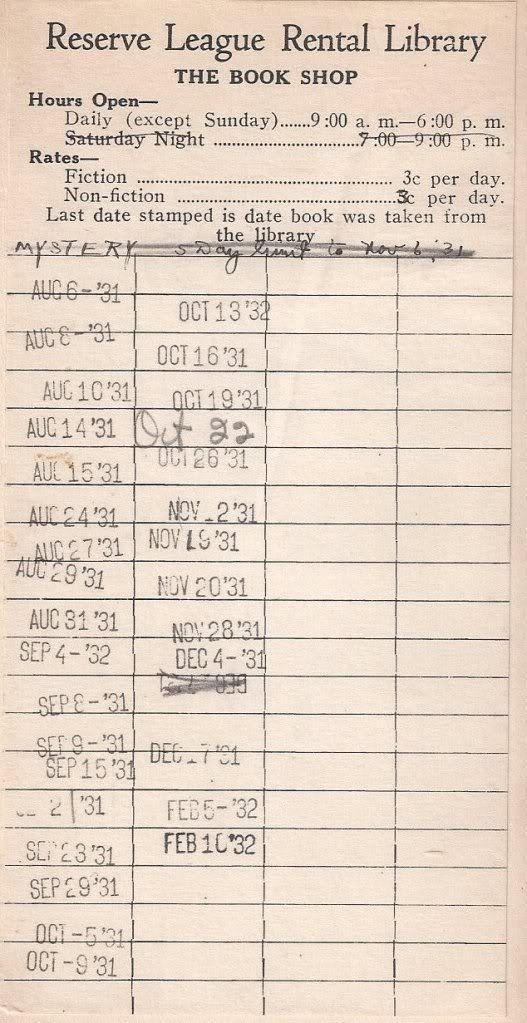
As a closer, I want to share with you a little treasure that was tucked away in my copy of the book for over 80 years! When I examined the book, I noticed that there was a library card from the 1930s glued on the inside. The first stamp dates from August 6, 1931 and was checked out over thirty times before it was borrowed one last time on February 10 of the following year.

Curt Evans, whose review prompted me to place an order for this book, made the following observation when he saw a scan of the card:

"It confirms how these books were widely read, though comparatively little sold. A mystery that sold but 2000 copies to libraries in the U.S. could have been read by 60,000 people conceivably.

I found in a diary a Kansas farm wife during the Dust Bowl years who was an avid
mystery reader, including John Rhode's
The House on Tollard Ridge. All rentals."

Well, I got an excellent, hard-to-get impossible crime novel, in fair condition, with a piece of history attached at a fraction of the price the book normally sells for (note that the only copy currently on sale goes at the tune of four hundred bucks). Yeah, you can consider me a happy boy!

7/17/11

The Barricaded Room

"But no matter how I tried 
The other side was locked so tight
That door, it wouldn't open." 
- Gotta Knock a Little Harder 
"Anthony Wynne" (1882-1963)
Back in September of last year, Curt Evans wrote a number of book reviews (here, here and here) on the rare and hard-to-get locked room novels by Anthony Wynne, the nom-de-plume of Scottish-born physician Robert McNair Wilson, who still stands as one of the most fertile writers of miracle problems. But in spite of fathering sixteen impossible crime novels, more than one-half of his entire output, he never accumulated the prestige and credit that was bestowed on John Dickson Carr, Hake Talbot and Clayton Rawson – or even that of lesser known writers such as Joseph Commings and Arthur Porges.

The impediment to acquiring ever-lasting fame, within the confines of the genre, was not due to a lack of imagination to deliver on resplendently conceived premises, but that he was depraved of even particle traces of humor and populated his stories with pasteboard characters who act like stage actors in a Victorian melodrama – prompting John Norris to aptly label them as "Detective Operas," in which an overwrought, melodramatic dénouement ends with the murderer promptly committing suicide after an aria of a confession.

But in defiance of these dire forebodings, I found myself unable to ignore a writer who turned out over a dozen locked room stories, occasionally packing a plot with more than one or two seemingly impossible situations, which reputedly are, at times, worthy of John Dickson Carr himself. I'll take a humorless, baroque style of writing, littered with two-dimensional characters, for granted if the exchange includes miracle problems of a Carrian quality – and I felt vindicated in that attitude after finishing The Green Knife (1932).

The flaws attributed to Wynne all give actes de présence in The Green Knife, but the murder of Sir Dyce Chalfont, an opulent power player on the financial scene, who "with the stroke of" a pen could "hand over a million men to despair and ruin," proved to be sufficiently baffling to distract your attention away from them – and the circumstances in which he died had me grasping at straws until the final page.

Here are the facts as they are known: witnesses that rushed to the bedroom door, after a disturbing scream, heard someone moving furniture around, to barricade the entrance, but when they managed to break-down the barrier the only occupant of the room was the body of the dead millionaire and the windows were securely bolted from the inside – creating an almost perfectly sealed area. But more importantly, the fatal stab wound inflicted on him precludes the possibility that he was attacked somewhere else in the house and fled into the bedroom to escape a murderous assailant – as he died within seconds after the blade ruptured his heart. I usually have a theory to offer as to how someone could've fled from an inescapable environment, but the best I could muster in this case was that the murderer curled himself up in a hidden compartment of the sofa that barricaded the door – an idea inspired by Edogawa Rampo's short horror story, "The Human Chair."


Fortunately, for my bloated, but fragile, ego, Dr. Eustace Hailey, who has a non-commending presence and a bland personality, was completely confounded, as well, especially when the servants start turning up dead under similar, apparently unfeasible, conditions – and every time they assume to have unlocked the door to one of the barricaded rooms, evidence from one of the other impossible murders breaks their theoretical key in several pieces and forces them to rethink their entire case all over again. The eventual solution is as clever as it is simple, a hallmark of a grand locked room trick, although you could draw a question mark or two in the column concerning the fair play aspect of it.

These engrossing puzzles and subsequent theorizing will occupy most of your attention, and therefore tend not to be bothered too much about the hammy writing or flat characters, but, to be honest, there was one excellent scene in the book that definitely benefited from the overwrought prose – which was when Dr. Eustace Hailey was locked-up in the darkened murder room with the killer, who was obliterating evidence from a previous murder, while the doctor was stumbling around in the dark and expecting any moment to feel a sliver of cold steel burying itself in his back. 

However, at times, he was also sloppy where details are concerned and any editor worth his or her salt should've picked up on them. When Sir Dyce was discovered it was immediately pointed out that he was stabbed in the back but when they discuss a bizarre suicide/accident-combo they talked as if the titular knife entered through his chest – and when the first servant is murdered, under eerily similar circumstances, they talked about back stabbings again. Huh? There's another irregularity in the story, concerning the impossibility of the first murder, but I can't go into details without divulging the solution of the locked room trick.

The tragedy of Anthony Wynne is that he was, at heart, a writer who belonged to a different era and had the misfortune to arrive on the scene long after his time had come and gone. I'm convinced that had he published such a book as The Green Knife 30-40 years earlier he would've been placed alongside Edgar Allan Poe, Wilkie Collins, Conan Doyle, G.K. Chesterton and Gaston Leroux as one of the trail blazing pioneers of the genre – instead of being perceived as a curiosity.

It's a shame, since you really have to admire someone who was able to saturate a story with impossible situations and false solutions, but I am afraid that less dedicated readers will find themselves bogged down by the overwrought writing and a deficiency of characterization, not to mention the scarcity and price-tags attached to most of the books, making this more a series for hopeless devotees of the locked room story and zealous collectors of hard cover editions than for regular mystery readers.

Yes, I'm one of those incurable aficionados of the impossible crime story, which means that you can look forward to more reviews of books by this obscure and forgotten author in the not so distant future – even if it means burgling the private libraries of John and Curt! Wait, did I just type that out-loud?