Showing posts with label Bruce Campbell. Show all posts

10/7/20

The Mystery of the Vanishing Magician (1956) by Bruce Campbell

"Bruce Campbell" is the penname of a husband-and-wife writing tandem, Sam and Beryl Epstein, who together produced the eighteen volume Ken Holt series, which has been rightly praised for its fine storytelling, logical plots and mature characterization – depicting two cub reporters on the brink of adulthood. More importantly, the series made a small, but not insignificant, contribution to the locked room and impossible crime story.

The Clue of the Phantom Car (1953) poses the conundrum of a speeding car that miraculously vanished from a dangerously narrow, hillside road and The Mystery of the Invisible Enemy (1959) concerns a highly secure and hermetically sealed laboratory leaking secretive information. Robert Adey overlooked these titles in Locked Room Murders (1991), but Brian Skupin corrected this oversight in Locked Room Murders: Supplement (2019). And added a third title!

The Mystery of the Vanishing Magician (1956) is the twelfth entry in the Ken Holt series, a young cub reporter, whose famous father, Richard Holt, "roamed the world as a foreign correspondent for the Global News Service" and therefore lives with the Allen family – who own the town's weekly newspaper, the Brentwood Advance. Ken works together with his best friend, Sandy Allen, as respectively a reporter and photographer on Pop Allen's newspaper staff. The opening chapter finds Ken and Sandy sitting in the audience of a charity show at the Brentwood High School auditorium, gathering material for the next edition of the Advance, when Sandy's older brother, Bert, recognizes Chris Bell in Magnus the Magician. A man who had once saved his life during a nearly deadly skiing holiday, in Vermont, but Chris Bell disappeared before they could properly thank him. And any attempt to trace him had been fruitless. Now he was standing in front of them, on stage, performing magic tricks!

During the big final, Magnus the Magician is going to perform "the old magical escape-and-transfer feat," magically transporting himself from one locked trunk to another, but he needs volunteers to inspect the trunks, handcuffs and to help shackling him. Bert is actually the one gets to cuff him and they see him saying something to magician, before he's lowered into one of the trunks. After three minutes have passed, the trunks are opened and they both turn out to be empty! But "he's not supposed to vanish!" However, this is not the impossibility of the story. That part comes later.

A backhand stage had seen Magnus coming out of the trunk and went away with the vague excuse that "he was unable to go on," but, as he made his getaway, he badly wrecked his car and is brought to the hospital in pretty bad shape. But things only go down hill from there. Police Chief or Brentwood, Alan Kane, identifies Chris Bell as Christopher Bell wanted in connection with a botched burglary and robbery of a jewelry store in Hilldale, Pennsylvania, where he had worked for nine years. Two men were nabbed by a cruising police car and they were so angry, because "the burglar alarm went off right after they entered the store," that they immediately identified Bell as their accomplice – whose only job was disabling the alarm and opening the safe door. Bell had already disappeared and with him "two hundred thousand dollars' worth of merchandise." And he has been on the run for four years!

It takes seven whole chapters of stalling and, yes, a little padding to finally get to the point of the story and the crux of the plot, but it was worth the wait, because the impossibility is an interesting one!

When they finally hear Bell's side of the story, they realize that "nobody else could have taken the stuff" except him, but the impossibility here is not represented by the double-locked door with an automatically-activated alarm system. The impossibility here comes in the form of a narrow window of time in which either Bell got clean away with the loot or one of his colleagues, James Turney, found a way to get merchandise out of the store. I know the premise sounds a little loose for a locked room mystery, but this is the genuine article with a well done false solution, accusing a least-likely-suspect with "a watertight alibi," based on classic locked room misdirection. I liked it that my initial, very Chestertonian, solution was mentioned in passing ("Or maybe you think he spread it out in the show window, where of course nobody could see it") right before the real trick was revealed. A wonderfully simplistic and logical explanation that was fairly clued and alluded to.

Unfortunately, the original locked room premise and its clever explanation also betrayed that The Mystery of the Vanishing Magician reads like an expended short story, because the whole plot hinges on the locked room-trick, but luckily, the Epsteins knew how to write – which is why I didn't notice it until well towards the end. But looking back on it, the plot is a bit of a patchwork.

The first seven chapters form a human interest story, ripped from the headlines, when Bert spots the man who saved his life, but inadvertently drove him into "a crack-up, and if he lives, he'll go to jail." So the Allens and Ken decide to help Bell prove his innocence. The detective work is done in the middle portion with Ken's two solutions as the highlight and the final quarter of the story moves into thriller territory.

A common trope in these junior detective novels is the obligatory spot of danger, or tight corner, in which the young heroes finds themselves trapped or tied up in an empty room or dark basement of an abandoned building. But these moments tend to be of a much more serious nature in this series with the Grim Reaper breathing down Ken and Sandy's neck. The Mystery of the Vanishing Magician could very well describe their most harrowing experience when they find themselves at the mercy of several crooks, inside a disused mine, who play a cat-and-mouse with each other full of bluffs and double-crosses. So its not just played for cheap thrills and shows how much the authors respected the intelligence of their teenage readers.

So, plot-wise, The Mystery of the Vanishing Magician is not quite as good, or intricate, as the previous two Ken Holt novels I've read, but the excellent storytelling masked those shortcomings and liked what it did with the locked room problem. Yeah, a relatively minor mystery novel, but a good example of the surprisingly original, often high quality, detective/impossible crime fiction hidden away in the often overlooked juvenile corner of the genre. 
 
Lastly, I especially recommend the Bruce Campbell locked room trio, The Clue of the Phantom Car, The Mystery of the Vanishing Magician and The Mystery of the Invisible Enemy, to every impossible crime aficionado as a fascinating contribution to the genre from the 1950s.

12/8/18

Stranger at the Inlet (1946) by Martin Colt

A year ago, I reviewed The Clue of the Phantom Car (1953) and The Mystery of the Invisible Enemy (1959) by "Bruce Campbell," a penname of Sam and Beryl Epstein, who cemented their legacy as the pioneers of the present-days Young Adult genre with the acclaimed Ken Holt series – which tended to be darker and more intricately plotted than most juvenile mystery series of the period. What's not as well known is that Ken Holt has a predecessor, Roger Baxter, who appeared in a couple of novels during the late 1940s.

The series comprises of three novels, Stranger at the Inlet (1946), The Secret of Baldhead Mountain (1946) and The Riddle of the Hidden Pesos (1948), which were published under two different names, "Charles Strong" and "Martin Colt." A very short-lived series, but as highly regarded by fans as the more well-known Holt series. And not without reason!

Roger Baxter is the 14-year-old protagonist of the series who lives with his 12-year-old brother, Bill, in the small, coastal town of Seaview and they were obviously the prototypes for Ken Holt and Sandy Allen.

Roger is, very much like Ken, the meticulous, rationally-minded thinker of the two. However, the difference between Ken and Sandy, who are the same age, is due to intelligence, while the difference between Roger and Bill is clearly age, because Roger has already began to mature and Bill is still in the phase between childhood and adolescence – which can make him a little bit naive at times. Roger and Bill are two very well-drawn, believable child characters on par with the children and teenagers found in the work of Gladys Mitchell.

The story opens during the summer holiday and the boys are planning to make a windmill on top of the empty cottage, owned by their parents, which they have come to regard "more or less as their private property." Unfortunately, their mother informs them the cottage has been rented for two months to a man, Robert "Slim" Warner, who wants a quiet place to recuperate from an operation. Luckily, Slim has no problem with Roger and Bill mounting a windmill on the roof of the cottage to generate electricity for the cottage. However, they soon begin to pick up hints and clues that Slim is not who he says he is.

Slim says he came to Seaview to convalesce, but carried around heavy bag, two at a time, without any trouble or pain. He drives "an old wreck of a car," but the motor in it "sounds almost brand-new." A power generator was delivered to the cottage, but Roger knows he never send the telegram to ask for it. And then there's the mysterious, late-night visitor to the cottage and they boys overheard them talking about Smugglers' Island.

An answer to all of these questions come, roughly, a quarter into the story, which plunges Roger and Bill head first into an exciting adventure that involves an elaborate smuggling operation – who use the peaceful, out-of-the-way seaside town as a clearing point. But this is all I can say about the plot without giving away too much.

What I can say about the story is that plot has a lot of nuts and bolts, which makes it a younger relative of Freeman Wills Crofts and John Rhode. The early chapter detailing how Roger, Bill and Slim build the windmill on top of the cottage reads like a partial instruction manual and they learn how to operate "a six-volt radio." As well as getting a crash course in Morse code. A combination of the two is put to ingenious use when they find themselves in a tight corner towards the end of their adventure. Obviously, a book that was written for young boys and teenagers.

The sole weakness of this excellently written novel is that the chase was more exciting, and fun, than the eventual capture of the culprits, which hardly came as a surprise. Something that enervates most juvenile mysteries for older readers.

Nonetheless, Stranger at the Inlet is a beautifully written, characterized and adventurous mystery novel with an equally beautiful, well-imagined backdrop. The writers evidently knew and respected their young audience, which they would come to perfect in the Ken Holt series when their plots became really trick and far more serious – fraught with very real, dangerous situations and consequences. So these two series are without question a cut above other juvenile series and can be enjoyed by young and old alike. Just for that, they deserve to be rediscovered.

9/30/17

Chasing Phantoms

"Well, to tell you the truth... there is a growing belief that this particular automobile has wings."
- Prof. Augustus S.F.X. van Dusen (Jacques Futrelle's Best Thinking Machine Detective Stories, 1973)
Last month, I posted a review of The Mystery of the Invisible Enemy (1959) by "Bruce Campbell," a shared pseudonym of Sam and Beryl Epstein, who wrote eighteen juvenile mystery novels about their series-character, Ken Holt – who lives with the family of his best friend, Sandy Allen. The series was published over a fourteen year period, between 1949 and 1963, and were praised for their detailed, logical plots.

The Mystery of the Invisible Enemy turned out to be a really good example of the early "Young Adult" detective novel and the plot even incorporated a (minor) locked room problem, which is what originally attracted my attention to this series. There were several other, interestingly sounding, titles that also appeared to qualify as impossible crime tales.

Predictably, I wanted to return to this series before too long and since "JJ" has started covering The Three Investigators, I had an excuse to take a break from Jupe, Pete and Bob to go after some of the titles in the Ken Holt series. And that brings me to the subject of today's blog-post.

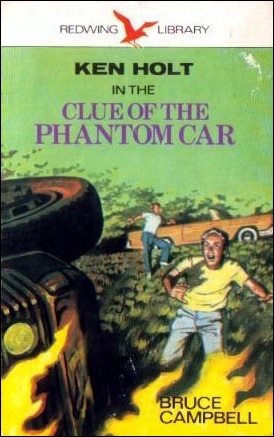
The Clue of the Phantom Car (1953) is the eighth book in the series and finds the protagonists, Ken and Sandy, working as cub reporters for the Brentwood Advance, which is a local, family-run, newspaper – owned by Sandy's father, Pop Allen. Ken and Sandy are reporting on the dedication of the new lakeside children's playground by the Mayor of Brentwood, but nothing particular newsworthy happens until they journey back home.

They decide to "take the old road" home and this route takes them through a narrow, one-mile land that climbed Sugarload Hill and as their red convertible climbed the hill they witnessed "a sudden flash of light" near "the crest of the hill." A "burst of red flame" and flared as if "the whole wooded crown were ablaze." When they arrive at the spot, they discover a trailer track had gone off the road and lay wrecked in a gully fifty feet below. And the driver was trapped inside.

Ralph Conner of the Conner Brothers Trucking Company is dragged from the wreck and they probably saved his life, but they soon learn this was only the latest accident in a series of dangerous, costly incidents that placed them in danger of losing their insurance cover – because the company is starting them to view as a liability. This latest accident comes with a story suffering from a severe lack of credibility. Ralph later tells to the police that he encountered a car that came right at him and attempted to avoid it, which forced him off the road, but the car must have passed Ken and Sandy as it raced down the hill along the narrow lane.

However, Ken and Sandy swear to the police that nothing passed them "all on the way up to the hill." The car couldn't have turned around and driven off in the opposite direction, because they would have seen the taillights. Nobody in their right mind would drive down that narrow hill road without lights.

So either the car that forced Ralph off the road "sprouted wings and flown away" or he made up a story that lay blame elsewhere to hold on to their insurance. As expected, Mort and Ralph have their policy canceled and this means they have to sell their trucking company. Mort and Ralph are beloved members of the Brentwood community and Ken and Sandy want to help them to keep the company, which they decide to do by trying to find evidence that the phantom car was not merely a figment of the imagination.

Dutch edition, "Spook Lights"
In my celebrated opinion (humility? Pfui!), the investigation into this seemingly impossible disappearance, and the explanation, could be condensed into short story form and presented as adult detective-fiction. A short story along the lines of the short (locked room) stories by Edward D. Hoch and Arthur Porges.

The authors do not simply, or dumb down, the plot to accommodate their young readership or the two boy-detectives. They even come up with a completely wrong answer on their attempt to crack the case, but the result is a false solution that is as clever as it original. It showed the boys playing around with ideas and looking into the various possibilities, which also distracts from the ultimate simple answer to the problem. One that Ken stumbles to during a homely scene and this incident suddenly makes a clue given by Ralph during the second time he was asked about the accident by Ken very clear.

So, as an impossible crime story, the first half of the book offers a pleasant read to the apostles of the miracle problem, but there's another side to the case.

The question of who could be behind the accidents, or sabotage, is not a big mystery, but who they exactly are is. And, more importantly, why. You can argue that the book is almost more of whydunit than anything else. Obviously, someone wanted to buy the small-town trucking company on the cheap, but what possible profits could be gained by buying uninsurable company?

I assumed something valuable had been hidden inside one of the trucks, or somewhere in the garage, and can only be retrieved by having unrestricted access. So Mort and Ralph had to be forced to sell their company. However, the actual explanation lacked the originality of the phantom car plot-thread and veered into cartoon villain territory. Not that it was bad and the authors wrote several exciting scenes around this stock-situation, which was actually a nice change of page compared to the first half. And the authors really loved placing their 17-year-old detectives in seriously dangerous, life-threatening situations. Anyway, it might for a well-written, exciting ending.

Something else that has to be mentioned is that Robert Arthur must have been influenced by Ken Holt when he created The Three Investigators. I have noticed a couple of interesting commonalities exist between both series. 
 
JJ has commented on the unusual family situation of Jupiter "Jupe" Jones, who lives with his aunt and uncle at their junkyard, which is a home situation that can be compared to Ken Holt's backstory. Holt is a motherless, teenage boy with a foreign correspondent as a father who is always traveling across the globe. So he lives as an adopted son with Sandy's family and works at the newspaper of Pop Allen. I suppose you also view the other Allens as fullfilling the same role, for example, the two Bavarian brothers who work at the junkyard of the Jones family.

Interestingly, the relationship between Kent and the Allens are introduced The Secret of Skeleton Island (1949) and that's the same book-title as the sixth entry in The Three Investigator series. Even more interestingly, the main plot-line of The Clue of the Phantom Car is practically the same as the plot of The Mystery of the Vanishing Treasure (1966), which also has a sub-plot about an impossible disappearance/theft.

I suppose Arthur could have been aware, or even read, this series and drew inspiration from it when he began to write The Three Investigator books. So that would make Ken Holt and Sandy Allen the literary ancestors of Jupe, Pete and Bob. And that would make my discovery of this series even better!

So, all in all, The Clue of the Phantom Car is a pleasant combination of the cerebral detective story with danger-pact ending with the high-light being the impossible problem and the false solution. Definitely a title I can recommend to readers of both juvenile mysteries and impossible crime fiction.

9/10/17

The Phantom Enemy

"It seems impossible, but Sherlock Holmes once said that when you have ruled out all other answers, what remains must be true."
- Jupiter Jones (Robert Arthur's The Mystery of the Whispering Mummy, 1965)
Earlier this month, "JJ" of The Invisible Event wrote a great blog-post, titled "Trifecta Perfecta – A Trio of Locked Room Riddles for Younger Readers," which coincided with a serendipitous discovery I made around the same time – once again demonstrating that these detective blogs are a hotbed for cosmic synchronicity. What I found was a practically unknown locked room novel in the juvenile, or young adult, category. And the publishing date places the book on the tail-end of the genre's Golden Age!

The Mystery of the Invisible Enemy (1959) is the fourteenth book in the Ken Holt series by Sam and Beryl Epstein, written under the joined pseudonym of "Bruce Campbell," consisting of eighteen books in total. This series is purportedly "one of the very best boys' series" and the stories were praised for their "logic and great attention to detail."

Ken Holt is the protagonist of the series and the son of a well-known foreign correspondent, Richard Holt of Global News, but lives with the family of his best friend and aspiring photographer, Sandy Allan – who runs a small-town newspaper called the Brentwood Advance. An arrangement stemming from the first book in the series, The Secret of Skeleton Island (1949), when the Allen family helped "a terrified Ken Holt" locate his missing, or kidnapped, father. In the end, the motherless Ken was invited to come live with the Allens, which suited his foreign-correspondent father, because the alternative would have made him the loneliest latchkey kid in the United States.

I should also point out that this series was obviously geared at a slightly older readership than, let's say, The Three Investigators by Robert Arthur and William Arden. One of them is that Ken and Sandy are in their late teens, probably sixteen or seventeen years old, who drive a red convertible, but more notably are the severity of the crimes. There are no less than three, very serious, attempts at murdering or severely wounding people. But more on that later.

The Mystery of the Invisible Enemy begins very benignly: Ken and Sandy, acting in the capacity of cub reporters, are tasked with reporting on the annual Halloween party for the employees of the Brentwood Foundry and Casting Company – who are about the celebrate their tenth anniversary. Only eleven years ago, the plant was owned by the Alborn Iron and Steel Corporation, but they deemed the Brentwood location obsolete and abandoned the plant. A decision that was an "absolute tragedy" for more than a hundred families in Brentwood. Luckily, a former plant manager, Lew Collins, gathered a group of local investors and breathed new life into the company. It was "a tough pull," but Lew's management saw the company grow and expand. And they were even able to sell shares in the company.

However, dark clouds were gathering above the company as its tenth anniversary looms on the horizon.

Alborn was offering to buy the company back, after it made profitable again, which is supported by a local real-estate magnate, Bob Jennings, who had bought himself into the company and now wanted to see a return on his investment – resulting in "a knockdown, drag-out fight." Collins barely held on to his company, but Alborn was underbidding the Brentwood plant. And that's not the only problem facings Collins. Ken and Sandy learn during the Halloween party that Collins is in the grip of a ruthless, devious and clever extortionist.

Collins has been diligently working an "an entirely new type of casting machine," one that casts molten metals quicker and more efficiently, but one day, an anonymous letter arrived with an enclosed photograph of a section of the blue prints of the automatic casting machine. The letter writer threatens to mail the full plans to all of their competitors, but gives Collins the opportunity to buy back the plans and negatives for the "reasonable price" of $100,000! Only problem is how the letter writer had been able to photograph the plans.

The casting machine was designed, constructed and perfected inside a practically hermetically sealed laboratory. A room with the only entrance, and exit, being a door that opened on the private-office of Collins and the only windows were steel-shuttered with locks that were "crusted with a layer of dirty grease" that took many months to accumulate. There were no scratches around the lock of the door to indicate that somebody attempted to pick it.

Ken Holt, Reporter-Detective
This is where the plot shows its first signs of the series reputed cleverness, because the locked room puzzle poses a double-edges problem for the boys.

Logically, the only person who could be the extortionist is one of the three people who are in possession of a key to the laboratory, which Collins and two of his engineers, Bruce Winters and Will Caton, but Collins refuses to believe he has been betrayed by the boys he helped get through college – something that, at first, appears to be the case. However, Ken and Sandy pursuing this angle shows them to be the type of fallible detectives in the Berkeley-Queen tradition.

I found this to be interesting take, particular in a juvenile mystery series, on a character who had been described as having a brain that could work "faster than a calculating machine."

So back to the drawing board for Ken and Sandy. What they're left with is a genuine locked room problem, which brings them to the darkest, most secretive, recesses of the company, but discovering the secret of the locked laboratory nearly cast them their lives. They're overtaken by the extortionist, tightly bound and gagged, and left to face certain death in one of the dangerous fanning-houses of the plant.

This is not your typical, dime-a-dozen, spot of danger usually found in these kind of juvenile novels, but an honest-to-god attempt at murdering the boys. The writers make it abundantly clear that the extortionist wants them out of the way and their predicament is positively harrowing. Ken and Sandy are stuck their for many hours and several attempts to find a way to escape their bonds fail miserably. Once again, this is a part of the story where series reputation manifest itself. The boys are gagged, but Ken came up with a clever way to communicate with Sandy by humming the tunes of popular songs. And how did Ken communicate to Sandy this is how they could talk to one another? Ken simply hummed the tune of "Say It With Music." A brilliant piece of reasoning and writing on the part of Ken and his creators. Easily my favorite part of the book.

Of course, this assault and attempted murder of Ken and Sandy proves to be the downfall of the extortionist, which came on top of the assault and attempted murder of a plant employee who was pushed off a ladder. On a side note, the assault that left that employee in the hospital functioned as a clue to the extortionist's schemes at the company and he had to put that person out of the way. The only reason this character lived to see the end of the book is that the target audience were teenagers, but otherwise, the plot was only a couple of steps removed from being adult (detective) fiction.

Finally, I should give some attention to the problem of the locked laboratory. I've seen variations of this locked room trick before, but, again, the writers did something really clever with this trick. Ken and Sandy realize that the locked room trick only gave the intruder limited access to the room, which leaves them with the question how the extortionist was able to gather a full set of photographs.

My only complaint is that Ken almost immediately figured out this angle to the locked room, but then again, they would find themselves in a life-threatening predicament only moments later – which made it necessary to get this plot-thread out of the way.

All in all, The Mystery of the Invisible Enemy was a pleasant and surprising discovery with a plot and story that was as good, and in some regards even better, as the best titles from the iconic series about The Three Investigators. So you can expect my return to this series to take a closer look at such titles as The Clue of the Phantom Car (1953) and The Mystery of the Vanishing Magician (1956). I'm not sure whether, or not, they are actually impossible crime stories, but the plot descriptions are very promising.