Showing posts with label Erle Stanley Gardner. Show all posts

7/25/17

Burning the Midnight Oil

"You know a murder case is apt to get messy."
- Tecumseh Fox (Rex Stout's Bad for Business, 1940)
Erle Stanley Gardner's The Case of the Smoking Chimney (1943) is the second of only two detective novels about one of his lesser-known characters, Gramp Wiggins, who's described by his own relatives as "an old reprobate" driving "an unwashed, rattletrap automobile" with worn tires and a cracked windshield – pulling "a thoroughly disreputable home-made trailer" behind it. At irregular intervals, Gramp Wiggins deposits his "bachelor's den-on-wheels" on the driveway of his granddaughter, Mildred, and grandson-in-law, Frank Duryea.

Frank Duryea is the District Attorney of Santa Delbarra County, California, whose work never fails to arouse the interest of the chronically curious Gramp Wiggins. A personality trait that's not exactly tempered by the fact a murder is committed in the district every time the old man parks his ramshackle trailer in the driveway of the D.A. However, I'm getting ahead of the plot.

The first dozen, briefly written, chapters are a testament to Gardner's talent for plot construction and his ability to manipulate an intricate web of plot-threads, which has strands running along a large cast of characters – giving armchair detectives enough possibilities to mull over. I think these chapters also demonstrated the author's expertise in legal shenanigans.

Ralph G. Pressman of Los Angeles is the unscrupulous businessman at the heart of these legal shenanigans, which spells bad news for the simple farmers and ranchers of a small town called Petrie. There was "a cloud on the title" of the farms and this meant that everyone who possesses the oil rights has "the right to enter upon the land" to "prospect for oil." Additionally, the oil rights also give the legal holder permission to erect derricks, sumps, refineries, storage tanks and pumping stations as well as laying new roads and pipelines. So whoever held the rights was pretty much allowed to do everything necessary to get "the oil out of the land."

Unfortunately, the local ranchers and farmers never took the potentially invasive reservation on their property very seriously until Pressman bought the oil rights for a song, which was rubber-stamped by the Santa Delbarra's superior court and the district court of appeals – prompting Everett True, editor of the Petrie Herald, to write a fiery condemnation. There is, however, nothing that can be done. One of the local ranchers, Hugh Sonders, already has an oil derrick planted on what he always assumed was his private property.

As if that wasn't bad enough, Pressman has an ace up his sleeve to ensure his scheme is profitable. After all, the oil wells might turn out to be as dry as a law book. So he wants the locals to have an opportunity to buy him out and has a bought a small, inexpensive ranch with a cabin under the name of Jack P. Reedley. When the local committee comes knocking for a contribution, Pressman will know how much is in the kitty and as a newcomer he'll ask question. If he plays his cards right, this little side-plan will give him all the inside information needed to wrangle money out of the oil wells. Even if they turn out to be bone dry.

Well, this alone would be good enough a premise for a detective story, but Gardner further complicated the plot with several additional plot-threads presented in those very same opening chapters!

Pressman's efficient secretary, Jane Graven, has the standing instructions to open all incoming mail and, in his absence, she opened an envelope from a private detective agency. The content of the envelope consisted of a report confirming that Pressman's much younger wife, Sophie, has been seeing a young stockbroker, named Pellman Baxter, behind his back – supplemented with photographic evidence. Sophie managed to get her hands on the envelope before the murder is discovered.

However, Sophie is not only one who has been taking advantage of the businessman: a cashier and auditor of the Pressman interest, Harvey Stanwood, has been dipping into his employer's pocket to nurture a gambling habit and impress his girlfriend, Eva Raymond. However, Stanwood's luck has run out and discovers himself in an impossible position when he has less than twenty-four hours to replace nearly $20,000 in embezzled money. Luckily, George Karper "believed that every man had his price" and wants to part with some hard cash in exchange for "the low-down on the Petrie oil business." All of it!

So there are more than enough potential suspects and motives to go around when Pressman's body is found in his locked cabin: the top of his head had been blown off by a bullet from a Colt revolver. The key to the door was tightly clasped inside the dead man's hand, but you should not read the book as a locked room mystery. As reported elsewhere, the book is on the marginal side as an impossible crime story and the answer to the locked door is a cheat. Nevertheless, the locked nature of the cabin is of relevance to the overall plot and even provides an important clue to the identity of the murderer, which is why I (reluctantly) labeled this blog-post as a locked room mystery. But you should not read the book solely for its minor locked room angle.

You should read The Case of the Smoking Chimney for the detective work done by Gramp Wiggins. Or to be more precise, the character interaction between Gramp Wiggins, Frank Duryea and Mildred that's at the heart of the investigation. A character-dynamic vaguely recalling Craig Rice's John J. Malone, Jake Justus and Helene Brand, but the relationships here are, of course, a little bit different.

One difference really setting this book apart from most of its contemporaries is that, regardless of his familial ties to the District Attorney, Gramp Wiggins isn't given unfettered access to the crime-scene and suspects – on the contrary! Duryea actively tries to dissuade his grandfather-in-law from intervening in the investigation, which proved to have a very low success rate. A good example of this is when Duryea, while looking over the body, discovers Gramp Wiggins has his face pressed against the window, like a creepy hobo, to see what was happening inside the cabin. Gramp Wiggins also managed to worm his way inside Duryea's office and question some of the witnesses. 
 
Regardless of his many eccentricities (such as plying his relatives with alcohol and smuggling coffee across the Mexican border), Gramp Wiggins does some first-class detective work by correctly interpreting such obscure clues as the meaning behind the fake suicide note, the footsteps heard inside the cabin a day before the murder and the amount of oil burned by the lamp during the night – which form a properly forged chain link of clues attached to the only person who could have done it. So that was a really rewarding aspect of the story.

On a whole, The Case of the Smoking Chimney is perhaps a minor detective novel, but the plot and clues are solid enough that they can be used as a convenient excuse to fling a copy of the book on your to-be-read pile. Not that most of you need an excuse, but it's there whenever you need it.

7/6/17

The Fatal Bullet

"Lawyers can be pests and often are."
- Archie Goodwin (Rex Stout's A Right to Die, 1964)
Erle Stanley Gardner was a prolific and consistent mystery writers, who churned out books and short stories faster than a Gatling machine gun can spit out bullets, which included over eighty (!) novels about his most famous creation, Perry Mason – a courtroom wizard who often took gross liberties with the law. However, Mason was not the only the character Gardner created.

Gardner penned three, novel-length mystery series with a relatively long and not entirely unsuccessful run. One of these series was published under a pseudonym, namely "A.A. Fair," which covered thirty books about the Nero Wolfean Bertha Cool and her legman, Donald Lam. A third series counted only nine titles and were originally serialized in slick magazines, such as The Country Gentleman and The Saturday Evening Post, before they were published as books. And this particular series has long held my interest as they seemed to offer a delicious slice of small town Americana.

The series in question is set in the fictional county of Madison City, California, which had been under the control of a political organization for fifteen years, but the then district attorney got careless and "the sheriff was crooked" - giving rise to a populist uprising against the political establishment of Madison City. Doug Selby and Rex Brandon "furnished the spearhead of a political ticket" that "swept the machine aside."

So Selby was sworn in as the new district attorney of the county and Brandon became the newly elected sheriff, but both men still have to content with the remnants of the old political structure. A structure that stills seems to work as a opposition power in the third book of the series. There is, however, another problem slinking into Selby's district.

The D.A. Draws a Circle (1939) introduces a dangerous and cunning antagonist for the district attorney, Alphonse Baker Carr, who is a well-known, unscrupulous criminal lawyer with notorious underworld figures as clients – which does not sit well with his new neighbors of the swanky neighborhood of Orange Heights. Mrs. Rita Artrim believes Carr has nothing to contribute to the community that's "either desirable or healthy," but Selby can't stop the lawyer from buying property in the county.

Nevertheless, the moment "old A.B.C." sets foot in his district the problems begin for the newly elected D.A. and sheriff: a bail-jumper from Los Angeles, Peter C. Ribber, is picked up by a patrol car and accidentally released again. A dry cleaner finds a brown suit in his truck, on which a "sinister red stain had encrusted into stiffness," with a powder-burned hole in the center. A resident of Orange Heights called the police to report a naked man, who was seen running around, which is followed by the report of a gunshot.

On the following morning, the body of a naked man is discovered with a fatal gunshot wound. However, the single gunshot wound has two bullets in them and "the second bullet almost paralleled the course of the first bullet." So the question is not only who fired the fatal shot, but also why anyone would toss a slug into a dead body.

The victim is identified as Morton Taleman, a criminal associate of Ribber, who is a client of A.B. Carr. As to be expected, Ribber immediately engages Carr upon his arrest, but Selby and Brandon have another problem on their plate. One of the previously mentioned characters, Mrs. Altrim, became a widow when she lost her husband in a roadside accident, which left her elderly father-in-law a cripple with amnesia. However, Selby learns from their live-in nurse, Miss Anne Saxe, that employer and patient may have designs on one another, because she believes Mrs. Altrim had a hand in the accident – which tosses a double-edged motive for murder into the household.

On the one hand, you have to old man who is slowly regaining his memory, as well as his mobility, while on the other you have someone afraid of being found out. This problems comes to a head when one of them goes missing and only leaves a blood-covered liquor closet behind. And this is also the plot-thread that gives the book its title, because Selby, based on the mileage on a speedometer, draws a circle on a map of the vicinity in which the body must have been hidden. On the last pages, the book-title gets an additional and delightful meaning.

So, that makes for a pretty bundle of trouble, but The D.A. Draws a Circle is not really about who did what and why, but how Selby navigates a treacherous maze of petty power politics and deceit. You can label the book as a strategic detective and the approach recalls that of an inverted mystery (e.g. Columbo), in which the primary question is how the detective will checkmate his opponents and in this instance it's a two-on-one match. The (interlocking) solutions to the aforementioned problems are merely the cherry on top.

I mentioned earlier how the political landscape of Madison City contains remnants of the previous regime, which are actively working against Selby and Brandon. You get a front-row seat to their scheming in the sixth chapter when the editor of the Blade, Frank Grierson, has a closed-door meeting with the dull-witted Chief of Police, Otto Larking. Grierson cooks up a plan ensuring Selby loses both face and political capital, which is done by making sure the man arrested by Larking is exonerated by Carr in court. Before the trail, the Blade is going to publish editorials minimizing the difficulties of the case and suggesting to the public that getting a conviction is a mere formality.

So that would make Selby look very bad, if he fails to secure a conviction, while the Blade and Larking come out of it smelling like a rose garden. There are only two routes that could upset this plan: beat the famous criminal lawyer in court or find a complete solution to the problems, which are both easier said than done.

In my (far from humble) opinion, the way in which Selby outwitted his reluctant prisoner and "a big-time, crooked shyster," simultaneously circumventing the schemes of his political opposition, is what made The D.A. Draws a Circle a tremendous read reminiscent of the best inverted detectives with a cleverly worked out, double-pronged (murder) plot on top of that.

So, I really should return to Gardner's work more often, because they always deliver in one way or another. Maybe I should try one of his Gramps Wiggins novels next. You know, for, uhm, obvious reasons. ;)

8/7/16

The Naked Truth


"The world is filled with mysteries... many very intelligent people work solving them. My skill lies in making that talent pay."
- Penelope Peters (Lois H. Gresh and Robert Weinberg's "Death Rides the Elevator," from The Mammoth Book of Locked Room Mysteries and Impossible Crimes, 2000)  
Erle Stanley Gardner was an incredible productive novelist, who had his roots in the pulps, but garnered everlasting fame in the genre as the author of more than eighty mysteries about a lawyer and courtroom wizard, named Perry Mason – which have the tendency to overshadow all of his other work.

Gardner also wrote a few short-lived series about such characters as Gramps Wiggins (e.g. The Case of the Smoking Chimney, 1941), Terry Clane (e.g. The Case of the Backward Mule, 1946) and Sheriff Bill Eldon (e.g. Two Clues, 1947). However, they only lasted for a couple of novels or a handful of novellas. The life-span of Doug Selby, the D.A. of fictitious town, stretched across nine novels, but, volume-wise, only one of Gardner's secondary series came (somewhat) close to matching the sheer prolificacy of the Perry Mason mysteries.

Bertha Cool and Donald Lam are at the front of twenty-nine novels, initially published under the name of "A.A. Fair," who were defined by the Thrilling Detective website as "one of the all-time great mismatched team ups in detective fiction" and "a real blast of fresh air." During the introduction of Cool and Lam (1958), an unsold pilot for CBS, Gardner described Lam as "a little thinking machine" and Cool as his "big, penny-pinching partner," which is all very appetizing, but I found myself in a quandary – where to begin? I was torn between The Bigger They Come (1939), Top of the Heap (1952) and The Count of Nine (1958), but settled, predictably, on the last one. Why is it predictable, you ask? Why, it's an impossible crime story! What else did you expect from me?

A globetrotter and gentleman-explorer, Dean Crockett, engaged Cool and Lam to keep out sticky-fingered gatecrashers from his upcoming social gathering. Or to prevent any potential intruders from leaving the place with a valuable item from his exhibition room. The last time he threw a party someone lifted "a jade statue worth six thousand bucks," but this time Crockett turned his penthouse into a mousetrap: the place is at the twentieth floor and can only be reached by a special elevator, which runs up to a vestibule-like room "that opened out from the twentieth floor hallway." You need to be let in or have a key to get inside the penthouse, but that’s not the only precaution that was taken.

Cool stationed herself by the door, in charge of checking invitations of the guests, while the elevator has been secretly out fitted with an x-ray machine. This turned the elevator in a primitive body scanner. Regardless of these obstacles, a second jade statue and a five feet long blow-pipe from Borneo were taken from the tightly watched and secured penthouse. It seems like a complete impossibility!

I've to make an annotation here that, at this point in the book, the story really began to show how wrong my assumptions about the characters were. I assumed Cool and Lam were, partially, inspired or based on Rex Stout's Nero Wolfe and Archie Goodwin, but it was Lam who most of the brain-and leg work – basically all of it after the theft was discovered. After Cool bungled the job, she receded into the background and occasionally hurled abuse at poor Lam ("I'll take a swing at you right here in front of all these people"). But it was her partner, not her, who figured out how a long, cumbersome blow-pipe and a jade statue were carried, unnoticed, out of a guarded apartment.

The explanation for the theft of the blow-pipe was logical, fairly well clued and not too difficult to solve yourself, but I can't say the same for how the carved jade Buddha was smuggled out of the apartment – which was revealed without giving any real clues. You could probably make a good guess how the statue was lifted, but it would be a pretty long shot. So I would say The Count of Nine is decent, but not stellar, as a locked room novel, but the seemingly impossible theft of a blow-pipe and a hunk of jade are not the only crimes confronting Cool and Lam. There's also a murder a little later on in the novel.

Dean Crockett’s lifeless body is found inside his so-called hibernation room, where he retreated to write travel articles and books, with "a dart from a blowgun embedded in his chest a short distance below the throat." The dart was fired into the room through the open window and the shot likely originated from the studio of his wife, Phyllis, who was painting a portrait of a nude model, Sylvia Hadley. She has a link to Crockett's personal photographer, Lionel Palmer, who has an interesting collection of photographs and gives Lam some pickup tricks. Finally, there is Crockett's public relations man, Melvin Otis Olney, and a receiver of stolen good hovering in the background.

All of these potential suspects dance around the body of the dead explorer, but the who and why of the murder were uninspired, bland and run-of-the-mill. Only the how-part of the explanation lifted this part of the plot slightly above the ordinary. Gardner toyed with ideas from G.K. Chesterton's "The Arrow of Heaven," collected in The Incredulity of Father Brown (1926), and Agatha Christie's Death in the Clouds (1935), but the clueing is a bit iffy – as the only proper hint was an observation that a second dart was "shot with sufficient force so that the point was deeply embedded in the wood" of a closet.

So I found The Count of Nine to be a very uneven mystery novel: there were definitely aspects of the story I liked, but there were also a lot of aspects that left me completely underwhelmed and unimpressed. Honestly, I expected a bit more from the author of Perry Mason, because those books had a fairly high and consistent quality of plots. But maybe I should try some of the earlier ones.

Well, that's all I have to say about The Count of Nine as a detective story, but there's one thing I need to point out to everyone. The book mentions vending machines at airports for insurance policies, which actually existed. I found the following link that briefly goes over the history of these vending machines and mentions how several airplanes were blown up with these insurance policies as a motive. One of these cases is the infamous 1955 bombing case of United States Flight 629, which resulted in 44 fatalities.

Finally, I have some good news that connects this review with a recent blog-post, "The Locked Room Reader V: A Selection of Lost Detective Stories," in which I went over a number of lost and unpublished manuscripts. Today, I learned Gardner's publisher shelves the second book in this series, The Knife Slipped, because they objected to Cool's tendency to "talk tough, swear, smoke cigarettes and try to gyp people," which happened to be exactly the kind of gal Hard Case Crime likes – who'll be publishing the book for the first time in December of this year. You can read more about the book here.

So that's one detective story we can scratch from that lamentable list of lost detective stories!

4/16/15

Gasping for Breath


"They're queer-looking things... some of 'em look like sea-monsters that haven't grown up."
 - Sgt. Heath (S.S. van Dine's The Dragon Murder Case, 1934) 
The Case of the Gold-digger's Purse (1942) is the twenty-sixth entry in Erle Stanley Gardner's Perry Mason series and the opening of the story enmeshed the cunning defense-attorney in a tangle of extortion, theft and murder – which began with a seemingly uninteresting and innocent consultation on gold fish.

Harrington Faulkner is in the real-estate business, where he amassed a king's ransom, but only cultivated a single passion to spend his dollars on: breeding gold fish.

Faulkner raised a particular strain of Veiltail Moor Telescopes, a gold fish completely cloaked in funeral black and often referred to as the "Fish of Death," but this school of rare fish are suffering from a deadly decease known as gill fever. A young, poor chemist and pet shop employee, Tom Gridley, developed a formula that cures gill fever. However, Gridley is suffering from tuberculoses and should take a break from work to recover, but he can't afford to leave his job and now his beautiful girlfriend, Sally Madison, is extorting thousands of dollars from Faulkner – in exchange for the formula.

A gold-digging extortionist and a bout of gill fever aren't the only plagues pestering the aquarist. Faulkner has had a fall-out with his business partner, Elmer Carson, who slapped a restraining order on Faulkner, which forbids him from removing the aquarium and its content from their shared office.

Mason is reluctant to get involved, but curiosity keeps getting the best of him until he and Della Street are in legitimate danger of becoming accessories after the fact in the murder of Harrington Faulkner. It begins when the office is burgled and the aquarium looted, which gives Mason an opportunity to make some astute deduction about the soup ladle, the pole it was mounted on and the size of the room. By the way, the theft was briefly teased as a locked room mystery. 

The gold fish are eventually found, alongside Faulkner's body, on the bloodstained bathroom floor of his home and Mason's typical, almost routine manipulation in murder cases has now dug him a hole for two. 

One of the most attractive aspects of the Perry Mason series, as an unabashed neo-classicist, is how densely plotted each novel is. There's barely any fat on the bone, so to speak. The multitude of cross-and hidden relationships and the motives that drives those relationships are often complex, which is exactly the case here, but there's also the physical evidence and how you can play around with that. There's a missing bullet from a previous murder attempt on Faulkner, a half dead gold fish that could indicate the time of death, fooling around with fingerprints and cheque stubs – and the titular purse stuffed with damning evidence.

Mason has to play a tight game of bluff poker and live up to his name as a courtroom magician in a preliminary hearing to prevent a murder trial for the wrong person. The courtroom chapters tended to drag on a bit, but you can't blame craftsmen, Gardner and Mason, for taking the time to work their magic.

In short: a good mystery from a solid series. Hopefully, the next review/blog-post will be substantially better written than this one.

The previous Perry Mason novels I have reviewed:

The Case of the Gold-digger's Purse (1942)
The Case of the Drowsy Mosquito (1943)
The Case of the Lonely Heiress (1948)

5/25/14

Shreds of Evidence


"Minutes may mean the difference between a good defense and a verdict of first-degree murder."
- Perry Mason 
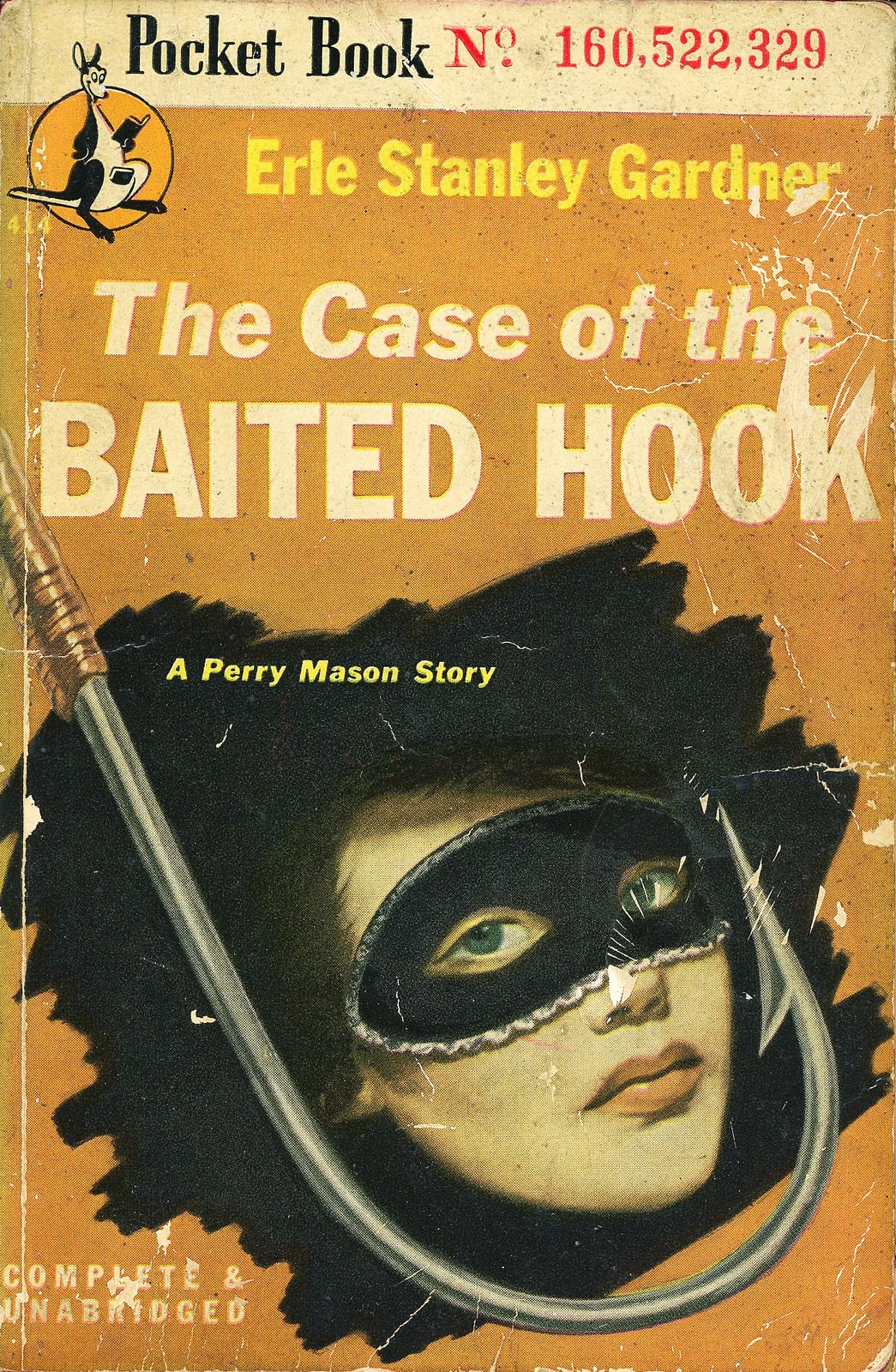
The Case of the Baited Hook (1940) marked the sixteenth appearance by Erle Stanley Gardner's scheming and manipulative defense attorney, the inimitable Perry Mason, since the series' inception in 1933 and begins when Mason is summoned back to the office by a late-night phone call.

Perry Mason is soon joined by Robert Peltham and a masked woman, completely garbed in an omnipresent, buttoned up raincoat, and Peltham wants her protected from a problem that will probably be all over the news papers the following day – without revealing any vital details of the case. For example: the identity of the masked woman. However, Mason takes the unknown case with an anonymous co-client and receives one-half of a severed $10.000 bill, which he'll receive in full when the woman reveals herself to him by giving the other half of the bill.

Meanwhile, there's another, more assertive, clientele waiting for Mason and Mrs. Trump's problem concerns the welfare of a now grown orphan, named Byrl Gailord, who lost her parents, Russian refugees, when the boat they were on was torpedoed in 1918. Mrs. Trump whisked the girl away and funded her stay in an orphanage home, but they sold Byrl regardless of the funding that was still coming in. Byrl's "mother" remarried after the death of her "father" and when her "mother" passed away, the trustee became her stepfather, Albert Tidings, which doesn't sit well with Mrs. Trump – and not without reason. Tidings' body is found in the bedroom of his bungalow, shot in the chest, without his shoes and lipstick smudges on his face. And thus the plot-threads begin to converge.

I guess one of the allures of the Perry Mason series, outside of the courtroom antics and shenanigans, remains the involvement of Mason himself in the cases and actively trying to influence the course of events – instead of just following them to their conclusion. Mason is always up to something and the reader is (usually) right there to witness it. The first thing Mason does after the phone call in the opening was getting in contact with his private-eye friend/business associate, Paul Drake, to call in a stake out of the street and trace license plates, but Mason really shines when he's treading on thin ice. In one instance, Mason resorts to purse snatching and turns the table on the poor woman when a police officer tries to intervene or when's putting the legal screws on an unwilling witness. There was also a collision between the scheming lawyer and the buffoonish Sgt. Holcombe, in which Mason is threatened to be arrested on the moment The Clarion is about to come with breaking news. Mason's commentary on possible headlines and editorial comments on his arrest were amusing, to say the least, and were reminiscent of the some of the verbal exchanges between Nero Wolfe and the always fuming Inspector Cramer.

As par of the course, The Case of the Baited Hook is a densely plotted affair and I have noted before that lesser, second-string mystery writers could probably have padded several novels with the amount of material Gardner packs into a single story. Interestingly, the manipulation of time was a recurring motif in The Case of the Baited Hook and surfaced in several of the plot-threads – hence the opening quote. Only downside was that there were perhaps too many fingers in the pie to create the kind of case that baffled even Mason for a large segment of the story.

It is, nevertheless, admirable that Gardner's name on a book cover is almost a hallmark guarantee of quality that the detective story you're about to read has an actual plot. Even if it makes those cursed things sometimes difficult to review. 

Previously reviewed in this series: 

The Case of the Baited Hook (1940)
The Case of the Empty Tin (1941)
The Case of the Drowning Duck (1942)
The Case of the Drowsy Mosquito (1943)
The Case of the Lonely Heiress (1948) 

7/14/13

A Matter of Wills


"A murder case is simply a jigsaw puzzle, a lot of things to be put together. If you have the right solution, all the parts fits into the picture. If some of the parts don't seem to fit, it's a pretty good indication you haven't the right solution."
- Perry Mason 
Some words before delving into Erle Stanley Gardner's The Case of the Lonely Heiress (1948) on my previous post, "Scattershot: Hoch, Line and Sinker," in which I discussed three short-shorts by Edward D. Hoch and another small nugget from Richard Curtis – whom I presumed was Richard Deming. I received a few emails from former Jury Box reviewer Jon L. Breen pointing out that the attribution of the Odds Bodkin stories to Deming is probably incorrect:
"As for Richard Curtis's stories for EQMM in the 1970s, the first one (not an Odds Bodkins) from the November 1961 issue has a bio that makes clear this is the young literary agent, just starting his writing career. Thus, I doubt they'd have another writer using the same byline after that, leaving only the possibility that Deming became a ghost for Curtis, which seems highly unlikely, besides which there's no evidence for it."
So there you have it. In a age where High-Definition snapshots of the surface of Mars can be conjured up with a simple click or a swipe the internet is still about as useful as a self-inflicted gunshot wound, if you happen to be looking around for scraps of background information on a little-known magazine writer from the 70s. Welcome to the niche corner! Oh, well, I want to thank Jon Breen for rectifying this mistake and I'll correct my post in regards to that short story as soon as possible with a link back to this explanation.

The Case of the Lonely Heiress opens with a visit from Robert Caddo, driving force behind an irregular published pamphlet, circulated for twenty-five cents per copy under the title Lonely Hearts Are Calling, who has come under scrutiny after accusations of placing false ads to boost sales. One ad in particular stands out, "Miss Box 96," a self-described heiress and that's not the type of person that usually subscribes to these kinds of services – especially in those days. Perry Mason and Della Street begin to compose love letters to the mysterious heiress, while their private-eye chum Paul Drake provides a detective to play the part of a lonely country boy looking for companionship in the big city.

This is a Gardner novel, however, and if you think this was going to be story about Mason and Della Street stalking a "Black Widow" in the Lonely Heart columns of an obscure city rag, while trying to unsnarl her web of lies – than you're dead wrong. Mason does bait a trap for Marilyn Marlow, but she ends up being his client after explaining her reasons involving a disputed will that made her an heiress. I have to point out here that this portion of the story describes something that’s known today as Cat Fishing: "It's quite the thing for pranksters to buy copies of the magazine, write that they're lonely widowers with large fortunes and good automobiles and things of that sort, and build up a correspondence with some of these women, simply for the purpose of a practical joke." If this line is actually an unedifying tidbit of digested history, instead of something Gardner made up to flesh out the story, there's a chance that there are still old prank letters out there fooling people who read them into thinking they stumbled to their grandmothers embarassing secret ("Mom mentioned Granma had a pep in her step a year after Granpa died.") It's also an iron-glad argument that computers surpassed us the moment we plugged the cord of the first prototype into a wall socket.  
 
Anyway, the second half is a cat-and-mouse game between Mason and Lieutenant Tragg of Homicide, who becomes involved after one of the witnesses to the contested will is stabbed to death, and fancies Marlow as his #1 suspect – which Mason has no shortage of objections to! Mason and Tragg try to score one of each other until they appear in court and while Mason sometimes (read: standard practice) takes liberties with the law, it's the Tragg who goes into the deep end by participating in "third-degreeing" Marlow with a nasty play on the good cop/bad cop routine. I think this is what makes Mason's behavior much more acceptable to readers than Tragg's, because the former doesn't pretend to be charming, straight-laced cop sneakily measuring someone's neck for a noose – based on an incorrect interpretation of the evidence. 

In summation, The Case of the Lonely Heiress was as readable and well plotted as the other Perry Mason cases previously discussed on here, which were not landmark works in the genre, but I never put one back on the shelf feeling disappointed or cheated. They are what they profess to be: detective stories.

On a final note: I picked this opening quote from the end of the book because it happened to be so similar to something Mason said in the previous story I read, and used it to start of that review with.

6/6/13

A Duck's Tale


"When you once get the correct master pattern, every single event fits into that pattern. It dovetails with every other event which impinges upon it. When you get a master pattern which seems to accommodate all of the events except one, and you can't make that event fit in, it's pretty apt to mean that your master pattern is wrong."
- Perry Mason 
The infamous courtroom conjurer, Perry Mason, has an admitted lack of interest in routine cases, but suspects that the problem that's bugging John L. Witherspoon has some points of interest – revolving around a murder presumed to have been solved and the murderer was hanged by the neck twenty years previously. And that's the premise of Erle Stanley Gardner's The Case of the Drowning Duck (1942).

John Witherspoon is a wealthy patrician who prefers that the ancestry of his future son-in-law can be traced back to the passengers aboard the Mayflower, which becomes a problem when Marvin Adams, the love interest of his daughter Lois, turns out to the be son of a convicted murderer. Marvin's mother always kept this a secret and Witherspoon wants Mason to pore over the transcript of the trial to see if there's any room for rehabilitation, if not, he's adamant to break up the engagement. Even if he has to put Marvin in a position that brings his inherit, homicidal tendencies to the surface. 

As to be expected from a Perry Mason novel, the plot buzzes with activity and quivers along multiple lines, which includes an extortion racket, a Hollywood scandal sheet and a shady private investigation firm – alongside the imagery of a drowning duck. There's no mystery how a duck can loose the ability to float on the water in this book, it's a new chemical known as a detergent, that affects the oily substance that helps them water proofing their feathers. Marvin is a keen young man interested in chemistry and psychics, who performed the experiment with the detergent and a duckling. And that forced Mason to adjust the evidence when stumbling upon a present-day crime scene.

Leslie L. Milter was one of the private detectives who worked for the firm Witherspoon hired to dig around in Adams' past, but when Mason and Officer Haggerty entered Milter's apartment they find his body sprawled on the kitchen floor – dead after apparently inhaling a whiff of deadly gas. But even more noteworthy is the aquarium, in which a duck was so far submerged that only part of its head and beak was sticking out of the surface while struggling not to drown.

A huge chunk of the fun in these stories is derived from Perry Mason manipulating and scheming his way through a murder case, from altering evidence at the scene to bending witnesses to his hand, which is arguably even more fun to read than his court room shenanigans. At least, I think so, because every action Mason undertakes usually has an opposite reaction, giving you the idea of a mental chess game. Perry Mason’s job is not just to provide an answer at the end of a story, but to move the entire plot to that destination. If that makes any sense.

There's a second murder that follows a pattern that has been rather prevalent on this blog: accidently finding (minor/borderline) locked room mysteries that were never recognized as impossible crimes. A second man is poisoned with gas in a room that was not locked, but the personal situation of the victim ruled out suicide and the trained police dogs patrolling the ground eliminated any outsiders – leaving John Witherspoon as the sole suspect and soon finds himself in the same circumstances as Marvin's father all those years ago.

Unfortunately, the solution to this second murder was under whelming to a locked room enthusiast like myself, however, it was only a cog in the wheel of a bigger story that, if not the best Mason novel I have read to date, was still a good read. Plot-wise, it was in search for a better second-half, but overall, not a bad read.  

Other Perry Mason novels I have reviewed:

The Case of the Empty Tin (1941)
The Case of the Drowning Duck (1942)
The Case of the Drowsy Mosquito (1943) 

11/18/12

Undermining the Law


"Sometimes we have to stand on our heads in order to see things the right-side up."
- Hadji (The Alchemist)

The last time I attempted to critique a Perry Mason mystery, The Case of the Empty Tin (1941), I ended up churning out an elongated synopsis of the plot, but only because they’re complex, plot-driven stories and discussing them past the first quarter of the book without giving anything away is very difficult. No – it's nigh impossible to do!

The Case of the Drowsy Mosquito (1943) poses a similar problem, in which Perry Mason takes on a case with enough angles to fill a small, bedside book stand – except that it's crammed between the covers of a single paperback. It all begins when "Salty" Bowers, who has the appearance of a distinguished tramp in a sun-faded suit, asks Mason to meet his long-time friend and mining partner, Banning Clarke, who was physically unable to come himself after suffering a heart attack. Upon meeting Clarke, the plot thickens... considerably!

Living and recuperating on the stretch of land behind his house, amidst the cactuses and shrubs, the mining engineer asks Mason to intervene in a scheme involving his mining company (and a legendary gold mine lost in the mists of time) and take on a fraud case that he's bound to lose, but these are just but a few threads in the rich tapestry of this plot.

Clark's in-laws, Lillian and her son James Bradisson, a cocksure and conceited president of the mining corporation, who fancies himself a business genius, become sick from arsenic poisoning. Live-in nurse Velma Starler is shot at by a prowler and hears the drowsy mosquito. Even Mason and his secretary Della Street are poisoned! The poisoning subplot is worked out alongside the other problems, intertwining here and there, showing that Agatha Christie wasn't the only name in the game that knew how to properly utilize that stuff. As a matter of fact, these poisonings could've easily been presented as impossible situations to beef up the plot even further, but then again, that might have been overdoing it just a bit. But it's cleverly done and even provides an interesting legal problem when Banning Clarke is murdered when he was already minutes, perhaps even seconds, away from succumbing to a lethal dose of arsenic poison. So who do you charge with murder? The person who administrated the arsenic or the person who pulled the trigger?

Like in the previous case I reviewed, Perry Mason functions more as a slick, manipulative private detective than as a crafty attorney with a penchant for courtroom theatrics, however, we do get a glimpse of the courtroom technician in the fraud case – turning the tables on everyone and takes James Bradisson and his lawyer down a peg or two.

But the most notable aspect of The Case of the Drowsy Mosquito is the desert setting and how the plot is build upon it. Somehow, it reminded me of one of Gardner's Sheriff Bill Eldon stories, "The Case of the Runaway Blonde," collected in Two Clues (1947), set outdoors and the vast expanse of ground are very important to the plot, but for completely different reasons. In another way, it also reminded me Clyde B. Clason's Blind Drifts (1937), which also involves "shenanigans" within a gold mining company, but where Clason was interested in technical side of the business, Gardner only concerned himself with the legal aspects of it.

All in all, an excellent read and The Passing Tramp should consider packing a few Perry Masons in that red handkerchief of his, because they've got enough plot on their spines to keep any mystery fan from feeling hungry.

4/6/12

A Can Full of Criminal Intent

"If there were no bad people there would be no good lawyers."
- Charles Dickens. 
Erle Stanley Gardner’s The Case of the Empty Tin (1941) opens with a peek behind the curtains of Mrs. Gentrie's home life. The household is homey, domestic and cozy. A tea-kettle whistles a familiar tune on the stove, mending work is loitering in a basket and her family gives the place the buzz of life. A charming and tranquil domestic scene, which takes a turn for the worst when Mrs. Gentrie finds an empty, unlabeled preserve tin in the cellar with a coded message scratched on the inside and this opens the proverbial can of worms: disturbances in the night-time and shots fired next door – and that's just for starters.

Their next door neighbor and ex-gunrunner, the wheelchair bound Elston A. Karr, enlists Perry Mason to keep him out of this mess and clean up the shooting incident in the apartment, one floor, beneath him before it becomes a nuisance that interferes with his business – willing to sign his name on the dotted line of a fat, but reasonable, paycheck if he succeeds. But there's one snag: no body! The tenant who lived on the first floor, one Red Hocksley, went missing and only left a few puddle of dried-up blood behind as silent witnesses, but their testimony becomes muddled when the name of his housekeeper, Mrs. Perlin, also finds its way onto the list of missing persons.

It's been so long since I read a Perry Mason novel, that I had completely forgot how fun and sharp they could be.

Mason acts here more as a detective-cum-lawbreaker than as an attorney, which was of assistance in piling up the fun as he diligently exposed hidden relationships, concealed clues and compounds one felony after another as he, for example, neglects to call the police to inform them that he has just stumbled over a body – an unwanted chore he leaves for his private-eye buddy, Paul Drake. There's also a good and amusing scene, in which Mason and his secretary, Della Street, are caught during a not so very legal sneak-and-peek operation (read: housebreaking) and brush the cop off after winning a one-sided game of bluff. However, this has one downside: the case never enters a courtroom and deprives Mason of an opportunity to showcase his legal sleight-of-hand, but hey, you can't have it all.

You could make an argument that its actual weakness is a somewhat contrived plot, but with the recent memories of more than just one dud, ricocheting around in my head, I found myself able to appreciate its intricacies. As convoluted as the plot may be, the clues were all on display and should enable you to catch on to the truth before turning over the final page.

I know this post has more of a resemblance to a brief synopsis than to one of my usual rambles, presented as an in-depth review, but I did not want to ruin any of the plot twists you would encounter for yourself if you ever decide to pick this one up – and I think this demonstrates how variegated the plot really is and how much fun I had reading this story. On the other hand, it  made writing this review somewhat of trial. I really had to drag out the right words for this short piece.  

The Case of the Empty Tin is an engaging mystery with a busy plot that plays absolutely fair with everyone willing to take a shot at whodunit. Because of that, a pretty solid effort from one of the most prolific mystery writers from the previous century.

On a final and not entirely unrelated note: Jeffrey Marks has set-up yet another mystery blog entitled The Corpse Steps Out. Marks wrote several autobiographies of some well-known mystery writer from the Golden Era and at the moment he’s working on a book that tells the story of Erle Stanley Gardner. 

You can also watch and hear Gardner in this black-and-white video clip of the game show What's My Line?