Showing posts with label Freeman Wills Crofts. Show all posts

10/17/21

Six Against the Yard (1936) by The Detection Club

The members of that august body known as The Detection Club, a Who's Who of British Golden Age mystery writers, produced a number of experimental collaborations that, nearly a century later, are still practically unique in the genre's history – which too often get dismissed as mere trifles or curiosities. Sure, the Detection Club collaborations never produced a genuine genre classic, but their experiments are not entirely without merit or interest. 

The Floating Admiral (1931) is a round-robin mystery novel written by no less than thirteen  different authors with each one, like a potluck luncheon, bringing something new and unexpected to the story. An experiment that should have ended in an unmitigated disaster had it not been for Anthony Berkeley's last chapter, "Cleaning Up the Mess," which made it appear as if they had planned the whole thing from the beginning. No mean feat! Ask a Policeman (1933) is not only one of those exceedingly rare crossovers, but a very unique type of crossover in which the collaborating writers exchanged their series-detective characters. So you have Berkeley taking on Dorothy L. Sayers' Lord Peter Wimsey and Sayers getting to work with Berkeley's Roger Sheringham. And they're all investigating the same murder! Something that was never done before or since. Not in our genre, anyway.

Not as experimental, but no less fascinating, is The Anatomy of Murder (1936). A collection of five true crime essays, penned by the likes of Berkeley, Sayers and E.R. Punshon, who shine their light on some infamous murderers and murder cases – such as Henri Landru and the Julia Wallace murder case. So you basically get a handful of mystery novelists who play armchair investigative journalists with real-life murder cases. Funnily enough, the Detection Club published a collection of short stories in which the roles are reversed with a former policeman nipping at their heels! 

Martin Edwards said Six Against the Yard (1936) is an ingenious and perhaps unique "variation on the conventional detective fiction anthology" with a half-a-dozen stories in which club members present their "potentially foolproof murders," but each chapter is followed by an analysis from ex-Superintendent Cornish of Scotland Yard. And it's his task to expose "the flaws in the criminal scheme" presented to him. A true battle-of-wits pitting theory against practice! Yes, I'll be keeping score throughout the review. 

Margery Allingham is the first in line to take a crack at devising the perfect murder with "It Didn't Work Out," a theatrical mystery of sorts, in which she kind of casts herself in the role of murderer, but not as Margery Allingham, the mystery writer – assuming the identity of a stage actress, "Polly Oliver." The story plays out over several decades during which Polly has to look on hopelessly as a close stage pal, Louie Lester, who married Frank Springer. A "four-flushing gasbag" with "such an inferiority complex" that "his whole life was spent trying to boost himself up to himself." And "the more weak and hopeless and inefficient he saw himself the wilder and more irritating his lies became." Over the years, decades even, he tore down his wife career and spirit. Until, many years later, they become lodgers of the now elderly and retired Polly who started her own boarding house. Polly decides enough is enough with Frank's charming personality and circumstances presenting her with an opportunity to stage a fatal accident.

Ex-Superintendent Cornish admits that Allingham's murder is "diabolically ingenious" and under favorable circumstances can be completely successful, but he can't be sure whether, or not, the murder truly represents a perfect crime. Because there are some avenues for the police to pursue. However, Cornish only gives a possible outcome of a more thorough police investigation, which depends the mentally unbalanced murderer confessing, but the altruistic motive and method would make securing a conviction a Herculean task. Cornish points out that a successful murder could emboldening Polly "to stage another apparent accident" when another situation arises that convinces her murder is "a reasonable and laudable act." But that's mere conjecture. So Allingham takes the first point for the Detection Club. TDC vs. Cornish: 1-0.

The very cheeky Father Ronald Knox presented with "The Fallen Idol" the most striking, unusual and non-inverted story of the bunch with a Ruritanian murder plot in Latin America. Somewhat reminiscent of Roger East's Twenty-Five Sanitary Inspectors (1935). Enrique Gamba, the Inspirer of the Magnolian Commonwealth, who emerged victorious from a coup and rules over the country with his right-hand man, General Almeda, but unpatriotic messages and threats are circulating the capitol city – promising to burn down Gamba's house with him in it. All of these threats were signed by "The Avenger." There's a fire at the house and Gamba is killed, shot through the head, before his body is flung out of an open window. Colonel Weinberg, the Chief of Police, has the unenviable task to find out who, how and why, which is a hazardous undertaking in a country like Magnolia. Fortunately, ex-Superintendent Cornish is in the luxurious position to not having to take the tinderbox politics of the country into consideration as he explains his case against the murderer and what probably happened after Knox ended the story. A very convincing account that evened the score. TDC vs. Cornish: 1-1.

So the previous story took place in an imaginary, cloud cuckoo-cuckoo land in South America, but Berkeley's "The Policeman Only Taps Once" imported a hardboiled confidence trickster from the United States to Jolly Old England. Eddie Tuffon managed to keep his record spotless, but the place was getting too hot and decided to go to England to give the marriage swindle the good old college try. A huge mistake! Eddie managed to get himself tied to an enormous, square-faced woman with numerous chins, Myrtle, who constantly bosses him around. Nor is she as rich as he had hoped. Myrtle constantly reminded him that her income is hardly enough "to keep an able-bodied husband in idleness" to the point where he "pretty near slugged her once or twice." Eddie comes to the conclusion that she has to go, but, even in an inverted mystery, there's always room for one of Berkeley's trademark twists. Unfortunately, Cornish points out in his analyses of the story, entitled "...And Then Come the Handcuffs," that Berkeley was "more successful in his clever and amusing parody of the new manner in American fiction than in his 'perfect murder''"– "ingeniously as he has worked it out." The twist in the story could very well end up being the one that tied the hangman's knot. Although he does admit that his case purely rests on a heap of circumstantial evidence, but, if there is enough of it, "circumstantial evidence is just as deadly as direct testimony." TDC vs. Cornish: 1-2. 

Russell Thorndike is a new name to me who warrants further investigation, because "The Strange Death of Major Scallion" is easily my favorite from this collection. Such a well written and imaginative story in which the narrator tells the reader about his intention to kill his cousin, of sorts, the titular Major Scallion. A "fat, full-blooded, loud-voiced, bearded and young" man full of conceit, self-satisfaction and tall tales who likely never served a day. Major Scallion has a hold over the narrator which he handily uses to make a claim on his purse and hospitality. Nothing more, nor less, than blackmail. Slowly, the narrator's disgust turned into a cold, terrible hatred and began "a close study of murder as an art" to concoct the perfect method to avoid scaffold. Interestingly, the murder that inspires the narrator comes from an account of Thorndike's anti-hero series-character, Doctor Syn, who's an 18th century parson and smuggler. He even name drops his off-page opponent ("that other enemy to murder, Mr. Cornish"). Eventually settling on a seemingly ingenious method involving Major Scallion's excessive smoking habit, homemade nicotine poison and "a sinister family of house beetles." Regrettably, for our narrator, the method is full of holes and you don't need Cornish to spot the fatal flaw that will deliver him into the capable hands of the public hangman. TDC vs. Cornish: 1-3.

Dorothy L. Sayers returns to the theater setting with "Blood Sacrifice" as a young playwright, John Scales, finally gets his big break when a well-known actor-manager, Garrick Drury, decides to put on his play, Bitter Laurel – which was intended to be cynical and shocking play. Drury slowly reshaped the play into something "revoltingly different" that appealed to the masses and not without success. Scales even wrote the new scenes and lines himself, because "his own lines would be less intolerable than the united efforts of cast and producer to write them for themselves." This killed him on the inside as his name is now associated with sob-stuff and ruined his reputation with his artistic friends, which made him think of murder. However, the inevitable death of Garrick Drury wasn't a premeditated murder or even an act in the heat of the moment. Drury was send flying through a shop window by a skidding car and cut an artery in his arm, which required a blood transfusion to safe his life. So while the doctor and ambulance men try to safe his life and test everyone to find the right blood group, Scales notices the test plate get mixed up. Drury likely got a deadly blood transfusion, or did he? Not even Scales is entirely sure what he saw, but he kept his mouth shut.

Ex-Superintendent Cornish admits he "could not hope to prove, either to a jury's satisfaction or to my own, that John Scales was guilty of the crime of murder," but points out that "neither could any other detective." Not even that distinguished amateur, Lord Peter Wimsey, because Sayers had "failed to establish the fact of murder." There's a case to be made that Scales is morally guilty, but nothing that can be brought home unless the police can prove that he knew the test plates were mixed up and said nothing. Something that's next to impossible. So, in spite of Cornish's objections, Sayers scored a much needed point for her team. TDC vs. Cornish: 2-3. 

Freeman Wills Crofts has the opportunity to end this battle-of-wits in a draw with his contribution, entitled "The Parcel," which is as simple as it's technical tricky and comes with a diagram of the murder weapon. The premise of the story is practically identical to Thorndike's "The Strange Death of Major Scallion" in which rehabilitated, one-time criminal, Stewart Haslar, returns to England with a wife and a modest fortune that he made when he sold his Australian chain of fruit stores. Only person who knows his real identity and past, Henry Blunt, returns to impose on Haslar's generosity. After nearly two years, Haslar comes to the conclusion Blunt has to go and devices, what he thinks, is a bombproof plan by sending his blackmailer a homemade explosive over the mail. A plan hinging entirely on the assumption that there's no traceable link between Blunt and Haslar, but, as Cornish pointed out, Blunt is unlikely to have covered his tracks as thoroughly as Haslar, which is one of the many paths the police can investigate in this murder – slowly building a complete case to present to the judge and jury. And "there is little doubt what the verdict will be." TDC vs Cornish: 2-4.

The 2013 reprint edition of Six Against the Yard closes with an afterword, or rather an introduction, to a 1929 true crime essay by Agatha Christie, but the only reason it was included was to emblazon her name on the cover. Why not include her own perfect murder story, “Wireless” (1926), with an analysis from a modern police inspector, or forensic detective, to show how the police could have brought the killer to justice. That would have given them a legitimate reason to plaster her name on the cover. Now it borders on false advertisement. Anyway, the introduction to the essay ended with this bummer of a line, "sadly, Superintendent Cornish, who died on 6th February 1959 at the age of 85, is unavailable for comment..." A salute to you, Superintendent Cornish! You were no Lestrade!

So, all in all, the Detection Club lost rather badly here with four of the six ending up in the docks, but the end score could have easily been flipped around had Berkeley and Knox showed off their plotting skills instead of their storytelling abilities. Nonetheless, I enjoyed these stories tremendously and particularly Cornish picking them apart that showed the police has one critical advantage over the amateur criminal: a ton of experience. Highly recommended! Particularly to mystery readers with a fondness for the inverted detective story.

11/27/20

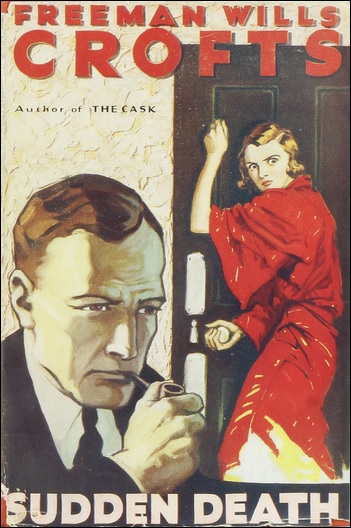
Sudden Death (1932) by Freeman Wills Crofts

This year, the Collins Crime Club imprint, of HarperCollins, reissued six long out-of-print novels by Freeman Wills Crofts in two batches of three with the second batch comprising of Mystery on Southampton Water (1934), Crime at Guildford (1935) and the novel that has been on my wishlist for ages, Sudden Death (1932) – which is Crofts' take on my beloved locked room mystery. Inspector Joseph French has build a reputation on being "invariably sceptical of alibis" and breaking them down with painstaking work and dogged determination. Sudden Death demonstrated French is as adept at tearing down locked rooms as he is at disassembling faked alibis with no less than two impossible murders coming his way!

Sudden Death also showed Crofts could be more, if he wanted to be, than a plot-technician with the story's viewpoint alternating between French and a young woman, Anne Day.

Anne had spent most of her early life in an old Gloucester parsonage attending her reclusive, scholarly father, Reverend Latimer Day, but when he passed away, she was left homeless with "an income of barely thirty pounds a year" – only lucky enough to find a job as a companion to an elderly lady. But when she died, a then 28-year-old Anne was forced back to the registry offices of London with no special qualifications while "shoes and gloves, and latterly even food and lodging" becoming "more and more hideously insistent problems." One day, Anne is offered a position in the home of Severus Grinsmead to help his sick, semi-invalid wife, Sybil, run the household. A well paid position with a very generous advance. Naturally, not everything is as rosy as it seems.

Surprisingly, coming from Crofts, there's a hint of The Had-I-But-Known School in the opening chapter with the line "had she known all that awaited her at Ashbridge," she "might well have drawn back in dismay" from "the agonies of fear and horror and suspense which she was fated to endure with the Grinsmeads."

Sybil is a sickly, cold and deeply suspicious woman and it takes Anne some time to gain her confidence, but she didn't need it to understand that the relationship between husband-and-wife resembles that of an armed truce between two hostile nations. Sybil is aware her husband is having an affair with the local grass widow, Irene Holt-Lancing, which convinced her that they want her dead and biding their time for the right moment – ensuring Anne there will be an accident or "it may look like suicide." Puzzling, Anne becomes privy of evidence and information both confirming and contradicting Sybil's deadly fears. I think False Impressions would have been a better title than Sudden Death, because it fits so many aspects of the plot and story.

Nevertheless, not everything is laden with impending doom or suspicion. Anne comes to find out that the governess to the Grinsmead children, Edith Cheame, shares a similar life story to her own and that Severus Grinsmead's mother is not quite as stiff or censorious as Sybil made her out to be. She also strikes up a friendship with the children and gets on with the chauffeur/gardener like a house on fire. So she could almost forget her employers unhappy marriage, infidelity and suspicion, but that all changes one morning when Anne went to her bedroom to bring her tea. Anne's knocking remained unanswered by the invitational click of the electric, push-button operated bolt. She then noticed that there was "an odd smell of gas" in the corridor and quickly realized "gas was simply pouring out" of the keyhole of Sybil's room. A hammer and chisel were needed to demolish the lock and open the solid door, but help had arrived too late. Inspector Kendal, of the local police, goes over the room with a fine tooth comb, but finds "an enclosed affair" that "you couldn't very well temper with." So concludes it was a suicide and that's the verdict at the inquest.

There are, however, some minor details bothering Kendal and Scotland Yard assigned Inspector Joseph French to the case to go over all the details again and give them a second opinion. I suppose this is where people who dislike Crofts will very likely stop liking Sudden Death.

Crofts tried to write a novel of character (singular) with Anne Day as in the lead during the first third of the story, but French's thorough and painstaking investigation of the locked room problem proved his heart lay with the nuts and bolts of the plot – coming up with a number of ways to gas someone behind a locked door. My fellow impossible crime enthusiast and Crofts aficionado, "JJ” of The Invisible Event, suggests in his review that "dazzling array of options" can be counted as "a Locked Room Lecture that predates that of The Hollow Man (1935) by John Dickson Carr," but Crofts is "less showy" about it. For once, I've to agree with JJ. Crofts doesn't break the fourth wall to acknowledge the reader and it's not presented as a lecture, but it can be read as a proto-Locked Room Lecture. Something that will no doubt please anyone with a special affinity for impossible crime fiction.

Another thing that occurred to me while reading is Crofts might have created the most convincing and believable of all so-called fallible detectives. Anthony Berkeley usually made an ass out of Roger Sheringham (e.g. Jumping Jenny, 1934) and Ellery Queen too angsty (e.g. Ten Days' Wonder, 1948), but Crofts created a competent, intelligent and imaginative Scotland Yard inspector, which are admirable qualities, but they come without cast-iron guarantees of success attached to them. French is not an enigmatic detective who can deduce the truth from a bowl of daffodils or the curious incident of the dog in the nighttime, but he does use the Sherlockian inspired method of rejecting the impossible and "see what is left." A thorough, painstaking process of elimination and fine-tuning of possibilities that has many dead ends and constant second guessing whether, or not, he was building his theories on "an foundation of sand." And it was a nice touch by making French sink his teeth in the case with a future chief inspectorship in the back of his mind.

You can, however, argue French came up a little short on this occasion with only a second death preventing a terrible mistake when one of his main suspects committed suicide in a room with all the doors and windows locked, or fastened, on the inside – forcing him to go back to the drawing board and start over again. So how good is Sudden Death as a locked room mystery novel with its two murders-disguised-as-suicides in completely locked rooms? Well, not too badly!
The solution to Sybil's murder in her locked bedroom is, to my knowledge, original and don't believe it has been used since, but, as you can probably guess, the trick is a technical, semi-mechanical nature. Not everyone is going to like it. The solution to the second impossibility is an old dodge of the locked room story, but it was put to good use and provided the story with a last clue to the murderer's identity. So, on balance, Sudden Death is not a classic of its kind, but as a good and solid take on the impossible crime novel. And not one that should be solely judged on the content of its locked rooms.

Crofts was one of the often maligned, so-called humdrum writers who were more interested in the how than the who-and why, which means that their murderers tend to be easily spotted. I wrongly assumed that the case here, but the murderer and motive were cleverly hidden with "the closed room as a blind." Crofts knew what makes a sound plot tick and that makes it the more baffling he left a small aspect of the first locked room murder unexplained. I can accept that from a mystery writer who's more interested in character or storytelling or a second-stringer, but the Chief Engineer of Crime should have known better and it seriously detracted from, what would otherwise have been, the best Inspector French novel to date. Now I have to reluctantly place it slightly below The Sea Mystery (1928), Mystery in the Channel (1931) and The Hog's Back Mystery (1933).

Omission not withstanding, Sudden Death is a fine piece of old-fashioned, Golden Age craftsmanship and it was fun to see the master of the unbreakable alibi apply himself to the locked room mystery while dabbling a little in domestic suspense and HIBK. Sudden Death shows Crofts is as deserving of being revived as he was undeserving of his old reputation as the writer who cured insomnia. Now all I want is a reprint of Crofts' second locked room novel, The End of Andrew Harrison (1938), but until then, my next stop in the series is probably going to be Sir John Magill's Last Journey (1930). So stay tuned!

6/30/20

The Hog's Back Mystery (1933) by Freeman Wills Crofts

Freeman Wills Crofts was one of the earlier Golden Age mystery writers and he was among the first whose work was resurrected in the early 2000s, courtesy of House of Stratus, before slumping back into obscurity again – until fifteen years later when the British Library Crime Classics and Collins Crime Club began reissuing his work en masse. Collins Crime Club is going to publish six more long out-of-print titles in Crofts' Inspector French series concluding in September with the reprint of his eagerly anticipated locked room novel, Sudden Death (1932).

So I wanted to remove one, or two, older reprints from my to-be-read pile before adding new ones to it and decided to finally take a shot at The Hog's Back Mystery (1933). One of those simon-pure jigsaw puzzle detective novels with a plot that, sort of, flirts with the impossible crime story.

The Hog's Back Mystery, published in America as The Strange Case of Dr. Earle, takes place in "the heart of wild Surrey," with "the spine of that curious narrow ridge known as the Hog's Back" in the background, where the retired Dr. James Earle settled down with his wife, Julia, in a typically English cottage – all around it was the woods. Giving the cottage that it might be "the only dwelling in the world." This where the Earles have decided to life a quiet, docile existence with Dr. Earle working on his manuscript on germ cultures and Julia buzzing around the place doing the household chores.

So, to liven up the place a little, Julia invited two guests to spend a short holiday at the cottage. Marjorie Lawes is Julia's unmarried sisters who lives most of the year abroad and churns out reams of sentimental love stories as a living. Ursula Stone is their childhood friend and the honorary secretary of a children's hospital in Bath, but she's the one who discovers that there was no love between James and Julia. They merely tolerated each other "in the spirit of trying to make the best of a bad bargain." What's more, Ursula discovers that Julia is probably involved with her next door neighbor, Reggie Slade. And even the mild, elderly James seems to be involved with a much younger woman dressed entirely in gray. This little, dime-a-dozen domestic intrigue turns out to be foundation for an extraordinary and baffling string of inexplicably disappearances.

On a Sunday evening, Dr. James Earle was seen sitting, before the fire, with his house slippers on and reading a newspaper, but, three minutes later, the newspaper was on the chair and he was gone – vanished without a trace with no hint of cause or method. Dr. James Earle had been spirited away! The way in which he disappeared was like "seeing the impossible happen before one's eyes."

Granted, the disappearance of Dr. Earle is not exactly an impossible crime, but, as Inspector French soon discovers, the case is as baffling and complex as the most intricately plotted and executed locked room mystery. The first disappearance seems simplistic enough with having to decide whether Dr. Earle had disappeared voluntarily or had been murdered, which appears to be answered when French discovers the woman-in-gray had also disappeared without a trace. French is not satisfied with this answer and the way in which he reasons the pros and cons of the various possibilities showed Crofts had great respect for the intelligence of his readers.

Every possible scenario and lead is discussed, closely examined and followed to its logical conclusions, which, on more than occasion, turns out to be incorrect and the reader is shown, through French's reasoning, why he had been wrong – right down to the last detail. French might not be an eccentric scientist-detective or an amateur reasoner of some celebrity, but his performance here, alone, makes him one of the Great Detectives of the Golden Age. The way in which French tries to get a firm grasp on the problems is a sheer joy to read, if you like your detective stories pure and undiluted with any literary pretensions. The Hog's Back Mystery is an exercise in rationality and stubborn, dogged determination.

Something else to admire about The Hog's Back Mystery is that the central problem keeps developing and expending the number of combinations and possibilities. You won't appreciate the full scope of the problem until a third person vanishes from an upstairs bedroom with people sitting in the room below, but it is this disappearance that provides French with the (physical) clues needed to force a much-needed breakthrough. What he discovers makes him determined to ensure the person responsible will pay "the heaviest penalty that the law allowed."

All of that being, I fear some readers will struggle with the slower, more plodding, final quarter of the story, particularly the last chapter, which hinges on timetables and movements of the suspects used to destroy a sturdy alibi. Don't worry. You're not expected to do any math homework. French is there to walk you through it.

The Hog's Back Mystery is an intelligently plotted and surprisingly charmingly written detective story. A little plodding in parts, perhaps, but I think it helped the story here as you can't help sympathize with French as he continues to plug away at a seemingly insoluble problem using little more than clear, honest reasoning and humanity's famous, mule-headed stubbornness. Needless to say, I loved the result.

4/9/17

Dead in the Water

"Where large sums of money are concerned, it is advisable to trust nobody."
- Andrew Lippincott (Agatha Christie's Endless Night, 1967)
Back in 2015, I finally got around to reading a couple of Freeman Wills Crofts' detective novels, The Cask (1920) and The Sea Mystery (1928), which were excellent and showed the hand of an intelligent, technically-minded and no-nonsense writer – who has been unfairly labeled as a humdrum. I wanted to continue exploring his work, but got distracted by the deluge of reprints mentioned in my previous blog-post.

Luckily, Crofts is one of the authors currently being reissued en masse. Several of his earlier books appear to be in the public domain (e.g. The Pit-Prop Syndicate, 1922), but the British Library and Collins Crime Club have both reprinted a number of titles from the late 1920-and 30s. So far, they've brought back such interesting titles as Sir John Magill's Last Journey (1930) and The Hog's Back Mystery (1933), but there was another title that caught my attention.

Mystery in the Channel (1931), or Mystery in the English Channel, is the seventh book about Crofts plain, but highly competent, policeman-character, Inspector Joseph French. What attracted my attention was its tantalizing premise.

A cross-channel steamer of the Southern Railway Company, Chichester, passed the halfway mark on their journey through the English Channel when they came across a motionless yacht. The name of the vessel is the Nymph and as they come nearer to the boat they see a man "lying in a heap on the deck." Upon closer inspection, the crew members of the steamer discover that there are two dead men aboard the pleasure yacht, shot through the head, but are unable to locate a gun – eliminating the possibility of a murder-suicide. So one of the crew members is tasked with sailing the "rich man's toy" back to England and handing the floating crime-scene over to the authorities.

The victim's are quickly identified as Paul A. Moxon and Sydney Deeping, the chairman and vice-chairman of Moxon's General Securities, which finds itself at the center of a financial disaster when they become unable to meet its liabilities. The total deficit is believed to approach eight million pounds, left thousands ruined and according to the newspapers "the tale of disaster is not yet complete." And they weren't wrong.

Bryce Raymond and Joshua Esdale, a third partner and chief accountant, are nowhere to be found, but they're not the only ones who are unaccounted for: a large sum of cash money, "a million and a half sterling," have disappeared from the company's strong-room – which makes for a pretty bundle of trouble.

Inspector French goes about his task with dogged determination and shrewdly reconstructed what roughly happened aboard based on blood-stains and a pool of blood. Equally impressive is chapter nine, titled "Distance Over Time Equals Speed," in which French reconstructs the movements of the various vessels involved and tries "to fix the point of the murders." Something he calls Point M. By the way, I think that would have been a better title for the book than the more mundane and less imaginative Mystery in the Channel.

Anyway, the investigation is not a solo performance on French's part and his success depends on the large, sprawling police apparatus of two countries.

As an overseas colleague said to French, "this is no longer a job for one man," but "a case for the organization" that could field hundreds, or even thousands, of men to follow up on every single lead. Crofts eagerly gives his readers a glimpse of the machination of these organizations and assigns various policemen to such background tasks as following "a trail of numbered banknotes" or trying to locate one of the missing men, which is painstaking work stretched out over several weeks – one throw-away remark revealed the case had been dragging on for six weeks.

So you can say that this series, particularly this title, is an early predecessor of the modern police procedural, but the plots are unquestionably a product of their time (i.e. pure Golden Age). The devilish clever and twisted plot here was unraveled by slow, determined police work, but carries all the hallmarks of a vintage detective novel and a notable aspect of this was the pool of blood aboard the yacht. French's first conclusion proved to be not entirely correct and emerging evidence showed there was a second explanation for what, initially, seemed fairly straightforward. Just what you'd expect from a classic mystery novel from the early 1930s!

I also loved the fiendishly clever, slightly technical, but ultimately simple, alibi-trick of the murderer. Or how the explanation has answers to the questions I began to ask myself while reading the book. Like why didn't the murderer threw the bodies overboard and scuttled the yacht? It would have made it all but impossible for the police to solve the case, but the solution provided a satisfying answer for these question.

I should also point out that Mystery in the Channel, like so many mysteries from the 1930s, was rife with condemnation for the figureheads in the financial calamities that left thousands of people "irretrievable ruined." On several occasions, Crofts gives brief details how people were ruined (e.g. "elderly men, having to start life again. And heaven knows where they'll get jobs."). Such characters as bankers, stockbrokers and financiers were not the most popular characters in the detective-fiction of the post-1929 world.

Apparently, Crofts loved ships and was personally very interested in the inner-workings of large business enterprises, which both come to the foreground in Mystery in the Channel and he erected a first-rate plot around these two pet subjects – in which every piece of evidence and event fits together like a jigsaw puzzle. Crofts may not have been a writer with too many literary pretensions, but he was a plotter of the first water and I should make an excursion to his work more often.

On a final note, I sure hope Sudden Death (1932) and The End of Andrew Harrison (1938) are considered for reprinting in the hopefully not so distant future. So, if any of you publishing people are reading this, you might want to scribble those two titles down.

10/21/15

Soaked in Tragedy


"The cautious murderer, in his anxiety to make himself secure, does too much; and it is this excess of precaution that leads to detection." 
- Dr. John Thorndyke (R. Austin Freeman's The Eye of Osiris, 1911)
Last month, I posted a review of The Cask (1920), which is an early classic from the Golden Age and embarked Freeman Wills Crofts on a career as one of the genre's more technically minded plotters – and was even considered as one of the "Big Five" British detective writers of the 1920-and 30s.

The plot of Freeman's debut novel concerned a cask "sent from France to London" and "was found to contain the body of a young married Frenchwoman." It required the combined efforts of Scotland Yard, Sûreté and the services of a private investigator to prevent the case from being shelved as unsolved.

I quite enjoyed that monument of a crime-novel with its old-world air, but the reason for bringing it up here is that Inspector French mentioned it in The Sea Mystery (1928), in which he observes that his current problem shared some similarities with "a case investigated several years ago by my old friend Inspector Burnley" – who has since retired from the force.

Funny how French's spoiler-ridden comments on The Cask confirmed my initial, unsubstantiated hunch of it being a companion piece to The Sea Mystery.

The Sea Mystery opens on a pleasant, balmy evening in September on the calm, smooth surface of the Burry Inlet, "on the south coast of Wales," where 14-year-old Evan Morgan is spending his last day-off fishing with his father. However, the only thing they managed to catch that day are the remnants of a perfect crime. Or an attempt at one anyway.

What they hooked was a solid, wooden packing crate, which was bare of "any helpful marks," but the same can’t be said for its putrid content: consisting of a horrendously decomposed body of a man, clad only in underclothes, whose features "had been brutally battered in" and "entirely obliterated" until "only an awful pulp remained." The medical-evidence places the crime five to six weeks ago.

Inspector French is faced with a problem that "seems absolutely insoluble," but believes "it is almost impossible to commit a murder without leaving a clue" and a logical, methodical mind, combined with experience, can get you pretty far.

So, first things first, French sets out to reconstruct how the crate got to the bottom of the inlet, which is done with a bit of math and a practical experiment. These first, preliminary inquiries have a pleasant amount of logical, science-based detective work, but there's a potential plot-hole.

Very early on, French determines a crane-lorry was used in the disposal of the crate, which is traced to a motorcar company, who rented out such a machine and they asked for a 300-pound deposit – which was quite a lump of money in those days. But it's never investigated if such a sum was drawn and re-deposit from a bank account around the time the crane-lorry was taken out. Which I assumed would be a rational route to follow in an investigation that, up to that point, was starved for solid, tangible clues.

A second plot-thread is introduced and involves a double disappearance from a location that'll immediately capture the attention and imagination of every mystery reader: namely the desolate, haunted and treacherous bogs and mires of Dartmoor – inextricably linked to Sir Arthur Conan Doyle's The Hound of the Baskervilles (1902).

One night in August, a pair of businessmen, named Charles Berlyn and Stanley Pyke, where on their way back home when their car broke down and they attempted to cross the moors and were never seen again in this world. The well-read, observant mystery reader should note the similarities between the plot of The Stoneware Monkey (1939) by R. Austin Freeman and the theories arising from the possible connections between both cases, which I thought was interesting. But not as interesting as the eventual explanation!

Crofts only provided French with a small pool of suspect to fish in, but managed to drag a clever and classically styled solution from it that was pure Golden Age. It won't leave the seasoned armchair detective god smacked, but they'll admire the well-clued, intricate plot solved by an intelligent and competent policeman – who's nonetheless as fallible and prone to mistakes as you and me.

Which made French more relatable than I expected and permanently shattered the preconceived notion, I once held, of Crofts as a dull, boring writer who had turned detective-stories into math homework assignments. Not the case at all! I'll definitely return to Crofts before too long. I just hope my tired brain has done some justice to The Sea Mystery

Well, I'll be back soon with another review of a vintage, Golden Age mystery.

9/1/15

Packed for Shipping


"We have every hope of clearing the matter up, but we find a little difficulty in getting anything to work upon. We have, of course, wired to the Belfast post-office, but a large number of parcels were handed in upon that day, and they have no means of identifying this particular one, or of remembering the sender."
- Inspector G. Lestrade (Sir Arthur Conan Doyle's "The Adventure of the Cardboard Box," from His Last Bow, 1892)
Since early 2011, I have reviewed a wide variety of detective-and crime fiction on this blog, from Pat McGerr and John Dickson Carr to Louise Penny and Keigo Higashino, but I consider my reading of the genre to be still rather shallow – especially when compared to a scholar such as Curt Evans or a professional fan boy like Bill Pronzini.

You might think that's an exaggeration on my part, but take a look at the authors whose work I have barely touched or ignored altogether.

My bookshelves are entirely bare of any traces of the works penned by Milward Kennedy and Margaret Millar. There's a tiny, largely unread clustering of mystery novels by J.J. Connington, Henry Wade and G.D.H. & M. Cole collecting dust on those very same shelves and the only thing I had read by Freeman Wills Crofts was a short story, entitled "The Mystery of the Sleeping-Car Express," in The Oxford Book of English Detective Stories (1990) – which is embarrassing for an enthusiastic advocate of Golden Age mysteries. Something had to change!

Since you have to begin somewhere, I decided to pick up Crofts' famous debut novel, The Cask (1920), which was written in 1919 "during a slow recovery from a long illness" with a "pencil and exercise book." A revised, more polished version of the draft was published a year later, which sold over a 100,000 copies and was translated in nine languages by the time my edition from 1946 rolled off the presses. The book was a commercial success and cemented Crofts reputation as a (Golden Age) mystery writer.

The Cask is an exuberant, old-fashioned story that takes place between the month's of March and May of 1912, but, stylistically, the book reminded me more of the stories from J.E. Preston-Muddock's Dick Donovan: The Glasgow Detective (collected in 2005) than (lets say) Conan Doyle's post-1800s Sherlock Holmes stories or A.E.W. Mason (e.g. At the Villa Rose, 1910) – even though the story is plotted like a Golden Age mystery.

The Insular and Continental Steam Navigation Company has a cargo ship by the name of Bullfinch arriving from Rouen, France, but one of the casks it was transporting appears to have suffered damage. Sawdust poured from a crack alongside several golden sovereigns. The content of the damaged casket is far less benevolent than the stuff it's spilling: a body of a woman, instead of a statue, and the managing-director of the company personally fetches Inspector Burnley of Scotland to investigate the matter.

However, when they arrive at the docks, someone, somehow, carried off with the burdened cask and the first portion of this three-part structured novel is concerned with finding it again. The makeshift casket disappears a second time over the course of this investigation and the golden sovereigns are possible linked to a 50,000-franc lottery prize, but, overall, this part can be considered as a very long prologue.

A small point of interest from this portion of the book that I have point out is that there's police-constable, named John Walker, who "had read Conan Doyle and Austin Freeman, and other masters of detective fiction, and their tales had stimulated his imagination," and whose heroes he tried emulate – as he "climbed to the giddy eminence of an Inspector of the Yard." I instantly liked this character and namedropping mystery writers would become something of a trope in the decades ahead. 

The second part of the book takes Inspector Burnley to France, where he's reunited with M. Lefarge of the Sûreté, having previously collaborated in the Marcelle murder case, "which attracted so much attention in both countries."

The work both investigators have to do in the second part is closer to classic detective, as we know it, than the first part as they establish the victim's identity and retrace the steps of a couple of suspects, which covers England, France and Belgium – and even Stockholm, Sweden is mentioned. A rigorous testing of alibis is something Crofts build a reputation around and even become something British mysteries were mocked for, but there was nothing tedious about it here. And their work eventually pays off, when they procure the evidence needed to make an arrest and bring the case to court.

In third and final part of the story, a solicitor engages the services of a private detective, Georges La Touche, to go over the evidence and prove his client's innocence, in which he succeeds, but the dénouement shows Crofts was still somewhat inexperienced. 

Freeman Wills Crofts, Professional Plotter

The Cask is, at it’s core, a fairly simple case and the murderer successfully muddled the waters, which is probably when Crofts realized he had plotted himself in a corner and this resulted in a rushed, somewhat forced ending – complete with a confession and an off-page suicide. I think the book would've had genuine status as a classic today if the murderer had laughed in Le Touche's face and wished him luck with proving his case in court, especially as an ending to an old-fashioned, almost charming story, but would such darkness have gone over well at the dawn of the Roaring Twenties?

In any case, The Cask was a successful debut that promised much from its author and the genre it belonged to, which was a promise that was most definitely kept by everyone involved.

On a final note, in the weeks ahead I'll tackle one or two mystery novels by E.R. Punshon. I have (yet) another foreign collection of stories from the East on the pile and I'll finally be tackling a detective novel that gave me serious case of hobby deformation. Stay tuned!