3/29/21

Down On His Luck: "The Silver Curtain" (1939) by Carter Dickson

Mike Ashley's momentous anthology The Mammoth Book of Locked Room Mysteries and Impossible Crimes (2000) introduced John Dickson Carr as the man whose name has become "indelibly linked with the impossible crime story," which is the indubitable truth, but comes with a caveat – since his short stories seldom reached the same heights as his novel-length locked room mysteries. But the keyword there is seldom. 

"The House in Goblin Wood" (1947) is the crown jewel of Carr's short fiction and together with Joseph Commings' "No Bones for Davy Jones" (1953), Robert Arthur's "The Glass Bridge" (1957) and Arthur Porges' "No Killer Has Wings" (1960) among the best dozen short impossible crime stories ever written. "The Dead Sleep Lightly" (1943) presents the detective story as a ghost yarn and demonstrates Carr easily could have been the next M.R. James as well as having one of my favorite lines in all of detective fiction. "Blind Man's Hood" (1937), "Persons or Things Unknown" (1938) and "Cabin B-13" (1943) have similar qualities (ghostly crimes), but for today, I decided to reread one of his most well-known, often reprinted short stories. 

"The Silver Curtain" (published as by "Carter Dickson") was first printed in the August, 1939, issue of The Strand and reprinted in The Department of Queer Complaints (1940), Merrivale, March and Murder (1991) and The Mammoth Book of Locked Room Mysteries and Impossible Crimes, which may have been its most important appearance to date – likely introducing the then long out-of-print Carr to many readers at the time. Our current reprint renaissance was still in its infancy in the early 2000s and it was not until recently Carr began to receive the renewed attention he so much deserves. 

"The Silver Curtain" differs from the stories mentioned above as it has none of the trappings of the ghost story, or even a hint of the supernatural, but an ordinary crime that's misunderstood. And the dark, rainy backdrop gives the crime an almost unearthly quality.

The story begins in a French casino where a young man, Jerry Winton, is having a run of bad luck at the tables, which left him practically cleaned out, but gets an unexpected offer from a man who won a pretty packet at the table. A sleek, oily-faced man, Ferdie Davos, asks if Jerry is interested in making ten thousand francs. Only thing Jerry has to do is go "see a doctor" to get a nerve tonic. Jerry gets an address and instructions to be there in about an hour. When Jerry sets out on his shady assignment, he suddenly notices Davos walking along the dim, rainy street and entering a cul-de-sac with two of its three sides being tall, blank brick walls and the third side formed a tall, flat house – "all of whose windows were closely shuttered." There was nowhere to go, or hide, but in "the second's space of time" it took for Jerry to glance back at "the figure of a policeman some distance away," someone killed Davos. A dying Davos is lying on the pavement with a heavy knife in the back of his neck and clutching a well-filled wallet. Even worse, Davos had been all alone in "an empty cul-de-sac as bare as a biscuit-box" and the position of the knife convinces the policeman Jerry killed the man during an attempt to rob him.

So the situation doesn't look very good for our young hero. Luckily, Colonel March, of Scotland Yard, happened to be in France to help investigate "a certain form of activity" that has "became intolerable both to the French and English authorities," which dovetailed with the impossible murder in the cul-de-sac. Colonel March more or less acts as deus ex machina as he doesn't enter the story until the last few pages. What he does is pulling out all of the relevant clues from his coat pockets, "with the air of a conjurer," which spells out a very clever and satisfying explanation to the seemingly impossible. A solution clearly showing just how much of an influence G.K. Chesterton was on Carr's work and perhaps it would have been better had Dr. Gideon Fell been the detective. But other than that, I've no complaints. 

"The Silver Curtain" is a vintage, snack-size impossible crime story and can be counted among Carr's half-dozen best short stories. Recommended!

3/27/21

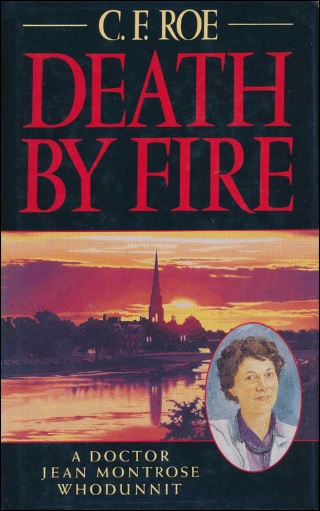
Death by Fire (1990) by C.F. Roe

Dr. C. Francis Roe was a Scottish-born American doctor and surgeon who spend his twilight years making pottery, sculptures and writing medical and mystery novels, which were published during the 1990s under the names "C.F. Roe" and "Francis Roe" – using the former for his eight Dr. Jean Montrose whodunits. Surprisingly, the Headline editions have "A Doctor Jean Montrose Whodunit" on their covers instead of the more common "Literary Thriller" or "A Novel." I guess the series must have enjoyed some popularity during the '90s as the books received multiple reprints under different titles. 

Death by Fire (1990), alternatively published as A Fiery Hint of Murder, is the second novel in the series and jotted down in Robert Adey's Locked Room Murders (1991) as an intriguing case of spontaneous human combustion in a locked house!

Firebugs, or fire-starters, occupy an interesting place in the genre as they rarely figured in pre-war detective novel and short stories. There were fires and arson, but it was usually done to destroy evidence. One such example can be found in my previous review of Gerald Verner's The Clue of the Green Candle (1932), but it was not until the post-WWII era that mystery writers began to see the bag of tricks and plot potential of the firebug. Even then they only appeared in the works of somewhat specialized mystery writers.

John Russell Fearn's Flashpoint (1950) centers on a series of explosions and fires in locked, guarded and otherwise deserted buildings, which is an idea Arthur Porges continued to explore further in some of his short stories like "To Barbecue a White Elephant" (1964) and "Fire for Peace" (1975) – collected in These Daisies Told: The Casebook of Professor Ulysses Price Middlebie (2018). Izo Hashimoto and Tomoshige Ichikawa's 2006, pulp-style manga series Fire Investigator Nanase, not known for its quality art or stories, but "Petals of Envy" has a new and fiery original locked room-trick to offer. A few months ago, I reviewed Shelly Reuben's arson-themed Spent Matches (1996) in which paintings locked away in a secure gallery inexplicably catch fire.

However, those novels and stories concern the destruction of property with "Petals of Envy" being the closest to a case of a spontaneous human combustion, but otherwise, Roe's Death by Fire could very well be the first one to use it in a (locked room) mystery novel. I don't know of any other example. 

Death by Fire takes place in Perth, Scotland, during an uncommonly long heatwave with "the dry, airless heat" oppressing and irritating the Scots like normally only the English can do. Seven miles out of Perth, stands a private boys school, St. Jude's Academy, where boys with parents "who wanted to see as little of their offspring as possible" were sent to, but it's not the "constrictive meanness" of the building that's the problem. It's the horrendous teachers from the hell who work there.

Morgan Stroud, a physics teacher, is despised and hated by pretty much everyone and the opening pages gives the reader an example why so many people could drink his blood. Stroud humiliates a student in class by mimicking his stammer, telling the class his father has fallen behind on the payment of school fees and hurling abuse – calling the boy scum and a "Darwinian reject." So there's more than one reason to treat his death as suspicious when his body is found at his home, torso charred "beyond any kind of recognition," which had two lower legs and hands still clutching the carpet sticking out of the pile of charred flesh – not much else was burned or damaged by the fire. Only thing near the body was a chair with a pile of school essay papers on it, but they're not even singed. There was nothing that could have caused a fire like a heater or gas stove. Even stranger is that the "house is alive with burglar alarms" and protected with "automatic locks on the doors, sensors on the windows" and "under the carpet."

So the local Perth police inspector, Douglas Niven, turns to Dr. Jean Montrose to help him out with the problem, because he can hardly believe there's an actual supernatural element to the case.

The medical background of both the author and his detective-character, I fully expected something along the lines of the previously cited scientific detective stories and writers. Death by Fire turned out to be a modern-day equivalent of a Gladys Mitchell. Well, the classical bits and pieces, anyway, which definitely has a touch of Mitchellian magic and madness. Some of the boys of St. Jude's started practicing black magic to make their hated teacher burst into flames and Stroud's wandering, religious sister, Gwen, believes her brother was "spawned by the devil" and "struck down by a ball of lighting" sent "by the Lord to destroy him." Dr. Malcolm Anderson is the local pathologist and convinced that has an opportunity to examine a rare, but genuine, case of spontaneous human combustion as the body's store of fuel had been inexplicably ignited. He dreams of becoming an instant authority, giving lectures abroad and being consulted by the police as he happily slices "grisly fragments" from the body. There's also a spiritual medium who arrives in town with a ton of media fanfare and predicts "more deaths" and "nothing but trouble here until the weather breaks."

A prediction that provides the story with an ending not unlike the conclusion of Mitchell's The Devil at Saxon Wall (1935), but the most noticeable thing Death by Fire has in common with Mitchell is that crimes against children are punished mercilessly. But this also introduces a stark reminder that the genre's Golden Age had ended three decades before the book was published.

Stroud turns out not to have been the most reprehensible creature teaching at St. Jude's as a
colleague is revealed to the reader as a dangerous predator with a taste for children and teenage boy, which would have been enough to warrant a second murder – only he also tried to make a buck out of it. Roe made an honest attempt here to find a way to bring the traditional, plot-driven detective story in line with the modern, character-driven and much darker crime novels. But this is the only kind of crime I don't want to come across in any type of crime or detective story. A lighter, modern touch to the story is that Dr. Montrose has a happy, lively family life and peripherally linked to the case as one of her daughter is seeing a boy involved with St. Jude's murders (because, of course).

So, how well does Death by Fire stack up as a detective story and particularly compared to the previously mentioned firebug novels and short stories? It's a bit of a mixed bag.

I already knew what kind of trick was used to make it appear as if Stroud had burst into flames, because I've read about it before and suppose it was less well-known in the pre-internet era. So all my hope was on the locked and burglar-alarm protected house, but the solution to that part of the puzzle was disappointingly simplistic and not very satisfying. Such a premise requires a little more ingenuity in its explanation and something that was more or less promised. Why else was the reader's attention drawn to Stroud's mysterious headaches and the large, ornate mirror? The murderer is easily spotted and you can make an educated guess about the motive.

However, while the solution didn't came as a surprise, or shock, the way in which the whole case is resolved was very well done and Dr. Montrose's private talk with the murderer was everything but orthodox – especially how it ended. Something both fans of vintage and modern crime fiction can appreciate. Because we have all wanted to read those lines (Avpr gurbel. Abj cebir vg). Add to this a fair attempt at clueing and it managed to warm up, what would otherwise have been, a lukewarm, quasi-negative review. It was just enough not to leave me disappointed.

Even if you narrow the scope to '90s mystery novels with a traditional slant, Death by Fire doesn't make it to the top of that pile, but I'e also read much worst novels from that decade. So there's a change I'll try another one, like A Hidden Cause of Murder (1996), if a copy ever comes my way.

I also try to find something good and solid for my next read because the quality has been very uneven lately.

3/24/21

The Clue of the Green Candle (1938) by Gerald Verner

The Clue of the Green Candle (1938) is Gerald Verner's ninth pulp-style detective novel starring his dramatist and amateur criminologist, Trevor Lowe, who's asked to discreetly investigate the strange disappearance of a celebrated mystery novelist, Roger Tempest – considered to be "one of the most ingenious of our detective writers." A mystery writer with "a most amazing capacity for evolving ingenious swindles" and "methods of robbery," but the opening lines of the story has him dictating a locked room mystery for Fiction Weekly to his secretary, Isabel Warren. So we already know he must have been a good guy! :) 

Several social obligations puts their work on hold until the next morning. Firstly, Roger expects a visit from his much younger, easy-going brother, Richard, who's "an inveterate gambler" and "a well-known figure on the racecourse." Roger quickly found out that "supplying his brother with money was rather like pouring water into a drain," which is why he tells Richard that he's not getting another penny until he turns his life around. This time, he means it!

After his brotherly sermon, Roger is driven to the home of his friends, the Sheldons, to have dinner, but, on his return home, he simply vanishes without a trace and nobody hears anything from him for over a week. Naturally, the publishers are getting a little restive with the non-delivery of his manuscripts and new contracts not getting signed.

So they bring in Trevor Lowe to start looking for him and, before too long, the bestselling author is found in a ditch with a stubby, unshaven face and dirty, bloodstained evening clothes with an ominous, narrow slit surrounded by a reddish brown stain in the shirtfront – ankles and wrists shows signs he had been tied up for some time. Suggesting he had been kept a prisoner somewhere until he no longer was of any use to his murderer. Just like "a bit out of one of his own books."

The Clue of the Green Candle is a pure, pulp-style detective novel, but you wouldn't be able to tell from its opening chapters and showed there was a proper, Golden Age-style mystery writer was hidden inside Verner. I guess the biggest stumbling block were his deadlines, because as the story progresses, you can actually feel his deadline coming closer as Verner's writing and plotting becomes more slipshod and pulpy. A change that becomes quickly apparent after an early, relevant inquest that adds new information instead of chewing cud (rejoice, JJ!) and ends with an arrest.

Regrettably, Verner immediately disposes of this new development and doesn't really come into play until the last chapters. This is also the point where the plot becomes a little more disjointed.

After the inquest, Lowe is asked to investigate the death of an old acquaintance, Sir Horace Gladwin, who was in "the best of health" when he went to bed and apparently died during the night of acute pneumonia, which is strange without any previous symptoms – reason why his doctor refuses to sign a death certificate. Lowe finds two important clues, "three dead flies and a green candle that has a queer smell," which convinces him "a very cunning crime" has been committed. But even he's surprised when he finds a tangible connection between the murders of Roger Tempest and Sir Horace.

On a sidenote, the murder of Sir Horace earned The Clue of the Green Candle a place in Robert Adey's Locked Room Murders (1991), but it's not a locked room or impossible crime in any shape or form. The bedroom door wasn't even locked! You have been warned.

So, as the story moves towards the halfway mark, it begins to enter pulp territory with its disjointed storytelling and the scheming presence of "a man with a dark overcoat and a wide-brimmed hat" who does everything in his power to get his hands on a sheaf of papers. Nothing is off the table. Arson, intimidation, violence, kidnapping and even murder comes the way of everyone who crosses path with this shadowy individual. There's a good, spirited attempt to misdirect the reader, but spotting the murderer is not too difficult a task and the only remarkable feature of the solution is the motive for murdering Roger Tempest, which is an uncut, diamond-in-the-rough of an idea – which deserved a better detective novel. Yeah, that's pretty much all that can be said about The Clue of the Green Candle. 

The Clue of the Green Candle is a short, fast and readable pulp novel with a few good ideas and a strong opening, full of promise, but the convoluted, sometimes confusing, second half killed any interest that the opening chapters had setup. For example, what exactly was the point of the intermezzo in which Lowe drives a swindler (unconnected to the story) to suicide? So, no, The Clue of the Green Candle is not in the same league as Verner's more accomplished novels, like They Walk in Darkness (1947), Noose for a Lady (1952) and Sorcerer's House (1956), but still makes for fun, uncomplicated hour or two of reading.

3/22/21

A Dickens of a Crime: "The House of the Red Candle" (2004) by Martin Edwards

One of the luxury problems facing connoisseurs of the traditional detective story today, which is enjoying a veritable renaissance, is the unending avalanche of reprints and translations of once hard-to-find, completely out-of-reach authors, novels and short stories – transforming manageable TBR-piles into mountainous monstrosities. Some of the authors and novels on my pile, like the bodies dotting Mount Everest, seemed to be doomed to be stuck there forever. 

Every now and then, I try to bring one down, but my taste for the obscure and crippling impossible crime addiction tends to take precedence. There is, however, no bullshit excuse why I didn't get to Martin Edwards sooner. An award-winning crime novelist, anthologist, genre historian and a leading light of the current reprint renaissance. So where better to start than with one of his locked room mysteries. 

"The House of the Red Candle" was written for Death by Dickens (2004), an anthology of original stories based on Charles Dickens' work, but Edwards' contribution made Dickens the detective and is accompanied by his drinking buddy and budding novelist, Wilkie Collins – who acts as the Dr. Watson to his Sherlock Holmes. Story begins with Collins telling the reader that he could have "woven a triple-decker novel of sensation" from "the macabre features" of the murder of Thaddeus Whiteacre. Dickens had told him "the case must never be solved" and Collins had honored that wish, but enough time had passed "to permit the truth to be revealed."

A story that begins in a crowded, Greenwich tavern where Dickens is acting mysteriously and asks Collins to come with him to the House of the Red Candle. A house of ill repute where he wants him to meet a woman, Bella, but asks him not to ask too many questions until then and to completely trust him. Dickens promises his friend that he "will not readily forget tonight."

When they arrive at the house, Dickens handily convinces the fat brothel-keeper, Mrs. Jugg, they're proper gentlemen with a handful of banknotes, but Bella is locked inside her room with another customer. Only then Mrs. Jugg notices Thaddeus Whiteacre had not paid her enough to have Bella for the better part of an hour, but their knocking is answered with a cry for help. So the door is smashed open and discover Whiteacre, dead and naked, tied with his wrists to the bedstead. Bella is nowhere to be found. She vanished from the locked and bolted room "as if she never existed."

A cracking premise for a historical locked room story with an adequately clued solution, which is more than sufficient to put all the pieces together yourself. The who-and why take precedent over the how as the latter is a direct result of the former with a nice peppering of the general cussedness of things. So it's not a terribly complicated detective story, but, to be fair to Edwards, "The House of the Red Candle" was commissioned as a Dickensian crime story and in that the story succeeded admirably – particular the historical shading of the story was very well done. Purely as a historical (locked room) mystery, Edwards' "The House of the Red Candle" can be compared and stand with Paul Doherty's historical mysteries (c.f. the locked brothel mystery in The Herald of Hell, 2015) as neither sanitized and dolled-up the less romantic, dirty and smudged pages of history. And that makes it all the more interesting when they're used as the setting for a classically-styled detective story. Only difference is that Edwards looks to be more character-driven than Doherty.

So, in closing, Edwards' "The House of the Red Candle" is not the most challenging, or puzzling, of detective stories, but still comes recommended as a well-written and realized historical mystery with a Dickens of a crime.

3/19/21

Murder Among Astrologists (1963) by Ton Vervoort

Previously, I looked at a little-known Dutch detective novel, W.H. van Eemlandt's Dood in schemer (Death in Half-Light, 1954), which takes place during a scientific expedition to a remote island to observe a solar eclipse and there was another Dutch mystery on the big pile with an alternative, cosmological-themed plot – contrasting beautifully with Death in Half-Light. Additionally, the covers of both editions suggested it was a detective story with a dying message. 

Peter Verstegen was a Dutch editor, translator and writer who played chess, studied astrology and wrote detective novels under the name "Ton Vervoort."

Between 1962 and 1965, Verstegen penned a handful of novel featuring a dandy, educated policeman, named Floris Jansen, and his close friend and narrator, Tom Vervoort, which together with the title-structure of the series (Murder Among [...]) betrays he aligned himself with S.S. van Dine and Ellery Queen – particularly their more surrealistic work. Moord onder astrologen (Murder Among Astrologists, 1963) is the third title in the Floris Jansen series and strongly reminded me of the Ellery-in-Wonderland novels like There Was An Old Woman (1943) and The Player on the Other Side (1963). A zany detective story complete with eccentric, crackpot characters, bizarre architecture and a stronger ending than you would expect from the first half of the story.

Christiaan Zoutman is a millionaire art collector and a staunch defender of "the oldest of the sciences," but nobody takes astrology serious in the Netherlands and even in enlightened France they're being laughed at. So he has began to device experiments in order to convince the scientific community of the value of astrology and intends to carry them out according "the strictest objective standards," which is not exactly what transpired. More on that later.

For his first experiment, Zoutman invited ten astrologists of very diverse backgrounds to his villa, in Bloemendaal, where they have to observe each others for a few days to identity everyone's astrological sign. Zoutman reasons a higher than 10% accuracy should give the Royal Academy of Sciences some food for thought.

Ton Vervoort's name is becoming well-known as Floris Jansen's biographer and the cover of Moord onder studenten (Murder Among Students, 1962) stated he was involved in astrology, which likely earned him an invitation, but he's not adverse to either a holiday in Bloemendaal or the 500 gulden (about 1400 euros today) as an expense allowance – gladly accepts the millionaire's generous invitation. Vervoort knows Zoutman is "one of the rare, colorful figures of the Dutch beau monde" with an equally colorful history, but his villa quickly begins to resemble a lunatic asylum with his guests acting as the inmates.

Villa Les 500 Merveilles, Bloemendaal, is an indescribable, modern monstrosity that rested on "iron columns that crisscrossed the different rooms" and there's no inner staircase to the bedrooms on the second floor, which can only be reached by an ornate iron staircase in the garden (imagine going to bed that way in the dead of winter). Second floor has no hallways and every bedroom door opens on a basalt walkway looking out over large garden filled with ponds, hedges and statues of nymphs, fauns, naiads and Bacchuses. One enormous hedge was cut like a "lying nude." A fitting setting for what's going to happen next, but it should also be mentioned that the villa houses Zoutman's 85 million gulden (about 240 million euros today) modern art collection.

The astrologists, amateurs, professional and two additional people, Zoutman has gathered at his home comprises of a young, beautiful widow, Margareta Vlijn, who's a woman of few words and can drink like a man. An amorous and jealous Spaniard, Alberto Gonzales, who's not the only man present to meet his match in Margareta. Herman Staal is a masseur who juggles his believe in astrology with being a born-again Christian. Mrs. Pietsie Tromp is a professional astrologist who spends her nights astral projecting among the stars, Catharina Dwarshuis is a South African painter who brought with her the dark arts of that continent and Boudewijn Scheps is teacher of classic languages. Theo Dopheide is a long-time, skeptical friend of Zoutman who's initiated the challenge and Eduard Dogger is a representative of the press. A late addition to the party is a rich industrialist, Wijnand Paauw, who makes all his business decisions according his astrological charts. Lastly, there's the elderly, infirm mother of their host, Mrs. Zoutman, who looks like "a living cadaver" and our narrator, Ton Vervoort.

So they're all let loose on the estate, and Bloemdaal, but the experiment is everything but scientific and most of the first half is a string of incidents involving nudism, heavy drinking, voodoo rituals, religious mania, botched rendezvous, fights and loopy, pseudo-scientific discussions – which lowered my expectations considerably. I fully expected to have to write another tepid review of an amusing, unchallenging mystery novel, but that all began to slowly change around the halfway mark.

Vervoort is drummed out of bed with the news that the burglar-alarm had been disabled and the lion's share of the paintings had been removed through a cut-out window, but, when they go to tell Zoutman, they find him sitting behind his desk with a knife in his chest. And with his dying strength, Zoutman had traced a symbol on his desk: two vertical stripes, next to each other, with an unfinished, horizontal stripe above it. The astrological sign gemini? A dying clue to his murderer?

Bloemendaal Police has very little-experience with multi-million gulden burglaries and coldblooded murder. So they agree to let Vervoort call in his friend of the Central Police in Amsterdam, Inspector Floris Jansen, whose investigation is as loose and lighthearted as the opening chapters, which also didn't help me prepare for the splendidly done ending. Jansen's interviews everyone involved, but he doesn't drag-the-marshes and the interviews can be so weird Jansen has to ask Vervoort if there's a madhouse nearby. A few lines did made me chuckle a little. 

Tromp: "Did you hear? I've reached the Solid Star!"

Jansen: "That's wonderful. But did you noticed anything about the burglary last night?"

Good god. The ending did not match the fast and loose, sometimes satirical, storytelling and didn't notice how much of a pure, neo-Golden Age detective Murder Among Astrologists really was until Jansen arrested the murderer. Something that at first came as an anti-climax.

I figured this person had to be murderer and had a good idea about the motive, but then Vervoort pulled the rug from underneath my feet and effectively turned the obvious murderer into the least-likely-suspect! When the rug was pulled away, I discovered what had been hidden right under my nose. The identification of the murderer demolished an original alibi-trick and revealed a second murder with a much more detailed motive than I imagined, which is cleverly tied to a criminal scheme concerning the stolen paintings and the simple, uncomplicated dying message – a splendid double-edged clue. You can easily deduce from that the solution that Vervoort was as much influenced by early period Ellery Queen as their later, much weirder detective novels. I also appreciated that the end of the zodiac experiment showed Vervoort could crack a joke at his own expense.

Only thing that can be said against Murder Among Astrologists is that the detection is not as focused as it could have been or the clueing as sharp as it should have been, which makes it a second-string mystery by American or British standards, but the ambitious ending places it far above the average detective novel of the time. I loved how perfectly it contrasted with my previous read. Death in Half-Light over promised and under delivered. Murder Among Astrologists under promised and over delivered. I couldn't have asked for more from what really was nothing more than a gamble. 

A note for the curious: Murder Among Astrologists is part of an unfinished, collaborative series of detective novels, entitled “Zodiac Mysteries,” which was intended to count twelve novels from as many different Dutch detective-and thriller writers – each novel centering on an astrological sign. Supposedly, Robert van Gulik was going to contribute a novel to the Zodiac Mysteries, but the series was abandoned after eight novels. 

Zodiac Mysteries: 

Bert Japin's Een kwestie van leeuwen of dood (an untranslatable pun, 1963)

Ton Vervoort's Moord onder astrologen (Murder Among Astrologists, 1963)

Rico Bulthuis' Het maagdenspel (The Virgin Game, 1964)

John Hoogland's Wat een geschutter (What a Shooting, 1964)

Louis de Lentdecker's Horens voor de stier (Horns for the Bull, 1964)

Bob van Oyen's IJsvogel en de schorpioen (IJsvogel and the Scorpion, 1964)

Yves van Domber's Een schim in de weegschaal (A Shadow in the Scales, 1965)

B.J. Kleymens' In de greep van de kreeft (In the Grip of Cancer, 1965)

3/17/21

Death in Half-Light (1954) by W.H. van Eemlandt

Last year, I reviewed W.H. van Eemlandt's tightly-plotted Kogels bij het dessert (Dessert with Bullets, 1954), a classically-styled Dutch locked room mystery, of sorts, with all the technical expertise of Freeman Wills Crofts and John Rhode – resulting in a novel that can be measured against its Anglo-American counterparts. Something that's always gratifying to find in a country that has been everything but fertile ground for the traditional detective story. Naturally, it was an invitation to return to Van Eemlandt sooner rather than later. So here we are! 

One novel that has always fascinated me is the fifth title in the Commissioner Arend van Houthem series, Dood in schemer (Death in Half-Light, 1954), which has a fascinating premise. A murder at the moment surpême of a scientific observation of a solar eclipse on the summit of a mountain in the Fiji Islands. 

Death in Half-Light is structured very differently from Dessert with Bullets and uses the first half of the book to introduce the characters, setting the scene and building towards the one of the most inevitable murders in all of detective fiction.

The spider in the web of Death in Half-Light is a professor of astrophysics, Doctor Arthur Suringa, who comes from an old, moneyed Amsterdam family that produced one or two notable figures every generation. Suringa family tree has its branches adorned with "distinguished generals, well-known scholars, famous scholars and writers" as well as "wealthy regents and merchants," but there were also some notable eccentrics – like mystics, zealots and crackpots. Dr. Arthur Suringa can be placed somewhere in the middle of his illustrious and eccentric ancestors. A largely absent, overworked father and an over indulgent mother turned him into a cold, egocentric and treacherous man with a devil of temper. Nonetheless, Suringa made his name as a promising physicist when he was only 28-years-old and thirty years later, he's patiently preparing the crowning achievement on his life work.

Suringa had to swallow his pride and went, cap in hand, to people he considered beneath contempt to bring together the funds needed to finance a scientific expedition to Koro Island. There he wants to use the latest, cutting edge scientific and technical marvels of the 1950s to observe and document the sun's corona during a full, 316-seconds long eclipse. The results of the observation could have "a long-lasting impact on the cosmogony of the future." So, with the money in the bank, he gathered a crack team of scientists, technicians and other people who are needed for their eclipse expedition.

Doctor Gerard Eggeling Hoves, obviously despised by Suringa, but someone who's still has his use to him "as a tool in the hand of a master." Doctor Hélène Daling is a beautiful young scientist with a growing international reputation as a spectroscopic analyst who's engaged to the engineer of the expedition, Karel Brandma, which adds another layer of tension to the expedition – as Suringa showers her with unwanted attention and innuendos. Doctor engineer Merelaer (no first name given) is one of the foremost experts in the world on astro-photography and is responsible for the photo-technical aspect of the expedition, but his death mask-like face and wooden, automatronic movements unnerves Suringa. Captain Leopoldsen is a retired administrative officer of the former KNIL (Dutch colonial army) who's in charge of the accounts and bookkeeping, but some "unclear, unresolved irregularities" placed a smudge on his record. There are a few last-minute additions to the party. Ann Narracott is an American astronomer who joined the expedition in San Francisco and Suringa's nephew, Rolf Teding, who's a promising scientist in his own right. Lastly, there's a newspaper reporter, Hidde Haima, who's there under the guise of free and laudatory publicity, but in actuality, he's there as a secretive peacekeeper per request of his long-time friend, Brandsma.

Commissioner Van Houthem briefly appears in the first half of the story when he receives an anonymous letter, posted to his home address, promising a perfect murder that has been planned to the second with "scientific certainty."

After this foreshadowing, the story moves to Koro Island where the expedition members setup camp and begin the long, arduous months of preparing and rehearsing their observation down to the last millisecond. Something that's not always easy when someone, like Suringa, is the head of the expedition and the long months don't pass without incidents. Most notably, Suringa nearly gets the whole expedition exiled from the island when he blundered into a holy place without the proper preparations or ceremony, which disturbed "the good spirit of Koro" who lives where they want to setup camp. Some unorthodox diplomacy was needed to put things right as Brandsma tells the natives that the sun will be attacked by evil spirits and the mountain top is the best place to successfully battle "the enemies of the sun."

When the eclipse finally came and went, the scientists got their data that will forever etch their names in their respective fields and the natives got to watch "a group of Westerns delivering the sun from the clutches of her captors," but the man of the hour sat silently slumped against the base of his telescope – a small, poison-smeared thorn sticking in his neck! Natives weren't anywhere close enough to the camp to have used a blowpipe and an analysis of the poison proves it was not indigenous to the island. So that means one of the observers must have fired, or stuck, the poisoned thorn into Suringa's neck, but they all have practically airtight alibis. Suringa was killed in a wide, open space during the most important phase of the eclipse and every fraction of a second was analyzed, which means that none of the suspects had even a second to spare to commit a murder. This makes it a borderline impossible crime and one of the character calls the murder a physical impossibility.

The local authorities, represented by the British Ashton (Good chap! Very tolerant of my compatriots), were unable to find a satisfactory answer to the death of Suringa and it takes some time before the file ends up Van Houthem's desk. Regrettable, the quality of the storytelling drops in the second half like a weighted down canal corpse and the explanation to the fascinatingly posed, quasi-impossible murder turned out to be a damp squib.

Firstly, the second half is waist deep in dragging-the-marshes territory with Van Houthem acting as an armchair detective as he smokes his pipe, reads documents and questions the expedition members, which largely goes over ground that has already been covered and can best be described as sifting everything that's known, or said, about the case through a sieve. This would have been perfectly acceptable had the clueing not been so ramshackle, or that you can only make an educated guess about the motive, but the worst part is how easy you can identify the murderer and that there was nothing clever, or inspired, about the alibi-trick and plot. It turned out to be the most simplistic answer that had already been alluded to earlier on the story.

I've praised detective writers in the past for getting more out of plot than they initially put into it. Such as Rupert Penny's Policeman's Evidence (1938), but Van Eemlandt did the complete opposite with Death in Half-Light. Van Eemlandt front loaded Death in Half-Light with potential gold and emerged with a few pieces of scrap metal, like reverse alchemy, which was really surprising considering the whole setup and was already vigorously padding myself on the back – assuming I seen through the elaborate and dastardly deception. I figured Suringa wrote the anonymous letter to Van Houthem and the story made it abundantly clear that the professor was not above hatching a nefarious scheme, but one of the expedition members turned the tables on him. There was one alibi, in particular, which left some room for a little trick that would allow this person the time to kill Suringa while everyone else were deeply concentrated on their tasks. Well, I was right about the murderer, but the trickery, or lack thereof, was deeply disappointing. Van Eemlandt also threw in a bit of mental instability to solve the problem that the Dutch police have no official standing in the case. Van Houthem can only identify the murderer and very little else.

So, yeah, I really wanted to like Death in Half-Light, which has good first half with a fascinating, well-done premise, but the second half was repetitive with a poorly clued and disappointing solution. What a step down from the clever, tightly-plotted Dessert with Bullets. But it show that the quality of the Dutch detective story, even when confined to a single writer, is all over the place. I'll stubbornly carry on with Van Eemlandt and already have an eye Code duizendpoot (The Centipede Code, 1955), which probably going to be a stupid gamble as its a Cold War novel with number stations and an on-air murder during a radio-play. Yes, the stove is hot. And, yet, I must touch it.

Speaking of touching hot stoves, my next read is going to be another gamble with an obscure, long out-of-print Dutch detective novel that can be either great, average or a complete disappointment. Why do it? The novel in question has a theme making too perfect not to use as a followup to Death in Half-Light. Fingers crossed!

3/13/21

About the Murder of a Circus Queen (1932) by Anthony Abbot

Back in November, I reviewed an excellent short story by Anthony Abbot, "About the Disappearance of Agatha King" (1932), which might not have been much as an impossible crime story, but the who-and why were splendidly and detailed clued – punctuated with a well-done and satisfying ending. A glittering gem of the short Golden Age detective story that begs the question why Abbot still hasn't returned to the printed page. 

So it was time to do some detective work and track down a secondhand copy of one of his long out-of-print novels, which brought one of Abbot's most striking detective novels my way. A novel with a "classic crime in Madison Square Garden" and a mention Robert Adey's Locked Room Murders (1991). 

About the Murder of a Circus Queen (1932), alternatively published as The Murder of a Circus Queen, marked the fourth appearance of Commissioner Thatcher Colt, of Centre Street, who's visited in the opening chapter by Colonel Tod Robinson – owner and manager of the Combined Greatest Shows on Earth. Colonel Robinson is "the last of the large independents" and recently obtained an engagement at Madison Square Garden, which required a large investment, but ever since the circus has been plagued by costly accidents. A train wreck destroyed two display floats and a gondola loaded with bleachers and grandstand seats. Sickness broke out along the elephant line, a "peculiar malady" attacked the bulls, their prize lion died of indigestion and trained clown mule broke its leg and had to be shot.

All of that could have been put down to a string of bad luck, but then the star performers began to receive threatening letters warning them, under penalty of death, "not to exhibit their best tricks during the New York engagement."

Initially, a little skeptical ("...I suppose you are advising the newspapers that in spite of these thrilling threats, your star performers are positively going to appear..."), Colt decides to personally tackle the case when the news reaches them that a mechanic had toppled off a high platform. So the police is confronted with a colorful cast of characters who form a closed community that's next to impossible to penetrate and "the black magic of dark ages" that filled the hardened New York policemen with horror.

The star of the show is the Queen of the Air, Josie LaTour, who's "paid the biggest salary in the history of the business" and Colt is an attendance when her flying body performed death defying stunts, but all of a sudden, she began to shake and struggle to keep her grip on the rings – uttering a cry before plunging to her death. Colt knows what he saw was not an accident. An impossible crime with nearly twenty thousand possible suspects and witnesses!

As a quick aside, to my knowledge, there's only been one other detective novel MSG as a setting, Ellery Queen's The American Gun Mystery (1933), which came a year after About the Murder of a Circus Queen. There's something else in About the Murder of Circus Queen that makes me suspect it might have given Queen an idea that was turned into The American Gun Mystery.

Anyway, Abbot made excellent use of the circus background of the case to fill the MSG with a pool of colorful, sometimes even lurid, suspects. There's the victim's husband, Flandrin, who's a rising young trapeze artist and really seemed to have loved his wife, but also has motives and opportunities to spare. They employed a husband-and-wife team of catchers, Flandreau and Flandra. Marburg Lovell is the millionaire backer of Colonel Robinson who had a side-interest in the Queen of the Air, which appeared to have earned him a black eye. Signor Sebastian is known as the King of the Air, but he's getting older and might be on his way down the ladder. The most curious of the bunch are undoubtedly the Ubangis, of the Mazzi tribe, who only speak a tribal dialect. Something that will become a stumbling as only their witch doctor, the educated Keblia, speaks English and he's conducting his own investigation.

Even more troublesome, the Unbangis possibly have a motive as the temperamental LaTour ("just a human tiger") savagely whipped two of them when she found them snooping around in her dressing room. Understandably, the Unbangis were quite sore at her and had closed door meeting. Throughout their investigation, the police come across "crude, awkwardly shaped" mud images that nevertheless "bore a definite and forceful resemblance to Josie LaTour" with long, sharp needles driven straight through the heart. Some of you are probably gritting your teeth at this point, but the depiction and treatment is not as harsh, or unflattering, as this plot-thread suggests. You'll probably be surprised how their role in the story is played out. Yes, it's a bit rough and unpolished by today's standards, but it's certainly not another The Stingaree Murders (1932).

So what more could you want from a vintage, 1930s mystery novel? A plot, you say. Abbot has you covered there!

Abbot plotted About the Murder of a Circus Queen like a chess player who willingly sacrificed (i.e. gave away) part of the solution to successfully misdirect the reader (this one anyway), not once, but twice. The observant, or seasoned, armchair detective will likely spot something that apparently gives the whole game away, but you'll probably get suspicious along the way, because the police is only too willing to go along with the obvious solution – particular the unlikable D.A. who loves third-degreeing suspects a little too much (see About the Murder of Geraldine Foster, 1930). Regardless, I figured the solution (how it was done) was not as obvious in 1932 as it's in 2021 and assumed Abbot banked on its relative newness to be more carefree with his clues and hints. A line halfway through the story, "what curious motives may exist in the terra incognita of the circus," gave me pause for thought and another suspect occurred to me. Someone who fitted the role of murderer perfectly and the clue of the second (not exactly) impossible crime also appeared to point towards this person.

So I had it all figured out, who, why and how, but then Colt began to talk about enclosing the murderer in "a narrow circle of deduction," a circle growing smaller and smaller, until an unexpected name remained – leaving me with egg and greasepaint on my face. It was comforting to know Colt worked on the exactly the same "false theory" before arriving at the correct solution, but none of that changes the fact that this was another one of my famous Roger Sheringham moments.

Only thing that can be said against the solution is that it only accomplished to skillfully sneak the murderer pass the reader, who's likely too busy with turning red herrings into fantastic theories, while either of the incorrect theories would have given the story a better, more fitting and darker ending. The actual solution is more in the "tadaah, surprise!" category.

But who cares? About the Murder of a Circus Queen is a genuine, fair play detective novel with a fascinating, vividly realized backdrop and a masterly-done piece of double-layered misdirection designed to teach readers who like to pretend they're the flesh-and-blood incarnation Mycroft Holmes a lesson. A small, plot-technical marvel and a fine piece of old-fashioned craftsmanship showing why the 1930s were the Golden Years of the Golden Age. Abbot deserves to be reprinted!

3/10/21

Death in White Pyjamas (1944) by John Bude

Last year, the British Library Crime Classics added a twofer volume to their lineup with a brace of John Bude's non-series detective novels, Death Knows No Calendar (1942) and Death in White Pyjamas (1944), of which the former is a locked room mystery that differed in one important aspect from his main series – a tricky plot with substance. The Detective Inspector Meredith novels I've read were well written, but the threadbare, scantily clued plots made them stories about a detective rather than proper detective stories. Death Knows No Calendar told a very different kind of story. So it was about time I got to the second novel in the volume, Death in White Pyjamas. 

Death in White Pyjamas is in turn very different from Death Knows No Calendar and closely resembles a typical Ngaio Marsh novel with the first half focusing heavily on the characters as the story slowly builds towards the murder. Second half brings in the police to put the pieces together.

Sam Richardson is a successful businessman who amassed "a cool million" out of biscuits, but he grew tired of biscuits and sold his factory to hunt for a fresh stamping grounds. Sam finds what's he looking for when he meets a theatrical producer, Basil Barnes, whose the polar opposite of the friendly, generous and generally all-round nice guy, Sam Richardson. Someone who "could never listen to a hard-up story without putting his hand in his pocket." Basil is "slightly sinister" looking man, who you would expect to produce a revolver when he put his hands in his pocket, but "they paired off perfectly" and he convinces Sam to become a theatrical promoter – buying and converting an old cinema into the Beaumont Theatre. Theatrical background of the characters is another aspect linking Death in White Pyjamas to Marsh.

The members of the Beaumont Theatre playing a central role in the story, beside the promoter and producer, comprises of a grand old character actor, Willy Farnham, who has a chronic gambling addiction ("he'd gamble on anything—cards, billiards, horses, weather, bluebottles or cockroaches"). A "brilliant young ingénue from the provinces," Angela Walsh, who's "a sweet young creature" and made two men loose their heads. Clara Maddison is "the company's most tried and trying actress" as well as the doting aunt of a young and aspiring playwright, Rudolph Millar. Basil pretty much vetoed to put on his play, Pigs in Porcelain. Lastly, there's Deirdre Lehaye, a designer of stage sets, who's an ambitious woman with a mercenary mindset and works mercilessly on building "a four figure reputation." A nice way of saying that she "collected enemies with as much energy as less perverted people collect postage stamps." So a potentially explosive cocktail of clashing personalities and emotions.

Old Knolle is Sam's place on the outskirts of the village of Lambdon and every year, in early summer, he opened "the doors of his castle as a kind of theatrical rest-house for his company." Often the first rehearsals of the next winter season were held at Old Knolle. But this time, the family party atmosphere gradually disappeared underwent a change.

A sizable sum of money is filched from Sam's desk and opens up the thief to a spot of blackmail. Basil and Rudolph both fall in love with Angela, but it's Basil, "a man whose past reputation was something to shudder at, whose future behaviour was something to be dreaded," appears to be the one who's winning her favors – while Deirdre plays her dangerous little games in the background. This culminates when one of them is found dead in the artificial lake of Old Knolle dressed in white satin pyjames, which both baffles and intrigues Inspector Harting and Sergeant Dane. 

Kate, of CrossexaminingCrime, noted in her own review that the weakness of Death in White Pyjamas is "the strength of the characterization," which makes it very easy to identity the murderer and motive once the body is discovered. This is also another feature the book has in common with Ngaio Marsh. For example, Marsh's Swing, Brother, Swing (1949) has an excellently written and characterized first half telling you enough about everyone involved to immediately tell who, why and how the moment the murderer strikes. So the second half is undeclared inverted mystery in which you read how the police eventually puts everything together. 

Death in White Pyjamas more or less follows the same pattern with one notable difference. The how is not immediately apparent, or fairly clued, but figured it had something to do with that, because a contemporary of Bude used the same gimmick in another 1940s detective novel. It stood out to me. A somewhat crude, but effective, piece of gimmickry that reminded me of E.C.R. Lorac. I actually wonder if Bude took his cues from Lorac and Marsh as it mirrors their work so perfectly and vastly differs from his Meredith novels. 

Death in White Pyjamas has a very strong, character-driven first half admirably using characterization as clueing to give the reader more information than the detectives who arrive at scene after the facts, but this begins to work against it in the second, more labored and workmanlike part of the story – which he should have played as howdunit a la John Rhode. Only a lack of clues as to how it was done prevented this. It surely was an interesting read, not a very challenging one, but it was mostly a well done, character-driven mystery. However, if you get this volume, I recommend you begin with the superior of the two novels, Death Knows No Calendar.

On a final, related note: I'm still keeping my fingers crossed for a reprint of Bude's other long out-of-print locked room mystery novel, Death on Paper (1940). Please, BL, help me get one step closer to crossing off every title in Robert Adey's Locked Room Murders (1991) and Brian Skupin Locked Room Murders: Supplement (2019).

3/8/21

A Brush with Rembrandt: Q.E.D. vol. 13 by Motohiro Katou

So it's been a little over a month since my previous review of Motohiro Katou's Q.E.D. vol. 12 and therefore about time to do another one, which brings me to the relatively minor, but fun, volume 13 comprising of two stories perched on two pillars of civilization – namely art and architecture. The first of these stories, entitled "Calamity Man," hearkens back to "1th, April, 1999" from vol. 4 with a plot constructed around an April Fools Day Challenge. But this time, the stakes were much higher! 

Alan Blade is the trillionaire (in Japanese yen) president of Alansoft and his company has developed an OS, Wings2001, which has been "installed on more than 90% of the world's computers," but recently, the quality of his recent employees has gone done. Have they made computers too easy to use and lowered the threshold? So he comes up with a very expensive, tricky plan that involves the teenage genius and high-school detective, Sou Touma.

Eight years ago, Touma was only 9-year-old child prodigy living in the United States and helped out Blade when he started his company from a garage. Touma actually had a part in helping to complete their first OS that "conquered the world." Naturally, he was asked to come work for them after he graduated, but Touma left America without a word to his fellow student (see "Breakthrough" from vol. 3). So now Blade has come to Japan to force Touma to partake into a high-stakes, April Fools Day Challenge and, if he wins, Touma has to come back with him to America to work at his company – renouncing his Japanese citizenship in the process. By the way, Touma holds dual nationality of the United States and Japan. Story mentions Touma has to pick between them when he turns 18.

Although what the challenge, exactly, entails is a little nebulous, but Blade has purchased a luxury cruise ship and turned it into a floating art exhibition of Rembrandt painting. Something a Dutch representative of the Netherlands Rembrandt Art Association "extremely disgraceful" and suspects one "particular piece might even be stolen." Touma's plucky friend, Kana Mizuhara, suggests they steal the painting, but Touma points out "stealing an expensive item like this is not a joke." What else could the challenge entail?

I suspected the direction the story was going to take the moment I read the name of the ship, which suggested two ways in which Touma could outsmart Blade with his dodgy art collection.

Nonetheless, it was a decent and fun enough story that (once more) demonstrated how much Q.E.D. differs from other anime-and manga detective series. Not merely in the very different type of detective stories you can only find in Q.E.D. (e.g. "Serial John Doe" from vol. 7), but it's also the only one with a distinctly international flavor. There have been some foreign excursions or non-Japanese characters in Detective Conan and The Kindaichi Case Files, but here it's part of the DNA of the series.

The second story, "Klein Tower," is more in line with your regular anime-and manga detective stories. Sou Touma and Kana Mizuhara are asked to lend a helping hand to the university's overburdened research department in photographing and gathering background on a historical structure – ominously called the Tower of Hell. A so-called Sazae Tower with "a double helix pathway" so "there's a single path that leads both in and out," which means "you can go around each floor of a 3 story building in a direct path." The Tower of Hell was built at the beginning of the Showa Era and the builder made it as his personal pathway to paradise. One day, he disappeared inside the tower without a trace and reappeared a year later, as a skeleton, on the top floor of the tower. A historical locked room mystery!


Ever since, the tower has been known as an entrance to the underworld, but, over the decades, the village where the tower stands has become "more and more lonely." So the village headman came up with a village revitalization project with the mysterious tower as a marketing ploy. There are, however, some financial hurdles to clear which makes it cheaper to dismantle the tower and rebuild it somewhere else in the village. But they had to know if that's even possible. So the university came to investigate with our two detectives doing the preliminary groundwork.

However, they soon have another task at hand as the current owner and the now very elder daughter of the builder, Umehara Rin, briefly disappears and is found dangling from a rope inside the tower. But it was neither suicide or a locked room murder. The old locked room-trick from the past was used in the present to create an air-tight alibi complete with a timetable. Very clever! But the story has one short coming.

I've had probably a little more exposure to the Japanese detective story than most of my fellow mystery aficionados, but can tell you Soji Shimada's Naname yashiki no hanzai (Murder in the Crooked House, 1982) is par for the course where bizarre and unusual architecture is concerned. Japanese mystery writers have used the corpse-puzzle and unorthodox architecture to completely revitalize the impossible crime and unbreakable alibi tropes. They added a whole bunch of new tricks and possibilities to the genre. So it's always exciting when a Japanese detective story has a building with peculiar features as it's setting, but the alibi/locked room-trick was surprisingly basic and simple. Everything fitted together nicely and liked the explanation to the historical mystery, but nothing outstanding or particular memorable. Something more could have been done with the setting.

So, all in all, a fairly average volume with two good, solid enough stories and, while not standouts in the series, together they were miles ahead of the disappointing stories that made up the previous volume. Things are looking up again!