9/25/15

All in a Maze


"Four things belong to a judge: to hear courteously, to answer wisely, to consider soberly and to decide impartially."
- Socrates 
Late last month, I posted a review of Judge Dee at Work (1967), a collection of eight, historical detective stories situated in Imperial China of the 7th century, which were penned by the late Robert H. van Gulik – a Dutch diplomat and fervent sinologist.

I had read the stories from that volume before, but they reminded me there were a few novels from the series I had yet to read. So I elevated one of them to the top of my to-be-read pile and the only surprising part about picking this particular title is why I hadn't read it before.

The Dutch and English-language editions of The Chinese Maze Murders (1956) were preceded by publications in Chinese and Japanese, which were released in 1951 and 1953. 

Needless to say, the chronology of when and where the Judge Dee novels were written/published can be Confucius confusing, but The Chinese Maze Murders is one of the earlier novels – which did its part in establishing the series and helped popularizing historical mysteries in the process.

The Chinese Maze Murders has Judge Dee arriving in Lan-fang, "a far-away district on the Northwestern border," and, as "a border town," had "to reckon with sudden attacks from the barbarian hordes of the western plains." However, the less than heartwarming and disrespectful reception the new magistrate and his entourage receive proved that the town had already fallen from within.

Lan-fang is under the thumb of a self-styled tyrant, named Chien Mow, who usurped power in the district a decade ago and the only magistrate who dared to go up against him ended up on the riverbank – "his throat cut from ear to ear." As a consequence, the court is in abeyance. So the first course of action for the new magistrate is disposing of "this miserable local tyrant" and reestablish a rule of law, which occupies a large swath of the first half of the story, but it's fun to read how a small, outnumbered group of people outsmarted a small-time despot.

It's not entirely comparable to the scheme Nero Wolfe hatched in Rex Stout's The Doorbell Rang (1965), in order to outwit a corrupt FBI, but the comparison suggested itself to me when reading it.

There are, however, other matters that Judge Dee finds of "absorbing interest" and prefers to concentrate on "two most interesting problems," which are "the ambiguous last will of old Governor Yoo" and the "murder of General Ding that is announced in advanced" – who holed himself up in his hermitically sealed library in his well protected, barricaded home. Hey, I told you it was kind of weird that I hadn't read this one before!

Well, the governor's last will is drawn up in a painting depicting a fantasy landscape and it's included among Van Gulik's illustrations. However, this plot-thread is thin, but dyed scarlet red and run through practically all of the other cases – which makes it difficult to comment upon without giving away too much. Luckily, there's also a murder in a locked room.

The Queen's Blessing
General Ding had "fought a victorious battle against barbarians across the northern border," but felt "unexpectedly compelled to resign" after returning to the capital and retired to Lan-fang. A month before Judge Dee arrivals he began "to notice that suspicious looking men" loitering in the neighborhood and began to wall himself up in his home. You have to take that last part somewhat literally. The gates of the general's mansion are "locked and barred day and night" and "walled up all doors and windows of his library save one." The one remaining door "has only one key," which the general always kept with him.

All of these safety measures proved insufficient in keeping an assassin from entering the sealed library and jab a small, peculiar looking dagger with a poison-daubed blade in the general’s throat.

Van Gulik noted in his postscript that The Case of the Sealed Room "was suggested by an anecdote concerning Yen Shih-fan," who was "a notoriously wicked statesman of the Ming period who died in 1565 AD," which gives some historical credence to a type of locked room-method that's always difficult to pull off without leaving the reader disappointed – especially the spoiled ones such as yours truly.

I mention this here not because I was disappointed about the method, but it felt terribly out-of-place in 7th century China. But, hey, who am I to argue with Van Gulik? He was the expert. The only problem I had, plot-wise, was that's next to impossible to deduce or even guess how it was done and the murderer was better hidden than you'd expect. I figured the murderer had left poison in the room, before the general locked himself in, and the small, poisonous blade was stuck in him after the door was broken down as a red herring that was to draw attention away from the actual poisoning-method. Well, I was wrong.

Anyhow, I think Paul Doherty would nod approvingly at the murderer's motive and army background of the killing, which are plot-elements that regularly turn up in his work.

These are just a handful of the problems thrown in Judge Dee's face upon his arrival in Lan-fang, which also involve a missing girl, barbarians and high treason. Most of these problems seem to eventually lead to an overgrown "country estate at the foot of a mountain" with "an old, dark house surrounded by a dense forrest" and has the titular maze – which is "bordered by thick undergrowth and large boulders" that "form an impenetrable wall."

As I said at the beginning of this post, The Chinese Maze Murders packs a lot of plot and storylines in this single, novel-length story, which is both a strength and a weakness. You're unlikely to get bored with this book, because there's always something happening or turning up – right up to the end when some of the culprits find themselves on the execution grounds about to pay for their crimes. On the other hand, there's so much happening that, plot-wise, the book misses the finesse and grace of some the later, tighter plotted-and written novels – such as The Chinese Gold Murders (1959) and Necklace and Calabash (1967).

Either way, fans of the Judge Dee series and historical fiction won't be disappointed by this entry in the series.

On final, semi-related note: I have tagged nearly 200 blog-posts as a locked room mystery. I see a commemorative filler-post in the not so distant future about this two-hundredth locked room post!

9/18/15

The Devil in the Summer-House


"Oh dear, I never realized what a terrible lot of explaining one has to do in a murder."
- Clarissa Hailsham-Brown (Agatha Christie's Spider's Web, 1954)
The collaboration between Dean Street Press, an independent publisher "devoted to revitalizing good books," and Curt Evans, genre historian and author of Masters of the "Hundrum" Mystery (2012), is arguably the best thing that happened to the forgotten detective story since the Rue Morgue Press and Crippen & Landru opened for business.

It's a collaborative effort that's slowly bringing E.R. Punshon's work back into circulation and republished, after close to a century of neglect, two mystery novels by Ianthe Jerrold – of which one, Dead Man's Quarry (1930), is a textbook example of a forgotten classic. And that's not just me saying that.

Annie Haynes is a mystery writer Evans first wrote about in 2013 and at the time he "knew of only two living persons," besides himself, "who had read any of her books." Thankfully, Dean Street Press will be adding her work to their expanding catalogue and Rupert Heath was kind enough to supply me with a review copy of The Crystal Beads Murder (1930), which was probably completed by "Anthony Gilbert" after Haynes untimely passing.

There are other persons of interest who could've completed the manuscript, but Evans made a compelling case as to why it might have been Gilbert.

I'll refrain from retracing parts of the introduction Evans wrote, but, if you want an idea of what kind of person Haynes was, there's a short, interesting foreword by one of her close friends, Ada Heather-Biggs – who mentioned Haynes once cycled "miles to visit the scene of the Luard Murder" and pushed "her way into the cellar of 39 Hilldrop Crescent, where the remains of Belle Elmore were discovered."

Unfortunately, "the last fifteen years of her life" Haynes "was in constant pain and writing itself was a considerable effort" with "her only journeys being from her bedroom to her study," but "this struggle with cruel circumstances" was "lightened by the warmth of friendship existing between Miss Haynes and her fellow authors."

Well, that dark cloud has long since passed and I'll be doing my part now in lifting Haynes from the memory hole of history by taking a look at her last novel.

The Crystal Beads Murder is the last recorded case in the Inspector Stoddard series and has a plot clustering around the murder of the odious William Saunderson, a professional moneylender and part-time blackmailer, who's shot to death in the summer-house of Lord and Lady Medchester – during an evening of drawing-and billiard room activities characteristic of the early 20th century.

A full house of potential suspects moved about the premise and garden, which isn't exactly helpful to the police, even though "an alibi is the easiest thing in the world to fake" and "the least satisfactory of defenses."

There is, however, one tangible clue, "three crystal beads finked together by a thin, gold chain," which was found upon a second examination of the body, but a superintendent swears it wasn't there during the initial inspection of the victim. So did the murderer, or someone else, returned to the scene of the crime and left a "clue," of sorts?

In this respect, the first half of the book often reminded me of the typical, 1920s mystery novel, but without excessive littering of monogrammed handkerchief and train tickets – which is a huge plus for a mystery writer who wrote and published practically her entire body of work during that decade. It's only to be expected that, stylistically, Haynes' work reflected the genre, as it was in the 1920s, which made the change of author especially noticeable in the second-half.

A policeman is mortally wounded by a bullet in the second leg of the story and his dying process, and aftermath, isn't the emotionless affair that the murder of Saunderson was.

Saunderson had a wife turning up out of nowhere. A wife who admitted her husband "had his faults" and didn't "see why he should be done in and nobody punished," but her main interest is the possible inheritance that could come her way in lieu of an official will. The portrayal of the emotionally devastated widow of the poor policeman is the complete opposite.

There's a genuine sense of lost and even their home reflects this sudden, painful lost: the home looked "so familiar, and yet with life turned gray and the pivot of her very existence removed, it all looked flat and unresponsive," followed by, "the clock on the mantelpiece that she and Bill had bought when he got promoted to sergeant still ticked on with the same monotonous perseverance as ever, but it seemed somehow to be telling quite a different story." These brief snippets of grief really made me sympathize with the hangman.

If you link that with another plot-thread, involving a domestic intruder attempting to force a marriage, and you've got another indication that the mystery author might have been Anthony Gilbert – because it reflects the kind of domestic strains she specialized in when her own career took off (e.g. Something Nasty in the Woodshed, 1942).

I've got one, minor complaint, before I cut this overlong, rambling review short, which is the clue Stoddard uses to solve the case. It's a piece of evidence that’s sloppily overlooked by the police during their first investigation of the crime-scene and thrown in the inspectors lap by a passing tramp (Curt?!) and the policeman's widow, which prevents Stoddard from leaving an ever-lasting impression on the readers – and that's a shame since this was his last recorded case.

But, aside from that, Connoisseurs of Murder will find another interesting and exciting rediscovery from the Golden Age of Mysteries in Haynes and The Crystal Beads Murder. The book is slated for release in early October of this year.

9/11/15

One by One


"None of you understand. I'm not locked up in here with you. You're locked up in here with me."
-
Rorschach (Alan Moore's Watchmen, 1986-87)
I've seen tons of praise being heaped on Eric Keith's Nine Man's Murder (2011), which is considered to be a modern, puzzle-oriented homage to Agatha Christie's And Then There Were None (1939) with more than one seemingly impossible situation confronting the reader. So what's not to like, I thought, right? Well...

Nine Man's Murder begins well enough, for this type of mystery novel, as nine former students of Damien Anderson's detective academy receive typewritten invitations for a reunion at Moon's End – and isolated vacation home on a snowy mountaintop in Northern California.

There are a string of past incidents described in the opening chapters and they provide a repository of motives, which come into effect when they discover the body of Damien Anderson in an upstairs closet. A knife-handle protrudes from his abdomen.

They further discover an obliterated bridge. A cut phone-line and a dead internet connection, which condemns them to spend a couple of days on the isolated mountaintop in the company of an ambitious killer – eager to rack up a respectable body count.

So far, so good, but the book doesn't break any new ground for this particular type of detective story. Granted, it's hard to do, but not impossible, because there are examples (e.g. Herbert Brean's The Clock Strikes Thirteen, 1954). Unfortunately, Nine Man's Murder settles on stock-in-trade depiction of the so-called "isolation-mysteries," but that not even my main objection to the book. Because that would've been forgivable.

The personalities of the characters resembles that of a group of Easter Island statues, because they're barely indistinguishable from one another and completely unmoved by what's been happening around them – which robbed the story of the mountain tension associated with these isolation-mysteries. A rising sense of terror and growing suspicion are the main ingredients for this type of story. Even if there's a puzzle at the heart of the story. Am I actually defending character-development?

Anyhow, my interest was briefly revived when a series of seemingly inexplicable murders began to occur, which include a shooting in an upstairs room when everyone else could be accounted for. Someone else is strangled to death inside a locked bedroom. A potential suspect is imprisoned in the library and the key is sealed away in a separate room, but the murderer was still able to get to the wrongly accused man.

I was hoping these locked rooms would be the books saving grace, but I couldn't have been farther from the truth. The explanation for the locked rooms harkened back to one of the oldest tricks in the book and it wasn't even done very well, which annoyed me even further and it was the point that I really began to hate the book – luckily, I had already arrived in the final pages of the book.

I really should end this review here, but I want to share an alternative explanation for the impossible murders to finish this review on a semi-positive note. There's also a reputation to maintain as the blogosphere's resident locked room enthusiast. So here we go.

Well, what if the doors at Moon's End had solid, wood-carved symbols embedded in them, such as a sun on the library door and stars on the bedroom doors, which appeared tightly sunken into the middle of the door, but could be taken out with a (special) nail, pen or stylus.

The murderer than could take aim through the newly opened hole in the door and shoot at his victims, which would provide the story with both a red herring and clue. There would be the acrid smell of gun smoke inside the locked room, suggesting the murderer was inside, but one of the trained detectives would notice the shots were very loud – perhaps too loud if they came from behind closed doors inside a locked room. It would also give the murderer more room and time to move around with less chance of being discovered.

I fully admit my solution isn’t entirely original either, but still better than what Nine Man's Murder offered its readers and it took me only a minute to come up with it. So, no, I didn't the like the book as a hole. Well, the clueing was decent, but that hardly justifies how the rest of the story was handled/played out.

Anyhow, I probably have something a lot better for my next review.

9/8/15

The Man on the Moon


"I think we're going to the moon, because it's in the nature of the human being to face challenges."
-
Neil Armstrong (Commander of the Apollo 11 Mission)
I'm not sure if James P. Hogan's Inherit the Stars (1977) would've captured my attention, if it weren't for a very tantalizing review on Ho-Ling's blog.

Inherit the Stars is categorized by some as a science-fiction mystery and procured a high-ranking spot on Japan's Tozai Mystery Best 100, which left behind many classics and fan-favorites – such as Agatha Christie's Death on the Nile (1937) and William L. DeAndrea's The HOG Murders (1979). That's something that'll get you noticed around this neck of the woods!

The events described in the book take place between the years 2027 and 2029, which is only a mere 12 years away from us, but, evidently, it's set in a world where history took a different path.

It's an alternative universe that saw "the ideological and racial tensions inherited from the twentieth century" being swept away as a result of a "tide of universal affluence and falling birth rates that came with the spread of high-technology living." A surplus of funds and resources, that became available after worldwide demilitarization, where shoveled in a rapidly expending United Nations Solar System Exploration – which has a floating laboratory above Venus, exploring Martian surface and has settled the Moon.

Than they make a discovery that could "keep the entire scientific world arguing for decades."

A normal-sized, anatomically modern remains of a human in a spacesuit is uncovered on the Moon, who’s christened "Charlie," but carbon-dating poses a serious problem to the scientific community and recorded history: the semi-mummified corpse and equipment is over 50.000 years old! It's a problem of the impossible kind, because humans were primitive hunters-gatherers at that period in time and than there's the lack of archaeological evidence of an ancient, technological advanced civilization in Earth's prehistory.

Japanese cover of Inherit the Stars
There are droves of scientists examining Charlie and his equipment, which range from physicists and linguistic experts to mathematicians and evolutionary biologists, but the main character the readers follows around is Dr. Victor Hunt – who's the one who eventually pieces everything together and comes up with a beautiful, unifying hypothesis to explain all that they've discovered.

It's next to impossible to give a brief, teasing summary of the investigation between Charlie's discovery and Hunt's explanation, because of the enormous scale of events and potential spoilers involved.

The extensive reconstruction of the distant past, analyzing of evidence and tossing around theories is very reminiscent of the detective genre, but key elements of Inherit the Stars are firmly rooted in science-fiction and this makes the book very different in nature from other science-fiction mysteries that attempt to find a balance between the two – such as Manly Wade Wellman's Devil's Planet (1942) and Isaac Asimov's The Caves of Steel (1954).

On the other hand, you should be able, based on the given evidence, to arrive at a similar conclusion as Hunt and that's quite an accomplishment if you know what the explanation is – which is, as Ho-Ling noted in his review, something that goes beyond a simple murder case with an alibi-trick or a locked room.

I actually feel embarrassed about my second-rate solution that had the carbon dating pegged as a red herring that covered the fact that Charlie was actually from a far-flung future instead of the distant past. Luckily, I was as wrong about that as my first impression that the solution might've been a cross between the Piltdown hoax and legends of missing Soviet cosmonauts.

So, before this becomes another shabbily written, outdrawn review that uses a lot of words to say very little... I'll conclude by saying that, read as a mystery, you'll find something far, far off the beaten track – which isn't necessarily a bad thing. The only sad part about Inheriting the Stars is that we, in 2027, won't have any people "exploring the Martian deserts" or plummeting "down, down, deep into the ice crust of Ganymede" inside a protected capsule to witness something truly special.

Finally, I tagged this review as a "locked room mystery" and "impossible crime" for one simple reason: we're culturally appropriating this novel. It's ours now!

9/6/15

Across and Down


"Well, it's all clues, isn't it? On a whole, crosswords are far more exotic and exiting than police work."
 - Morse (Inspector Morse: The Settling of the Sun, 1988)
During his lifetime, E.R. Punshon garnered favorable reviews as a fully-rounded mystery writer from the likes of Dorothy L. Sayers and the pseudonymous "Torquemada," but decades of shameful neglect preceded his slow rediscovery during the 2000s and now his work is finally brought back into circulation – courtesy of Dean Street Press.

I first took notice of Punshon when I read Nick Fuller's now defunct website, which described his "ability to construct labyrinthine plots" as being "rivaled only by John Dickson Carr."

Well, that comparison made me perk up like a prisoner receiving a jolt from the electric chair and I could see why the comparison was made when I finally read Information Received (1933). It was an excellent mystery novel reminiscent of Carr's darker, standalone work such as Poison in Jest (1932) and The Emperor's Snuff-Box (1942), but it was the only one I could get my hands on at the time. So I'm glad Punshon's is made accessible again to today's horde of mystery readers.

Crossword Mystery (1934) is one of the titles reissued this past summer and has an introduction written by our crime-fiction historian Curt Evans, which described it as "a novel with an intricate, fairly-clued puzzle, incisive social observation" capped with "an astonishing climax that surely is unique within the literature of crime fiction" – alongside some glowing quotes from Dorothy Sayers and Charles Williams. The latter saw in the book hope for the detective story's future and placed it alongside Ronald A. Knox's Still Dead (1934) and Sayers' The Nine Tailors (1934). You could argue that Evans' preface is more of an appetizer than an introduction.

The book opens with Punshon's series-character, Detective-Constable Bobby Owen, being send to Suffby Cove, which is a quiet, seaside village that had remained largely untouched by the 20th century. Owen's task is to pose as a houseguest in the home of a retired stockbroker, Mr. George Winterton, who's convinced that his brother's drowning was murder and requested protection – because he fears he may be next.

There are, of course, multiple suspects milling around the place, which includes three of Winterton's nephews: a horse-racing fanatic, named Colin Ross, a painter and black sheep of the family by the name of James Matthews and Miles Winterton – who was reprimanded by his uncle for flirting with his secretary.

Miss Raby is Winterton's secretary/typist and types out the pages for his book, Justification of the Gold Standard, while in her spare time she constructs crossword puzzles for the Daily Announcer. The list of suspects are rounded out by the servants, Mr. and Mrs. Cooper, and a businessman from London who wanted to turn Snuffby Cove into a seaside resort, which George's brother managed to prevent before his drowning.

All of the ingredients for a proper, thoroughly English country house/village mystery are present, but Owen wonders, early on the case, who "would want to murder two quiet, inoffensive, retired business men" spending their old-age at the coast – writing books, solving crossword puzzles and swimming in the cove. The answer is that there's obviously someone when an unmistakable case of murder occurs and it's (briefly) presented as a locked room mystery!

Owen has instructed Winterton to lock his bedroom door and fasten his windows, which are still in place the following morning and even the key is sticking in the lock from the inside.

E.R. Punshon
However, the body of the locked room's occupant has been mysteriously transported to the lawn outside, but the mystification about this aspect is cleared up within one chapter and the explanation is pulled from an old bag of tricks – very similar to the impossible elements from Agatha Christie's Hercule Poirot's Christmas (1938) and Nicholas Blake's The Case of the Abominable Snowman (1941). So I have to tag this as a locked room mystery, but with reservations.

After the second murder, the story slowly moves away from the traditional country house-and village mystery to a treasure hunt-type of thriller. A clumsily made crossword puzzle with a keyword, "Gold," made by Winterton's is key to this hunt and beautifully reproduced in this edition. Anywhow, I have seen this portion of the novel being compared to (there she's again) Sayers' "The Fascinating Problem of Uncle Meleager's Will," from Lord Peter Views the Body (1928), but I thought the plot was more indebted to Sherlock Holmes than Lord Peter.

There are light signals seen in the garden that might be connected to a recently released criminal (The Hound of the Baskervilles, 1902), but there's also a dog that doesn't bark when he's supposed to ("Silver Blaze") and the treasure hunt reminded me somewhat of one of my favorite Holmes story, "The Musgrave Ritual." However, the most intriguing aspect of Crossword Mystery is that it was published in the same year as Darwin L. Teilhet's The Talking Sparrow Murders (1934), which are among the earliest examples in fiction that took a critical look at the then new Nazi regime in Germany.

This aspect in Crossword Mystery is poured into a late chapter, but it's there and with its connection to the solution one could argue that it's a prelude of the deluge of WWII mystery/spy-thrillers that would flood the market less than a decade later – making Punshon somewhat of a visionary. I would have preferred if Punshon's would've stayed within the territory of the country house/village mystery, because that was the best part of this book, but, historically, the final stretch of the story isn't without merit either.

So I'll end this messy, over-referenced review on that note, because I can't seem to write anything short and to the point these days.

9/3/15

Death and His Brother Sleep


"I'm afraid you'll think I haven't exactly been minding my own business. Why should I, anyhow? Two months in this place ought to reveal all our secrets, if we have any. Mind you, it was a sheer accident in the way it happened..."
- Captain Charles Mallinson (James Hilton's Lost Horizon, 1933) 
There are several well-known documented cases of hobby deformation among mystery readers, which include associating the literary father of Winnie-the-Pooh, A.A. Milne, with The Red House Mystery (1922) and Gaston Leroux with Le mystère de la chambre jaune (The Mystery of the Yellow Room, 1907) instead of La fantôme de l’opéra (The Phantom of the Opera, 1910).

Well, was it murder?
Similar examples dot the landscape of the genre, but there's one writer I'll never be able to associate solely with his one-off contribution to the detective-and thriller genre.

James Hilton was an English novelist best known today for Goodbye, Mr. Chips (1934) and a wonderful adventure-fantasy novel, Lost Horizon (1933), which I read during a short period when I was reading "Lost World" stories. There were, however, only a small amount of such books available at the time. So it was only a brief excursion outside of the detective story, but it did put Hilton's sole mystery novel on my radar.

Was it Murder? (1931) originally appeared as Murder at School, under the byline of "Glen Trevor," which remained an obscure fact for decades after success came knocking on Hilton's door and one presumes the book was filed away as a youthful indiscretion – until Dover Publications brought it back in circulation in the late 1970s.

I enthusiastically bought a copy years ago, but continuously put off reading it after perusing some decidedly mixed reviews of the book. Well, the book left me with some mixed feelings now that I have read it myself. Lets begin at the beginning...

The backdrop of the book is a minor, unassuming public school, named Oakington, where a student by the name of Robert Marshall fell victim of a peculiar accident when a heavy, old-fashioned gas fitting crushed his skull in the dormitory during the night. Dr. Robert Roseveare, current Head of Oakington, would've let the dead rest in peace were it not for a strange note he found inside the boy's algebra-book, telling that "if anything should happen to me, I leave everything to my brother Wilbraham" – which aren't the kind of thoughts you'd expect to be on the mind of a public school boy.

Dr. Roseveare calls in the help of an old student, Colin Revell, who once solved "a little affair at Oxford" when "a rather valuable manuscript had disappeared from the College libraby" and had solved the case "by means of a little amateur detective-work." The first impressions of Revell begs for comparisons with Roger Sheringham and Philip Trent, but there's a difference between the fallibility of the later two and the incompetence of the former.

A Mysterious Story of a Different Kind
Oh, there's enough to enjoy about Revell's handling of the case for the plot-driven reader. There are plenty of possible explanations bandied about and leads to follow up on around the school grounds, but Revell never appears to be fully on the mark and eventually has to leave without having cleared up the first death – not to the readers satisfaction anyway. I mean, why were the students who were sleeping right next to Marshall never considered to be suspects or even questioned as potential witnesses? That's just sloppy.

There are several months between Revell's first and second visit to Oakington, which occurs when learning about the supposedly accidental death of Wilbraham Marshall in the empty swimming baths of the school. It smacks of murder and has attracted the attention of an actual detective from Scotland Yard, Guthrie, but he only gives off the impression of being more competent than Revell and eventually leaves empty handed after a third fatality – which is annoying because I had correctly figured out the correct solution at this point.

And they were still roughly a 150-pages removed from stumbling across the solution themselves, but Hilton's pleasant, often light-hearted style has to be commended here as it sustained my interest in the story. The "surprise" revelation fell somewhat flat, but the effort was appreciated.

I also found it interesting that, in spite of the witty writing, there's somber shadow cast over the story by the Great War and its lingering affect it had on some of the characters. I've always been interested in detective stories that are tied to the World Wars of the 20th century, but I don't remember having ever read one in which the ghost of World War I was almost background character in itself. A very interesting aspect of the book.

Anyway, Was it Murder? is a prime-example of the amateur detective and mystery novel, but whether that's a good or bad thing is up to the individual reader. I'm still very divided on that question, but I do want to re-read Lost Horizon now, because that's a prime-example of an excellent potboiler!

9/2/15

Where the Truth Lies


"Well, whatever it is, it sure must be most unusual. Uh, the reason I say that is because, you know, when my wife and I try to remember what happened yesterday or the day before, well, we don't agree on anything."
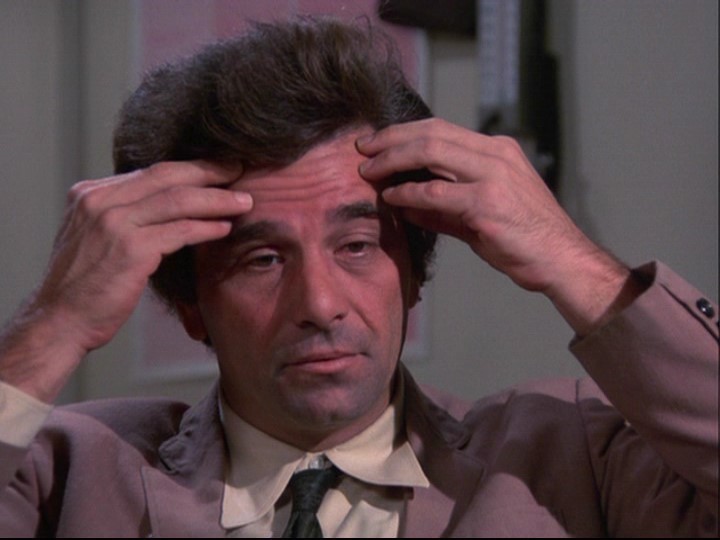
- Lt. Columbo (Dagger of the Mind, 1972)
A warning to the reader: this is going to be a filler-post involving conflicting memories, parallel universes, Columbo and Dr. Watson's brain. This is your only chance to turn away and come back within a day or two when I have regular review up. You've been warned!

Recently, I stumbled across a website, The Mandela Effect, collecting shared, alternate memories of events and popular culture that contradict the recorded history of our plain of reality – indicating to some that we're sliding between parallel universes.

A popular series of children's books, The Berenstain Bears, is central to this phenomenon, because people across the world swear they remember the name being spelled as BerenSTEIN.

It became enough of a thing that (reputedly) the son of the creators, Mike Berenstain, felt compelled to respond to a particular blog-post to explain the history of his family name and how "most people have just misread the name." A reasonable that has done nothing to make the debate subside. Other examples include confusion over the date of Nelson Mandela's death, the number of states within the U.S. and the titles of TV-series or movies. 

Dr. John H. Watson
As a consummate reader of detective fiction, I was immediate reminded of a phenomenon known within mystery circles as Dr. Watson's faulty memory, which is especially notable in two particular short stories: "The Adventure of the Cardboard Box" from His Last Bow (1892) and "The Adventure of the Resident Patient" from The Memoirs of Sherlock Holmes (1893).

The stories open on a very similar, almost identical scene that has Holmes performing a mind-reading trick on Watson, which was the result of some editorial acrobats, but in their universe it's Watson's unreliable memory that recollected that moment at the start of two completely different cases. And this wasn't the only time Watson's mind became fuzzy on the finer details. He ascribed the first name of James to both Holmes' arch-nemesis, Prof. James Moriarty, and his brother, Col. James Moriarty, which makes no sense at all!

So I agree with Mike Berenstain's simple explanation. However, I can understand why some people would freak out over this, because I have a crispy clear memory of an alternative ending to one of my favorite Columbo episodes. A faulty memory I had shelved away as a Watsonian lapse of the mind, but when I came across the Mandela effect I saw an opportunity for a filler post! 

Columbo: Oh, the mind boggles, sir!
Try and Catch Me (1977) is arguably one of the greatest Columbo episodes, in which Lt. Columbo's opponent is one of the most likeable murderers you'll ever meet on the small screen: a small, somewhat elfish-looking mystery writer, named Abigail Mitchell, who avenged her niece by locking the murderer inside her walk-in safe – which eventually began to lack the oxygen needed to breath.

Well, I was quite surprised, even a little shocked, upon re-watching Try and Catch Me for the second time, because I remembered a completely different ending to the episode. I remembered Columbo allowing Abigail Mitchell to get away and even handed over the car keys, a key piece (pun!) of evidence, to her, but that was not the ending I saw the second time around. On the contrary! Columbo makes no bones about it: she's coming with him to the police station.

Abigail Mitchell even asks Columbo if he "would consider making an exception" in her case. After all, she's "an old woman, quite harmless, all in all." To which Columbo replies, "you're a very professional person in your work and so am I." However, the episode ends with a line suggesting an alternate time-line, "if you had investigated my niece's death, all this need never have happened," but that would've made for an entirely different story altogether.

There's nothing in the episode that would justify the ending I initially remembered, but I've got a possible explanation as to why my mind butchered my recollection of the episode: it was during the time I began to discover the detective genre in earnest and wanted everything to be exactly like my favorite detective stories, which, at the time, included Agatha Christie's The Murder on the Orient Express (1934) – which is a book that shares in the blame of turning me into the mystery addict you know today. If you know the solution of that mystery and its morally ambigious ending, you probably understand why my mind did what it did.

Well, that's all I've to say on this subject. I wish I could've delivered the definitive proof of dual realities, but hey, what you gonna do.

Hopefully, I have a new review up before long and meanwhile, you could check out my recent reviews of Freeman Wills Crofts' classic debut novel, The Cask (1920), or Robert van Gulik's Judge Dee at Work (1967), which is collection of short stories.

Oh, and my sincere apologies for wasting your time with this post.