8/11/23

The Paradise Affair (2021) by Bill Pronzini

In 2005, Bill Pronzini revived his two historical gumshoes, John Quincannon and Sabina Carpenter, who sold their professional detective services in San Francisco at the turn-of-the-century – when the Old West was coming to an end. This new run of short stories appeared in Ellery Queen's Mystery Magazine starting with "Quincannon in Paradise" (collected in Quincannon's Game: A Western Quartet, 2005) and seems to have ended with "Pick Up Sticks" (2021). During the 2010s, Pronzini started to rework the Quincannon and Carpenter short stories into novel-length mysteries with his wife, Marcia Muller. The series began with the delightful The Bughouse Affair (2013) and some have called it the novel that rebooted the series, but it's more of a continuation of Quincannon (1985) and Beyond the Grave (1986) merging and streamlining the short stories with the original 1980s novels.

The Paradise Affair (2021) is the ninth and, as of this writing, seemingly last entry in the series based on the short stories "Quincannon in Paradise" and "Pick Up Sticks." A whole lot has changed since the days of The Bughouse Affair.

John Quincannon and Sabina Carpenter finally tied the marital knot, "their future together was bright," but Quincannon, "the most accomplished detective in the western United States," suffered an affront to his pride and skills – allowing two slippery criminals to escape his clutches. Jackson "Lonesome Jack" Vereen ("an ironical moniker, for he was a libertine of gargantuan appetites") and E.B. "Nevada Ned" Nagle ("whose primary vice was the opium derivative morphine") are con artists who graduated over their lengthy career from bait-and-switch trickery to swindling people with phony stocks. Their latest mark and Quincannon's current client, R.W. Anderson, not only bought two-thousand dollars of bogus stock in a nonexistent silver mine, but the two swindlers seized upon an opportune to make off with his portfolio of stock certificates and bearer bonds. Anderson hired Quincannon to bring the two to justice and hopefully recover the stolen portfolio. However, two weeks of exhaustive detective work gets thrown out of the window when Quincannon learns his quarries booked a passage for for Honolulu, Hawaii.

Sabina spots an opportunity for a second, busman's honeymoon ("we deserve a vacation, even if it is a working one") and convinces both her husband and their client to follow Lonesome Jack and Nevada Ned to Honolulu.

The Paradise Affair takes place during the first-half of 1898, "the Sandwich Islands Kingdom was overthrown and Queen Lili'uokalani's reign ended in January of '93, five years ago," but before the United States annexed the then independent Republic of Hawaii – which happened later that year on August 12, 1898. So the story is drenched in local and historical color. The impending annexation is a popular conversational topic ("...if Japan doesn't invade and annex it first, as they have threatened to do"), while the Spanish-American war and increased U.S. military presence hover in the background (Admiral Dewey's Asiatic Squadron swarm Honolulu Harbor). However, the best and most evocative part is Quincannon riding a donkey pass the rugged coastline, fishing villages, lava tubes and spouting blowholes as he tracks down his elusive quarries. It takes Quincannon's resigned Scottish pessimism ("no boats, no horses, naught but wagons and asses! What other handicaps did these island gardens of delight hold in store?") a while to acclimate, before his feelings towards the islands begin to mellow. And while her husband is hunting down a pair of swindlers, Sabina gets a case of her own practically thrown in her lap.

During their voyage, the Quincannon's befriended the Prichards, Lyman and Margaret, who are traveling homeward and invited them to stay at their Waikiki home. So stays with their new friends when her husband is roaming the islands for Lonesome Jack and Nevada Ned, but one particular hot, stuffy night, Sabina ventures out into garden when "an explosive report broke the quiet" – a gunshot coming from the house next door. Gordon Pettibone, owner of the neighboring property, had apparently had locked himself in the study with a loaded gun and opinions differ on how he got shot. The local police believes it was suicide, but Philip Oakes insists his uncle had been fiddling with the gun and accidentally shot himself. A twenty thousand dollar insurance policy with a nonpayment clause in case of suicide depends on it. Oakes heard Sabina is a detective and asks her to prove his uncle's death was due to an accidental misfire, but she has the sneaking suspicion Pettibone might have been cleverly murdered. Sabina thought she a shadowy shape close to the back wall shortly after hearing the gunshot and than there's those three, strange words Pettibone spoke before he died, "pick up sticks." Like the old nursery rhyme ("One, two, buckle my shoe. Three, four, knock on the door. Five, six, pick up sticks").

Ah, yes, an Ellery Queen-style dying message inside a John Dickson Carr-like locked room mystery. The detective story's take on the riddle wrapped inside an enigma and Sabina's knows dying messages and impossible murders is Quincannon's bread and butter ("conundrums of this sort intrigued him"), but "she had, after all, been instrumental in solving a few conundrums herself." Sabina makes short work of the locked room and dying message puzzles with the latter having a clever answer to the criticism often leveled at the dying message. Why would a mortally injured and dying person come up with a cryptic clue on the spot instead of outright naming the murderer? This dying message is even more damning than simply naming the murderer. The locked room-trick is a nicely-done variation on an impossible crime technique that always fascinated me (ROT13: haybpxrq qbbef naq jvaqbjf gung nccrne gb or ybpxrq naq obygrq sebz gur vafvqr). So both quickly, and neatly, wrap up their respective investigations with days left to spare to enjoy that second, well deserved honeymoon.

The Paradise Affair is a relatively short, but tightly written and plotted locked room mystery full of local and historical color, which certainly makes it a standout of the series. More importantly, it provided a satisfying closure to the character-arcs of John and Sabina Quincannon. John Quincannon was introduced as a broken ex-Secret Service operative haunted by the gun battle in which his ricocheting bullet killed a pregnant woman ("the burden of responsibility for the loss of two innocent lives had been unbearable"). Everything changed when he met Sabina, then a "Pink Rose" of the Pinkerton Agency, who had lost her husband in the line of duty. Their first collaboration allowed both of them to move on and create Carpenter and Quincannon, Professional Detective Services. So, if The Paradise Affair really is their last outing, they got a happy sendoff that retrospectively brightened Beyond the Grave. A crossover across time between this series and Muller's short-lived series-character Elena Oliverez, which takes place in 1894 and 1986. The 1986 portion of the story makes it very clear Carpenter and Quincannon are long gone. Either way, this is not the last you have seen of them on this blog. I still have The Bags of Tricks Affair (2018), which I overlooked and forgot about. The stories collected in Quincannon's Game warrant a second look as three of the four stories are locked room mysteries. Why not end where the series began, Quincannon, because that would be on theme for this blog.

8/7/23

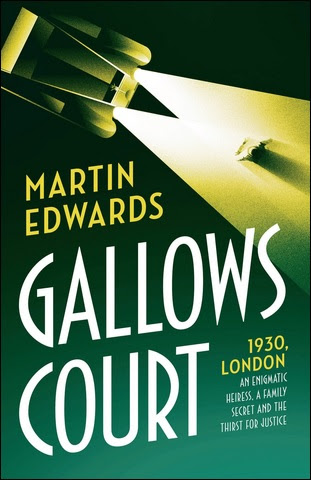
Gallows Court (2018) by Martin Edwards

Martin Edwards is a British solicitor turned award-winning crime writer and anthologist who debuted with All the Lonely People (1991), introducing his first series-character Harry Devlin, but, over the past ten years, Edwards has been tirelessly championing the classics – assuming the role of Nestor of the Golden Age Renaissance. Edwards published well-timed genre studies, The Golden Age of Murder (2015) and The Story of Classic Crime in 100 Books (2017), right when the reprint renaissance gained some serious momentum. Serving as companion pieces and introductory guides to the swelling flood of reprints. Edwards has also been working overtime as he compiled over twenty anthologies, beginning with Capital Crimes (2015), published under the British Library Crime Classics banner. A noteworthy entry in the British Library anthology series is the locked room-themed Miraculous Mysteries (2017).

That's merely a small sampling of Edwards' contributions to the genre, classic and contemporary, but I've only read two of his short stories, "Waiting for Godstow" (2000) and "The House of the Red Candle" (2004), to date. So about time I tried one of his novels. Where better to begin than with the 1930s historical retro-GAD series Edwards created five years ago?

Gallows Court (2018) is the first of currently four novels in the Rachel Savernake series and had been warned that the novel is incredibly difficult to discuss and properly review. Holy shit, the reviews were not kidding! Gallows Court is an intricately-plotted, pulp-style thriller that can be best summed up as cloak-and-daggers in a dark labyrinth, surrounded by a dense hedge maze, rigged with traps, explosives and secret passageways – bodies around every corner the story takes. All the chaos and mayhem served one purpose: introducing and establishing the character of Rachel Savernake.

Rachel Savernake is the daughter of a wealthy and notorious hanging judge, "Savernake of the Scaffold, people called him," who was forced to retire after attempting to slash his wrists at the Old Bailey. So the old judge returned and Rachel returned to Savernake Hall, situated on an island called Gaunt, which is "as isolated as anywhere in the kingdom." Rachel spend her childhood in that lonely, isolated place with a demented father and some retainers reading every volume of criminal history in the judge's private library ("...no place for a child to grow up"). But when the old judge finally passed away, the now twenty-some Rachel returned to London as a fabulously rich woman while retaining her reclusive habits. She bought a mansion, rechristened Gaunt Hall, turned it into "a luxurious fortress" and generally shunned publicity. However, Rachel apparently has been playing amateur detective as she solved the Chorus Girl Murder and is currently on the trail of the Headless Torso Killer, but the murderers conveniently committed suicide. One took enough strychnine to put down a horse and the other swallowed a bullet inside a locked room.

Gallows Court makes it abundantly clear Rachel and her own faithful retainers had a hand in their suicides, but to what extend? You always have to take certain narrative tricks into consideration. The story is interspersed with old diary entries from Rachel's distant cousin, Juliet Brentano, who lived at Savernake Hall at the time of the Spanish flu pandemic and the diary entries do not paint a very flattering picture of the then 14-year-old Rachel – a child as "mad as the old brute who fathered her." Now she appears to be all tied in a spate of violent murders and dodgy suicides.

That unavoidably begins to attract unwanted attention. Firstly, there's the Clarion reporter, Jacob Flint, whose chief crime correspondent, Thomas Betts, was run over and is now on his death bed. Betts heard rumors of Rachel ferreting out the culprit behind the Chorus Girl Murder, but everyone refused to talk on the record. And then he got run over. So, recognizing a good story and wanting to tell Rachel's story, Flint dives head first into a very deep and dangerous rabbit hole, but realizes too late that everyone even remotely connected to the case has to fear for their lives. To say that there are a lot of murder would be an understatement. It would be more accurate to say that Gallows Court has the Paul Doherty amount of bodies. Flint does not emerge from his horrific ordeal entirely unscathed.

Now all of this still sounds relatively straightforward and comprehensible for a historical, pulp-style thriller, but the further the story progresses, the deeper it descends into pulp and thriller territory – really out there kind of pulp. Gallows Court reads like a modern descendant of the pulp-style mystery thrillers by John Russell Fearn (The Rattenbury Mystery, 1955) and Gerald Verner (They Walk in Darkness, 1947), but dialed all the way up. So with new plot developments, twists and turns every other chapter, the plot of Gallows Court is next to impossible to boil down. It's quite the journey. What can be said is mystery readers looking for a more traditionally treatment of the 1930s detective story will be disappointed as the story is essentially a thriller clad like a Golden Age detective, but it has a very good reason to take this route.

I noted earlier the plot serves to introduce and establish the character of Rachel Savernake, while peeling away the layers of her backstory. I think most people who read this blog can anticipate one of the main plot-twists concerning Rachel's character, but what counts is how it sets-up the series and the implications of Rachel appearing on the scene of an ordinary-looking murder. Rachel Savernake reminds me in that regard of younger version of Gladys Mitchell's Mrs. Bradley. You can draw a comparison between Rachel's debut and Mrs. Bradley's first appearance in Speedy Death (1929), but, like everything else in Gallows Court, the character of Rachel is dialed up to eleven. So its fortunate I listened to my inner voice of reason this time around and not immediately skipped to the third novel in the series (Blackstone Fell, 2022), because it has two impossible disappearances from a locked gatehouse and a clue-finder! So it was very tempting to start with the locked room title, but Gallows Court is clearly an essential piece needed to understand and fully appreciate what comes next. Look at me being chronological all of a sudden.

So while the thriller is not always the game I enjoy, I can enjoy a good, pulp-style thriller every now and then. Edwards wrote engrossing and absorbing historical thriller that keeps you turn the pages to see what's going to explode in your face next. Mortmain Hall (2020) and Blackstone Fell have been moved up the big pile. To be continued...

8/4/23

The Other Way Around: "The Mystery of the Green Room" (1936) by Pierre Véry

Pierre Véry was a French mystery writer, "novelist of adventure, novelist of the fantastic," who believed in preserving "what has been able to remain in us as the child that we were" so "full of flaws, of changes of heart, of shadow and mystery" – describing his own work as fairytales for grown-ups. While steeped in gentle surrealism, Véry was one of the Big Four of the French Golden Age mystery novel. Xavier Lechard, of At the Villa Rose, warns that "anyone expecting to find Christie-like deceptions will be sorely disappointed," but "Véry was quite able to manage brilliant tricks when he wanted" and pointed out Les quatre vipères (The Four Vipers, 1934) as "arguably one of the best locked room mysteries ever written." So, regrettably, only a tiny sampling of Véry's detective fiction has made it into translation.

Back in 2008, Alan Grimes translated and self-published a handful of Véry's whimsical mysteries that included two Prosper Lepicq novels, L'assassinat du Pére Noël (The Murder of Father Christmas, 1934) and Le thé des vieilles dames (The Old Ladies' Tea Party, 1937). The translations have since gone out-of-print, out-of-stock and secondhand copies are now difficult to find. Three years later, John Pugmire translated Véry's pastiche of Gaston Leroux's Le mystère de la chambre jaune (The Mystery of the Yellow Room, 1907). And that short story is not difficult to find.

Pugmire's translation of "Le mystére de la chambre verte" ("The Mystery of the Green Room," 1936) appeared in the August, 2011, issue of Ellery Queen's Mystery Magazine and anthologized in Foreign Bodies (2018). "The Mystery of the Green Room" is an inspired and immensely enjoyable take on Leroux's The Mystery of the Yellow Room, but, let the reader be warned, you should not read Véry's pastiche without having read Leroux's historic genre milestone – whose solution is integral to the plot of "The Mystery of the Green Room." A plot concerning an otherwise ordinary-looking burglary and robbery, where it not for a very peculiar feature.

Madame Emilienne de Rouvres is attacked in her own home, gagged and bound to a chair, while a masked individual ransacked the place. This person helped himself to the silverware, a small clock and several thousands francs from the wall safe, but these were meager pickings compared to Madame de Rouvres jewelry. A pearl necklace and a string of diamonds, "estimated to be worth eight hundred thousand francs," which were kept in the drawer of a bedside table in the green room ("I imagine safes attract burglars like bears to honey"). However, the thief only poked his head in from the doorway, but never stepped into the bedroom. So the small fortune lying there for the picking remained untouched. Marcel Fermier, private insurance investigator, remarks to the Inspector Jean Martin that the green room puzzle is exactly the same as the yellow room puzzle from Gaston Leroux's famous locked room mystery "in the sense that it's the precise opposite." An open-room puzzle. The thief had every opportunity to have gone into the green room, take jewelry and come out again. So why didn't he?

"The Mystery of the Green Room" was published in the same year as Leo Bruce's Case for Three Detectives (1936) and you can draw similarities between the two with their rivaling detectives ("while the policeman looked for clues, Fermier tried to determine the motive"), humor, false-solutions and cleverly spoofing Leroux – modeling the correct solution on "a parallelism of opposition" between the green and yellow room puzzles. And it worked so incredibly well! A tiny gemstone of the detective pastiche and a wonderfully done, immensely enjoyable homage to one of the most famous locked room mysteries of the 20th century that's actually not a locked room mystery itself. And, again, it worked! Highly recommended! Hopefully, this is not the last we have seen of Véry on this side of the language barrier. Le testament de Basil Crookes (The Testament of Basil Crookes, 1930) and The Four Vipers sound too good not to be exposed to a wider, international audience.

7/31/23

The Delft Blue Mystery (2023) by Anne van Doorn

Good news for your non-Dutch speaking mystery readers and impossible crime connoisseurs. Last year, I reviewed the first short novel in the new Gisella Markus series, In diepe rust (In Deep Peace, 2022), written by Dutch crime-and detective novelist M.P.O. Books and came with the announcement he was working on another series – an internationally flavored series published under his penname "Anne van Doorn." The first entry in the New York Cops series, Het Delfts blauw mysterie (The Delft Blue Mystery, 2023), was originally scheduled to be published in 2022, but the original Dutch edition got delayed until last May. Yes, you read that correctly. There's currently an English version in the works.

The Delft Blue Mystery has already been translated into English and the only thing holding up its publication is the ongoing search for a literary agent in the United States. So it may be some time before the English translation is released, but a few people have already read and commented on The Delft Blue Mystery like David Dean ("an impossible crime/locked-room mystery in modern day NYC is quite a feat of writing") and Tom Mead ("I absolutely love it"). I've been graciously given a review copy of the translation by E-Pulp to give my take on it as the resident locked room fanboy. And the timing couldn't have been better.

The Delft Blue Mystery is dedicated to Josh Pachter, author and translator, whose The Adventures of the Puzzle Club (2022), co-ghosted with Ellery Queen, was recently discussed on this blog – followed by reviews of S.S. van Dine's The Scarab Murder Case (1930) and Clayton Rawson's Death from a Top Hat (1938). So contemporary, Dutch seasoned take on Van Dine, Queen and Ed McBain's 87th Precinct series is a perfect, unintended capstone to that round of reviews. Let's see if Van Doorn succeeded in retaking Manhattan.

The story begins with a storm rocking New York City making the New Singer Building, a high-rise tower on West 33rd Street, sway like it has never done before. Mrs. Philippa DeRoos, blinded and paralyzed from the waist down in a climbing accident, lives on the seventy-second floor and "can't stand it when the tower is struck by strong winds," but the roaring wind is not the only reason for the deeply suspicious and superstitious Philippa DeRoos to be jittery. Philippa DeRoos has been getting weird phone calls and found two voodoo dolls on her bed, "one doll lay on her side of the bed, the other on her husband's," covered with dozens of needles. Suspected to be the handiwork of their former Haitian housekeeper. Gilbert DeRoos tries to reassure his wife, "evil spirits do not roam the streets, alleys, and skyscrapers of New York City," telling her that she's absolutely safe inside the penthouse as long as she don't anyone inside ("only someone who comes up can hurt you"). And then rushes off to an important business meeting. But soon things begin to happen inside the supposedly secure penthouse.

Philippa DeRoos believes she senses a presence around her, someone moving around the place and hears something crashing to the floor. She rings up the building's security guard, Jack O'Grady, who searches the place, but only finds fragments of white and blue pottery underneath a tall bookcase – which has collection of delftware pottery placed on it. Was it the swaying of the tower and Philippa DeRoos overactive imagination or had someone really invaded the penthouse? But the guard finds no one on the premises and left. When DeRoos returns from his business meeting, he finds that his wife locked herself in their bedroom and doesn't respond to his knocking. So together with another security guard, they break down the bedroom door to find Philippa's body. She died under very mysterious and suspicious circumstances, but how can an intruder possibly have bypassed the security cameras, keycard protected doors that log every opening and closing without showing up on any of them? Not to mention the bedroom door that was locked from the inside with the key still in the lock!

First of all, the opening chapters with the high-rise building swaying in the storm and an possible intruder, prowling invisibly, on the top-floor penthouse culminating with an inexplicable death in a locked room are excellent. It breaths like a Van Dine-Queen style detective novel and in particular Anthony Abbot's About the Murder of the Night Club Lady (1931), which also concerns an apparently invisible intruder in a top floor penthouse despite being guarded and constantly searched by the police. Only difference is that the New Singer Building has a view of modern-day New York and not merely guarded by locks, bolts and guards, but security cameras and computer-logged doors. This contrast between past and present, classics and moderns, permeates throughout the story and characters.

Detective Krell, of the 16th Precinct in midtown Manhattan, begins his day not only with a possible homicide on his hands, but gets saddled with a new partner. Merrilee Hopper comes from rural South Dakota and worked as a detective in a town called Salem Meadows, but transferred to New York to follow in the footsteps of S.S. van Dine, Ellery Queen and Rex Stout ("the city of the classics, the city of my heroes"). Merrilee likes to make Sherlockian deductions, theorize with brainstorm sessions and generally treats the investigation as a game. This greatly annoys the realistic-minded Krell whose first year with the NYPD cured him of such illusions ("crime investigation is no fun"). Krell tells Merrilee not to expect any carefully crafted puzzles in New York City, “crime is sordid,” because its filled with lying suspects and witnesses, corrupt officers, snitches, unsolved cases and manufactured evidence – simply "life as a police detective is also an ugly piece of shit." But his advise falls on deaf ears. And is told by the higher ups he's stuck with her for the foreseeable future.

So they have to investigate another sordid crime in New York City by working together as they try to find out how a nervous neighbor, a jealous lover, shoddy security guards and shady business dealing possibly figure in the death of Philippa DeRoos. However, the decidedly classical storybook trimmings of the case become hard to ignore when they persist in sticking around the place. The police locked and sealed the penthouse, but someone is heard moving inside and a witness from adjacent building saw someone with a flashlight walking from room to room. But, when the police arrive to inspect the place, nobody is found!

The Delft Blue Mystery is a locked room mystery with two impossibilities: the invisible intruder and the murder of Philippa DeRoos behind the locked doors of her bedroom. Firstly, the solution to the invisible intruder and how it related to broken Delft Blue bowl is brilliant! More importantly, the reason behind those intrusive incidents proved to be not without consequences. Secondly, the murder of Philippa DeRoos is a locked room mystery of a different order, but no less clever or inspired and rather reminiscent (in spirit) of the another, massively underrated New York mystery writer, Herbert Resnicow – who specialized in these type of impossible crimes. I'm just in two minds about the clueing and misdirection. Krell and Hopper have to wait a while for the results of the autopsy to come back, which makes the exact cause of death as mysterious as the circumstances under which Philippa died and pulled a haze over the clues. There are more than enough cleverly-planted clues, pointing both to the method and murderer, but with the cause of death being an open question, you can't expect your average armchair detective to spot and correctly interpreter all those clues. Long story short, I failed to pull-off a Gideon Fell with this locked room-puzzle. But other than picking at that one thread, I have absolutely nothing to complain or nitpick.

Van Doorn's The Delft Blue Mystery is not only an excellent introduction to a promising new series, but a fine example of what can be done when you build on the rich history of the genre to create something new and exciting for the future. This is another step towards our Second Golden Age.

A note for the curious: M.P.O. Books has been writing and publishing crime and detective novels of all stripes for nearly 20 years now, beginning with police procedurals/thrillers, but a love for Sherlock Holmes and Agatha Christie made him branch out to the more traditional forms of detective fictions – always trying to strike a balance between the classic and modern schools of crime fiction. So you can call him the Roger Ormerod of the Netherlands with a hint of Paul Halter as nobody in the history of my country has any writer been as prolific and consistent in producing impossible crime fiction as Books. Now that the English edition of The Delft Blue Mystery is in the works, I hope some of his older work eventually finds its way to a much more appreciative overseas audience. De laatste kans (The Last Chance, 2011) is an excellent detective dressed as a police procedural with one of my all-time favorite clues and need to reread it one of these days. Een afgesloten huis (A Sealed House, 2013) is the first notable locked room mystery to be published since Cor Docter's Koude vrouw in Kralingen (Cold Woman in Kralingen, 1970) and many turned over the years in the books and short stories published under his now open penname. Such as "Het huis dat ongeluk bracht" ("The House That Brought Bad Luck," 2018) and De man die zijn geweten ontlastte (The Man Who Relieved His Conscience, 2019). So tell the American, Brits, French and Japanese to make room, because the Dutch are coming to claim their seat at the table.

7/27/23

The Scarab Murder Case (1930) by S.S. van Dine

Willard Huntington Wright was an art critic, editor and, under the non de plume "S.S. van Dine," one of the most celebrated and influential American mystery writer of his day – who brought the Golden Age of detective fiction to the United States. Van Dine penned a dozen novels between 1926 and 1939 about aesthete and dilettante detective, Philo Vance. A somewhat divisive character who inspired Ogden Nash to write the now famous line, "Philo Vance needs a kick in the pance." Van Dine and Vance have been criticized for their batty plots, dotty logic and Vance's erudition on any subject that happened to be at the heart of the plot. You name the subject and Vance can give you his expert, first-hand opinion on it. But they also have their champions. Mike Grost writes on his website, "the mystery field does not honor Van Dine enough" as "he tried to synthesize the best elements of mystery fiction in his work" and "in doing so he founded a new school, one that opened the door for some of the best detective writing in American history."

My own experience with Van Dine's detective fiction has been spotty. I remember immediately solving The Benson Murder Case (1926) and only recall The "Canary" Murder Case (1927) had a decent locked room-trick. The Greene Murder Case (1928) took an interesting approach to the structuring of a detective story, but hardly a beacon of fair play and read an annoying, poorly dated Dutch translation of The Bishop Murder Case (1929). I think, to the surprise of absolutely nobody, that The Kennel Murder Case (1932) is the best Philo Vance (locked room) mystery encountered, so far, but The Dragon Murder Case (1933) completely put me off Van Dine until now. A ludicrously bad detective story about a premeditated murder hinging on two unpredictable assumptions that somehow came off exactly like the murderer planned. It was so ridiculously insulting, the remaining Philo Vance novels were moved to the bottom of the pile.

So never got around to supposedly good novels like The Casino Murder Case (1934), The Garden Murder Case (1935) or The Kidnap Murder Case (1936), but enough water has passed under the bridge to give Van Dine and Vance a second shot. After all, this blog is littered with references to the Van Dine School and reviews of writers like Anthony Abbot, Kelley Roos, Roger Scarlett and Ellery Queen.

The Scarab Murder Case (1930) is Van Dine's fifth detective novels and brings Philo Vance to the East Twentieth Street home of a famous Egyptologist, Dr. Mindrum W. C. Bliss, where he maintained a private museum of Egyptian antiquities – crammed with ancient treasures and trinkets. Dr. Bliss employs an archaeologist and technical expert, Donald Scarlett, who happened to be an old college mate of Vance and turned to him when he made a unsettling discovery in the private museum. Scarlett came to New York with Dr. Bliss as a member of his staff and went to the museum that morning to classify a batch of photographs, but found the body of "that old philanthropist and art patron," Benjamin H. Kyle, lying crumpled in the corner of the room. Kyle's skull had been crushed like an eggshell with a two-foot long statue of the Egyptian goddess of vengeance, Sakhmet, still lying across his head. And his arms encircling the feet of the feet of a life-sized statue of Anubis. The god of the underworld. There are a ton of highly incriminating clues, "the scarab pin, the financial report, and the footprints," which lead straight to Dr. Bliss. Vance warns Markham and Sgt. Heath not to rush to an arrest as "a devilish plot" (is there any other in this series?) has been introduced into Kyle's murder and unraveling that hideous scheme will save an innocent person from the electric chair ("a single false step on our part, and the plot will succeed").

So the story follows the fairly typical pattern of these 1920s and '30s Van Dine-Queen style brownstone mysteries with the lion's share taking place inside the walls of the East Twentieth Street brownstone and the private museum. The scene of the crime and uncovered clues are as closely scrutinized as the other members of the household. There's the wife of Dr. Bliss, Meryt-Amen, who's half Egyptian and her faithful family retainer, Anûpu Hani. A Coptic Christian, of sorts, who believes the murder was Sakhmet's vengeance for the desecration of Egypt's tombs. Lastly, the Assistant Curator of the Bliss Museum and Kyle's nephew, Robert Salveter. So a good, old-fashioned murder mystery with "the mystic and fantastic lore of ancient Egypt" with "its confused mythology and its grotesque pantheon of beast-headed
gods
" furnishing the background of the story. Obviously trading on the Egyptian craze that gripped the West for nearly decades following Howard Carter's discovery of the long-lost tomb of Tutankhamen. But how does it all stack up?

First of all, The Scarab Murder Case marked Vance's fifth appearance and Van Dine evidently made some attempts to humanize Vance since debuting him in The Benson Murder Case. Vance still affects British mannerisms ("beastly mess, people getting murdered, what?") and is annoyingly up to date on all things Egyptological, which allows him to decipher a hieroglyphic letter ("let me see how well I remember my Egyptian... it's been years since I did any transliterating..."), but Vance is entirely motivated by preventing a miscarriage of justice and saving the reputations of his friends, Markham and Heath. Vance even show a glimmer of humor when Heath suggests he should have been a lawyer ("I'm only tryin' to save you and Mr. Markham from making a silly blunder. And what thanks do I get? I'm told I should have been a lawyer! Alack and welladay!"). A great improvement on his first appearance as The Benson Murder Case never answered the question how Markham resisted the urge to throttle Vance on the spot. Secondly, the treatment of clues and red herrings is fascinating. Markham refers to them as negative clues and direct clues, but, essentially, the red herrings the murderer planted at the murder scene become clues when Vance identified them as red herrings. That turns his normally annoyingly cryptic remarks into clues. So it's a pity the misdirection has worn a little thin nearly a 100 years after its original publication. I'm sure it worked like a train back in 1930, but, in 2023, it's only going to fool the newest, most innocently-eyed and unblemished of mystery fans.

However, while I spotted the murderer early in the game and cottoned on to all the clues, my only real bone of contention is how Vance disposed of the murderer. It's one thing to believe and lament "this elaborate invention of imbeciles, called the law, has failed to provide for the extermination of a dangerous and despicable criminal," but do the dirty work yourself. For someone of Vance's intellect, it would have been a mere parlor trick to improve on that preposterous death trap and have the murderer's death being written off as a cosmic coincidence or "divine justice." Other than that, The Scarab Murder Case has completely renewed my interest in Van Dine and will excavate The Casino Murder Case, The Kidnap Murder Case and English copy of The Bishop Murder Case from the depths of the big pile. Even more than that, The Scarab Murder Case made me want to reread Clyde B. Clason's The Man from Tibet (1938). So... to be continued.

7/23/23

Death from a Top Hat (1938) by Clayton Rawson

I did not intend to do another reread so soon after the recent Agatha Christie triptych of The Mysterious Affair at Styles (1916/20), The Murder at the Vicarage (1930) and Curtain (c. 1940/75), but lately, there has been a drought of detective fiction with a substantial locked room tangle – which is not to say there has been a dearth of impossible crime reviews. There's never a shortage of those around here. However, the only significant locked room mysteries discussed over the past three months on this blog are Bruce Elliott's You'll Die Laughing (1945), Christianna Brand's Suddenly at His Residence (1946) and Yukito Ayatsuji's Suishakan no satsujin (The Mill House Murders, 1988). So began digging around for a good, old-fashioned locked room mystery that lays it on thick, but currently nothing new or unread resides on the big pile that could make such a guarantee. I turned to a novel with a reputation for reveling in the seemingly miraculous and downright impossible.

Clayton Rawson was an American magician, managing editor of Ellery Queen's Mystery
Magazine
and mystery novelist whose debut, Death from a Top Hat (1938), left something of a mark on the genre.

Since its publication, Rawson's Death from a Top Hat has enjoyed the status as a classic of its kind and a 1981 panel of seventeen authors, reviewers and experts voted the seventh best locked mystery of all time – beating the likes of Anthony Boucher's Nine Times Nine (1940), Helen McCloy's Through a Glass, Darkly (1950) and John Sladek's Invisible Green (1977). But when the next century rolled around, the list of long-time genre classics underwent a slow revision as the internet began to make them easily accessible. Something I commented on in my reviews of Christie's Murder on the Orient Express (1934) and John Dickson Carr's Till Death Do Us Part (1944). Death from a Top Hat is one of those classics whose status has been challenged in recent times as some have argued its reputation far outstrips the quality of the plot. Let's find out if it can stand up to a reread.

First of all, this is the first I've read Death from a Top Hat in English as the first read was a Dutch translation, De vermoorde magiër (The Murdered Magician). Secondly, Death from a Top Hat is inevitable compared to Carr's The Three Coffins (1935) as it expands on Dr. Gideon Fell's famous Locked Room Lecture and always thought it was a little unfair to measure Rawson's debut against The Three Coffins, but had forgotten those comparisons were invited.

The Three Coffins opened alluding to the impossible murder of Professor Grimaud and the equally incredible crime in Cagliostro Street, which were committed "in such fashion that the murderer must not only have been invisible, but lighter than air." A murderer who can disappear into thin air and pass over freshly-fallen snow without leaving footprints. Death from a Top Hat begins on a similar note stating, "the New York Police Department's official attitude toward the infernal arts of witchcraft and sorcery was damnably inconvenient” when facing "murderer who apparently leaves the scene of his crimes by walking straight through solid walls of brick and plaster and by floating in midair out of second story windows." The Three Coffins is also famous for the brief scene in which Dr. Fell breaks the fourth wall and while Rawson never goes that far here, the first chapter can certainly be read as a piece of meta-fiction.

The story begins with the narrator of the series and freelance reporter, Ross Harte, writing a treatise on the deplorable state of the detective story ("why write a detective story when all the good plots have been used, all the changes rung, all the devices made trite?") in his New York apartment when there's a ruckus next door. In the corridor, there are three people pounding on the door of the apartment across Harte's and a woman's voice saying, "there is death in that room." The apartment belongs to a once top-rated anthropologist, Dr. Cesare Sabbat, who specializes in primitive magic and religions, but "his subject ran away with him" – giving credence to vampires and dabbling "in what he called modern alchemy." When the door is broken open, the group finds the strangled remains of Dr. Sabbat lying on the living room floor, "symmetrically spread-eagled in the exact center of a large star shape that had been drawn on the floor with chalk," tipped at each point with a burning candle. Strange words drawn in chalk, "Come Surgat," surround the pentacle. All the windows are bolted shut and the doors, both of them, were locked, bolted and the keyholes plugged from the inside with pieces of cloth.

By the way, Surgat is the name of a minor demon "who opens all locks" and the book include a neat woodcut reproduction of the fella in question, but is "Surgat roaming around loose, twisting necks and slithering out through keyholes"?

Inspector Homer Gavigan, "one of the department's brighter lights," arrives on the scene to find that practically all his witnesses and potential suspects comprise of a small and vastly growing variety act ("...would only bring along a couple of acrobats and a man who could play Humoresque on the saw, we could go to town with a full evening's show"). However, I'm going to bother with the cast of characters as a not wholly unjustly criticism of Death from a Top Hat today is that it's all plot and no characters. Only real characters here are Ross Harte, Inspector Gavigan and Rawson's series-detective, The Great Merlini, who runs a magic shop (Miracles for Sale) and has helped the police in the past. Harte suggests to Gavigan to bring him in as an outside expert and they go all in on the locked room problem. The banter and discussion of "locked room theory" between those three was a sheer joy to rediscover as Rawson wrote like Death from a Top Hat was going to be his only detective novel. Rawson piled on the cast-iron and gold-plated alibis, false-solutions and additional impossibilities like a tailed suspect vanishing from a taxi. And that only accounts for the first-half of the story.

I don't recall this was ever brought up or pointed out, but, while Rawson aligned Death from a Top Hat with Carr's The Three Coffins, the first-half is unmistakably written in the tradition of S.S. van Dine, Anthony Abbot and early Ellery Queen – missing only a challenge to the reader. Firstly, a good chunk of the first-half takes place in the victim's apartment. A thorough, even exhaustive, investigation to detect and deduce what happened is a staple of the early Van Dinean detective story. Secondly, Merlini is undoubtedly a much more likable character than Philo Vance and young Ellery Queen, but you can see their characters reflected in Merlini during the first-half as he displays his specialized knowledge or when discovering Dr. Sabbat's book collection ("...when you turn a bookworm of my inclinations loose in a pasture like this..."). Lastly, the story is littered with Van Dine-like footnotes providing ancient recipes for the flying ointment or to explain that "a colony of 1000 Lemurians (from the Pacific's even more ancient lost continent of Mu) was reported as late as 1932 to exist on the slopes of Mt. Shasta." They added a little extra to the overall story in addition to two detailed illustrations of locked room crime scenes.

Somewhere around the halfway mark, the body of a second victim is discovered under nearly identical circumstances, "exactly the same position as had the body of Sabbat," which offers an even bigger impossibility. Before the body is found, two witnesses heard a strong and lively argument going on inside the locked room ending with the man who they heard laughing saying, "and the police will never know." When the room is entered, they find everything properly locked and bolted with the exception of an open window with a ladder propped up on the outside. However, the foot of the ladder surrounded by snow "as white and unmarked as a new sheet of paper" and the murderer must have been able to float in midair to have escaped that way. This second impossible murder turns Merlini attention to Dr. Gideon Fell and his famous Locked Room Lecture from The Three Coffins. That "fairly comprehensive classification of the possible methods of committing murder and contriving to have the body found in a sealed room," which is put to good use as Merlini plucks half a dozen false-solutions out of thin air as easily and routinely as making a half dollar coin vanish and reappear. Robert Adey referred to this portion of Death from a Top Hat as "the second-best essay on the methods of effecting a locked-room murder" in Locked Room Murders (1991). Right behind Dr. Fell's Locked Room Lecture. It certainly is an impressive play on the multiple solution ploy from a debuting author.

But does it all hold up in the end? Was the 1981 panel correct in voting it the seventh best locked room mystery up until then or is the criticism from today's somewhat justified? This is going to be a cop out, because I think there's something to be said for both camps.

I half-remembered the locked room-tricks being a bit more involved and complicated, but they were extremely basic with some stage dressing thrown on them. That made them land like a damp squib. After all the building and examining numerous possible explanations to the locked rooms, you would expect something moderately clever that was overlooked or unsuspected combination of the various false-solutions. Even if that, too, turns out to be somewhat basic in nature. But something that looks new or used in a different way. This is like if Carr would have revealed that the mysterious, ever-present judas window he had been making a lot of hay about is nothing more than a hidden knot-hole in the locked door or the wooden frame of the steel-shuttered windows. Not the stuff of classics!

So have to agree with the critics of today that, purely as a locked room mystery, Death from a Top Hat is not the seventh best of its kind, but I can understand how it acquired its classical status – why it endured such a long-lasting popularity among locked room connoisseurs. For the longest time, Death from a Top Hat was the only detective novel offering readers a locked room extravaganza with the everything and the kitchen sink approach. Gaston Leroux's L'homme qui revient de loin (The Man Who Came Back from the Dead, 1912) and Noël Vindry's A travers les murailles (Through the Walls, 1936) were tucked away behind a language barrier. Horatio Winslow and Leslie Quirk's Into Thin Air (1928/29) was as obscure back then as it's today. Hake Talbot's Rim of the Pit (1944) was still six years away from being published and John Vance's The Fox Valley Murders (1966) was not identified as a multiple impossible crime novel until Brian Skupin's Locked Room Murders: Supplement (2019) corrected that oversight. Nowadays, we have become terribly spoiled when it comes to locked room mysteries with multiple, ingeniously-contrived impossible crimes littering the works of James Scott Byrnside, A. Carver, Paul Halter, Jim Noy and the growing list of Japanese translations, but there was a time when Death from a Top Hat was one of those few treats locked room fans could completely loose themselves in. No extraneous, detracting matters like character building or realism. Just throwing out possible solutions how you can get out of sealed rooms.

I was not immune to its charm and thoroughly enjoyed it, even if the ending lacked some much needed ingenuity or simply something clever to punch its ticket as an all-time classic. Death from a Top Hat has now lost some of its shine as others have since come along and played a similar game with better and much more satisfying results. Still an impressive debut warmly recommended to hopeless addicts of locked room and impossible crime fiction like myself.

7/19/23

The Adventures of the Puzzle Club (2022) by Ellery Queen and Josh Pachter

The New York cousins Frederic Dannay and Manfred B. Lee were the heart and brain behind one of the most important names in the American detective story, "Ellery Queen," whose contributions as writers, editors and founders of Ellery Queen's Mystery Magazine cannot be overstated – promoting and spreading the detective story across the world. Ellery Queen still enjoys popularity today in counties like Italy and Japan where they influenced such writers as Alice Arisugawa and Rintaro Norizuki. And while the English-speaking world has yet to produce someone who can lay claim to the Queen's mantle, the cousins have to this day a dedicated and active fanbase who continue to champion their work.


A group of radical royalists, called The West 87th Street Irregulars, "who collectively have committed themselves to the preservation and revival of Ellery Queen" with "the goal of making Ellery Queen once again a vibrant and recognized name in detective fiction." A queen's quorum of writers and editors who write pastiches, parodies and continuations concerning all things Elleryana and editing anthologies. In recent years, Dale C. Andrews and Josh Pachter compiled two EQ themed anthologies, The Misadventures of Ellery Queen (2018) and The Further Misadventures of Ellery Queen (2020), which in spite of their titles are glowing tributes to Ellery Queen. And not a single truly bad story between them!

Josh Pachter's most recent project, The Adventures of the Puzzle Club (2022), is dedicated to a largely forgotten passage from the tail-end of Dannay and Lee's writing career. During the 1960s and early '70s, they produced five short-short stories introducing Ellery Queen and his readers to the members of the Puzzle Club. A tiny group of puzzle enthusiasts comprising of Cyrus Syres ("multimillionaire oilman"), Emmy Wandermere ("the Pulitzer Prize-winning poet"), Dr. Vreeland ("noted psychiatrist"), Darnell ("celebrated criminal lawyer"), Dr. Arkavy ("the Nobel biochemist") and the famous detective novelist, Ellery Queen. The Puzzle Club convene regularly at Syres' Park Avenue penthouse to mystify each other, "in a sort of ritual adoration of the question mark," which originally covered five short-short stories published in two badges – two in 1965 and three in 1971. The series ended with Lee's passing in 1971. The stories were collected separately, in Queen's Experiments in Detection (1968) and The Tragedy of Errors (1999), but never appeared together as there simply were not enough of them to justify a collection.

Fortunately, Pachter had a pastiche, "a further adventure for Ellery and the Puzzle Club," published in Ellery Queen's Mystery Magazine in 2019 and editor Janet Hutchings accepted the story with "the caveat that it would be a one-off, not the kick-off for a series of Puzzle Club pastiches." So he wrote four additionally Puzzle Club with Sherlockian-themed titles. Suddenly, the amount of material had doubled. Add introductions for each individual story and Pachter's four short stories about Tyson County’s Griffen family, The Adventures of the Puzzle Club was practically ready to go to the printers. Let's see how this collection turned out.

"The Little Spy" originally appeared in the January, 1965, issue of Cavalier and begins with Ellery Queen receiving an invitation to attend the next meeting of the Puzzle Club to be subjected to a membership test ("...if you fail to solve the puzzle we're going to throw at you tonight, you'll never be invited to try again"). The WWII-era problem he has to solve concerns an undistinguished ex-civil servant, "who came out of retirement to do his bit for Uncle Sam," but, shortly before D-Day, Intelligence received an important tip – accusing the undistinguished civil servant of being a German spy. So when he suddenly booked a priority airline passage to London, they yanked him off the plane and gave him "the most thorough search in the long and honorable history of spy-catching." It took them a while, but, in the end, they found the top-secret material. The question Ellery Queen has to answer is where the Intelligence people discovered the spy message. A clever little story that gives the central clue in the setup of the problem and then becomes a process of elimination as Ellery goes over every possible hiding place. Needless to say, Ellery passes the test to become the sixth regular member of the Puzzle Club.


"The President Regrets" first appeared in the September, 1965, issue of Diners Club Magazine and the Puzzle Club intended to welcome no less a figure than the President of the United States ("...known to be a devotee of mysteries in all lawful forms"), but the president had to cancel at the last minute. So it's up to Ellery to improvise a puzzle for his fellow club members and imagines the murder of a Hollywood starlet, Valetta van Buren, who had been threatened by one of her four suitors and had written to Ellery to ask for help. But the letter arrived too late. Valetta was murdered by the suitor who had threatened her without naming him, but she wrote in the letter "she had something in common with three of the four, and that the fourth was the one who had threatened her." Arguably, the most obvious and telegraphed solution ever devised by EQ.

"The Three Students," originally published in the March, 1971, issue of Playboy, centers on the problem of a ring taken from the office of a college president and "a delegation of three students who represent three dissident groups at the college" play the role of suspects. Only clue is a scrap of paper with a gibberish verse written on it. Unfortunately, the solution hinges on a specialized piece of knowledge. So practically unsolvable for most readers.

A note for the curious: the story is introduced by Martin Edwards and comments how extraordinary it seems that it was originally published in Playboy, which is a subject that came up not so long ago on this blog. Back in March, I reviewed Lawrence Block's "The Burglar Who Dropped In On Elvis" (1990) and "D," from Vintage Pop Fiction, commented, "Playboy published some excellent fiction because they could afford to pay writers real money."

"The Odd Man" originally appeared in the June, 1971, issue of Playboy and is the best of the original five Puzzle Club stories brilliantly playing on that EQ specialty, the multiple solutions. The Puzzle Club has concocted a riddle bound to confound their resident mystery writer and has to do with an undercover agent whose assignment it is to track down a dope supplier, which the agent narrowed down to three suspects who all live in the same building – a three-story house ("someday... instead of a three-story house, I shall make up a three-house story"). The undercover agent is murdered, but there was a clue in his last report referring to the drug supplier as "the odd man of the three." The Puzzle Club believe there's only one possible solution to the problem, but Queen points out there are two more solutions. All three solutions come back to the same person. A minor tour-de-force!

"The Honest Swindler" appeared in The Saturday Evening Post during the Summer of 1971 and relatively simple, straightforward problem of Old Pete who gathered funds to finance his hunt for uranium with the promise that "every last investor at least gets back his original investment" in case of failure. So how was Prospector Pete able to pack back everyone of his backers when he returned empty handed? A decent enough short-short, but unremarkable.

The next five stories, "The Pastiches," were penned by Pachter who brought the band back
together after nearly fifty years and aged the characters along. Syres is now a wiry, crippled old man in a wheelchair and Ellery takes an Uber to the Park Avenue skyscraper. Pachter's pastiches unapologetically revels in the typical EQ elements of dying messages, missing clues and the-three/four-suspects. So, in a way, Pachter succeeded in making his pastiches even more Queen-ish than the original five Puzzle Club stories.

"A Study in Scarlett," originally published in the May/June, 2019, issue of EQMM brings the club together for the first time in decades and they immediately place Ellery in the hot seat – known known as the "Problem Chair." The intellectual challenge of the meeting takes Ellery to the Sherbert Theater, on West 47th Street, where lead actress, Brooke Rivers, is found murdered in her dressing room. Rivers loved word games, "crosswords, cryptics, acrostics, word searches, logic problems," fittingly left a dying message. A hastily scrawled word, "FOUR." Even more fittingly, there are exactly four suspects who could have murdered the starlet. I suppose the dying message is solvable, but you probably should put the book away when you arrive at the challenge to the reader and mull it over. I didn't get this one.

"The Adventure of the Red Circles" first appeared in the January/February, 2020, issue of EQMM and the Puzzle Club have a tailor-made problem for Ellery: owner of a successful chain of grocery stores and a collector of first editions of Golden Age detective novels, Jeremiah "Red" Edwards, died in his (unlocked) library of an apparently self-inflicted gunshot wound. On the desk, the police finds the proofs for next week's advertising circular and Edwards had circled photographs of four items on the page with cheeses ("...in true dying-message-story fashion"). The fun solution is something only an Ellery Queen fan can dream up and appreciate.

"The Adventure of the Black-and-Blue Carbuncle" was originally published in the November/December, 2020, issue of EQMM and the Puzzle Club have another dying message problem for Ellery, but found the premise and backdrop of the puzzle better than its execution. Professor Lee Dannay is a SETI researcher (The Search for Extra-Terrestrial Intelligence) who's hunched over the controls of the radio telescope one night, when a gunman enters the observatory. The gunman forces the professor to write a suicide note and shoots him, but the professor hide a clue to the murderer's identity in the note. Ellery has to find it and correctly interpreter it to solve the puzzle. The problem is that the plot (deliberately) recycles the central idea from a previous story, which came with exactly the same limitation.

A note for the curious: the story is introduced by Kurt Sercu, founder of Ellery Queen: A Website On Deduction, who writes Pachter warned him that it might be impossible for him to beat Ellery to the solution, because Sercu's not American "born and bred." Funnily enough, both Pachter and Sercu speak Dutch. If you speak Dutch, you should be able to eliminate one of the three suspects.

"The Five Orange Pipes" was first published in the January/February, 2021, issue of EQMM and is the hardest story to describe. This time, Ellery challenges the other members of the Puzzle Club with a problem starved of details, but the central question is the proximate cause of death of two of the characters. The solution is one of those elbow-in-the-ribs jokes, but amusing enough. Somewhat like a lighthearted take on Edmund Crispin and Geoffrey Bush's "Who Killed Baker?" (1950). I learned that the term Sherlockian is used in the United States and Holmesian purely British. I always used them interchangeable. There's a lock in Sherlockian. So I'll stick with that one from now on.

"Their Last Bow," originally published in the January/February, 2022, issue of EQMM, is equally difficult to discuss. In his introduction, Pachter writes "I was determined not to write more about the Puzzle Club than Dannay and Lee did, I felt that I had to do something in the fifth story to make it clear that there would never be—could never be—another one." Ellery does not meet his Reichenbach, of course, but it's the end for the Puzzle Club. I think Dannay and Lee would have approved of the conclusion to this unfinished chapter of their writing career.

The collection ends with Pachter's four short stories about the eleven children of Inspector Ross Griffen, of the Tyson County Police Force, all of whom he named after famous detective characters. I previously reviewed "E.Q. Griffin Earns His Name" (1968) in The Misadventures of Ellery Queen and "E.Q. Griffin's Second Case" (1970) in The Further Misadventures of Ellery Queen. So onto the third story.

"Sam Buried Caesar," originally published in the August, 1971, issue of EQMM, when Pachter was 18-years-old and, as I read the story, it went from a highlight of the collection to one of my all-time favorite detective parodies. The story tells the only recorded case of the youngest child of the Griffen family, Nero Wolfe Griffen, who runs a detective agency from the family garage with his best friend, Artie Goodman – who needs to keep reminding everyone his name Artie ("...not Archie Goodwin"). They charge fifteen cents, plus expenses, which is "nowhere near as profitable as a good paper route but lots more enjoyable." Their newest client is Sam Cabot whose dog, Caesar, has just been killed by a speeding car near a lonely and vacant field. Not knowing what to do and without any adults around, Sam decided to bury Caesar in a corner of the vacant field. But decided to go back to get Caesar's collar and tags as a memento. When he dug up the grave, Caesar's body was gone! So what happened? Just like Nero Wolfe and Archie Goodwin, Artie has to do all the legwork and comes away with skinned arms, while N.W. Griffen never left the armchair in the garage. But at the end of the day, they both arrive at exactly the same conclusion. An incredibly amusing story and a strangely spot on parody of Rex Stout.

A note for the curious: Pachter mentions on his website that Stout "was still alive at the time the story appeared in print and I got a very nice not from him, telling me that he's enjoyed it."

"50" originally appeared in the November/December, 2018, issue of EQMM and written to mark the 50th anniversary of "E.Q. Griffin Earns His Name," which makes it as difficult to discuss as "Their Last Bow." The story is a reminiscence rather than a detective story in which Pachter seems to have merged himself with the now 66-year-old Professor E.Q. Griffen who teaches English literature at a small college. When the story opens, Griffen is preparing a lecture when his mind begins to wander to the past and reveals he wrote “E.Q. Griffin Earns His Name” as sixteen year old ("for the purposes of this, his first short story, young Ellery had expanded the family to eleven children..."). That brings him to an old and solved murder case as his father told him "not all crimes are mysteries," but reviewing his old, half-forgotten memories supplemented by a couple of Google searches proposes a new solution to the murder based on the victim's dying message. But what can be done five decades after the facts? A very odd, but weirdly effective, story to round out the collection. I really liked the blurring between author and character.

The Adventures of the Puzzle Club is an enjoyable collection and an even better tribute to an obscure passage from Ellery Queen's varied career, but comes with the proviso that the Puzzle Club stories are riddles and brainteasers in short-short story form. So the stories are just slightly more substantial than the radio episodes of Ellery Queen's Minute Mysteries or the one-page shorts from How Good a Detective Are You? (1934). "The Odd Man" being the only real exception with its impressive triple solutions. Unless you're a fan of EQ, you have to approach this collection as something of an oddity, but if you're a fan or simply like EQ, The Adventures of the Puzzle Club is not to be missed.

 On a somewhat related and final note: I always wanted to see Timothy Hutton reprise his father's role from the 1975 TV-series of Ellery Queen, if only for a one-off, but it has pointed out that Hutton is getting a little too old to play Ellery. So why not adapt Dale C. Andrews and Kurt Sercu's pastiche "The Book Case" (2007) with a 100-year-old Ellery as the canonical ending to the original TV-series? You can age him up with makeup and he would like Jim Hutton's Ellery at age 100.